Click on pictures for larger size. Depending on your machine, you can use your figures to enlarge or shrink the picture, or there may be a '+' on the picture which will expand again and allow you to slide the large picture to see all of it. Click on the header arrow pointing left to go back to the regular screen.

Monday, February 14, 2011

HofT: More Double Jeopardy and the Morschauser's Roots Show

I set up and played Crysler's Farm today. The report is not quite done and I'm about to trundle off to bed so it'll be up tomorrow.  After the last 2 HofT games, I still had some uneasyness about the Shaken rules and winning and losing conditions from a gaming point of view. On top of that, I've been having an e-discussion about the affect on individual units when a brigade becomes shaken, different issues from mine but  grist for the thought mill.

Crsyler's Farm is a small battle, which means that not only are the numbers of dice small enough to allow for extreme dice effects but by the end of the day, the table was looking a little bare even thoguh the game wasn't over yet. The effect was heightened since I had fielded 4 single figures per line company and marked hits by removing figures. This means a single figure might be left representing his company. A base with 6 20mm figures and 3 hit markers would have looked much less forlorn.

.Last man standing?

The original Morschauser rules are very bloody. A Horse & Musket company or stand (Basic Unit) is destroyed when it takes a hit and melees are only resolved when 1 side is destroyed. Rosters allow a stand to take more hits from shooting but melee is still to the death. One of the first things I changed was to allow units to retreat from melee and to allow hits to be rallied off. I also allowed units to share hits amongst companies. This worked great and had just the sort of effect I wanted, units could fight on and take a lot of hits bit hang together until they reached the tipping point at which point they disintegrated rapidly. Commander's would try to pull badly battered units out of the line to try to rally them. There were only 2 problems,  a 5 stand unit might need as many as 12 casualty markers which was either unsightly or hard to track if trailing the unit, (when trying to use single figures it was even more confusing unless one dragged the bodies along)   and, the games dragged on forever unless there was a turn limit which always seemed to leave someone convinced that if they had had just one more turn...... .

The solution to this was in part to make it easier to remove stands but allow units to fight on. This has run afoul of the shaken rules and looks odd on the table. In short I haven't really digested what it means and what I can live with. My reaction so far has been to drastically reduce what a unit in a shaken brigade can do and find ways to remove them all together. This hasn't felt right in a couple of situations and worse doesn't seem to be solving the issue either.

There is also the double jeopardy issue again. Hits are supposed to represent a loss of morale, cohesion and effectiveness as well as physical losses and straggling, but, with shaken units, I am also heaping additional penalties. To be consistent, teh main penalty should be increased losses. The reduced combat effectiveness would be better served if I left all the stands of a unit on the table so that a collection of remnants could not be as strong as a fresh unit but then I'm back to al those markers or replacement bases..

Time to summarize the Desired State:

a) Armies should not fight to the last man
b) Armies and parts of armies have, for want of a better term, a Tipping Point. Up to that point they are willing to take losses but beyond they lose the will to fight. Its not just losses but also situation or stress induced. (This can mean panic and routs in life but as long as stands come off I don;t care what its called in game terms).
c) Shooting at shaken units should be less effective than attacking them
d) The solution should reflect the Brigadier's decisions as well as a loss of cohesion amongst the troops.
e) whatever mechanisms are used must be simple, not admin heavy, clean on the table.

Ideally the solution should also "look" right but I think I can be happy if it is consistent with the rules. There is always the option of leaving "dead" stands on the table or using place holders.

Oh, and the solution must not involve major changes as I'm generally happy with how things work.

At the moment, I'm contemplating 2 changes, one is to remove the melee target restrictions that force units to split their hits if facing multiple enemy units and instead will allow them to concentrate so that a mixed unit is not stronger than a pure one of the same size.  The second is to lift the no shooting and no attack restirctions with a "no move towards the enemy" restriction which will allow remnants to defend them selves other than in melee. the 3rd is to replace the autobreak if defeated in melee with a straggler roll. Lastly will be to replace the current bonus for attacking shaken units with double casualties for shaken units to encourage players to protect them and to reflect increased straggling.

The new army morale rule needs to be adjusted, I'm just not sure how. Counting stands not units would work best but is too much like a computer's job.

Next Post: Crsyler's Farm refought.

Friday, February 11, 2011

The Other Boer War

When I was a wee lad, there was this book in the hallway bookcase. It once belonged to my grandfather.

History of The War in South Africa  by James H Birch. It was published in 1899, you know, after the war ended...(oops).  You can download it or read it on line, pictures included,  here on openlibrary.org
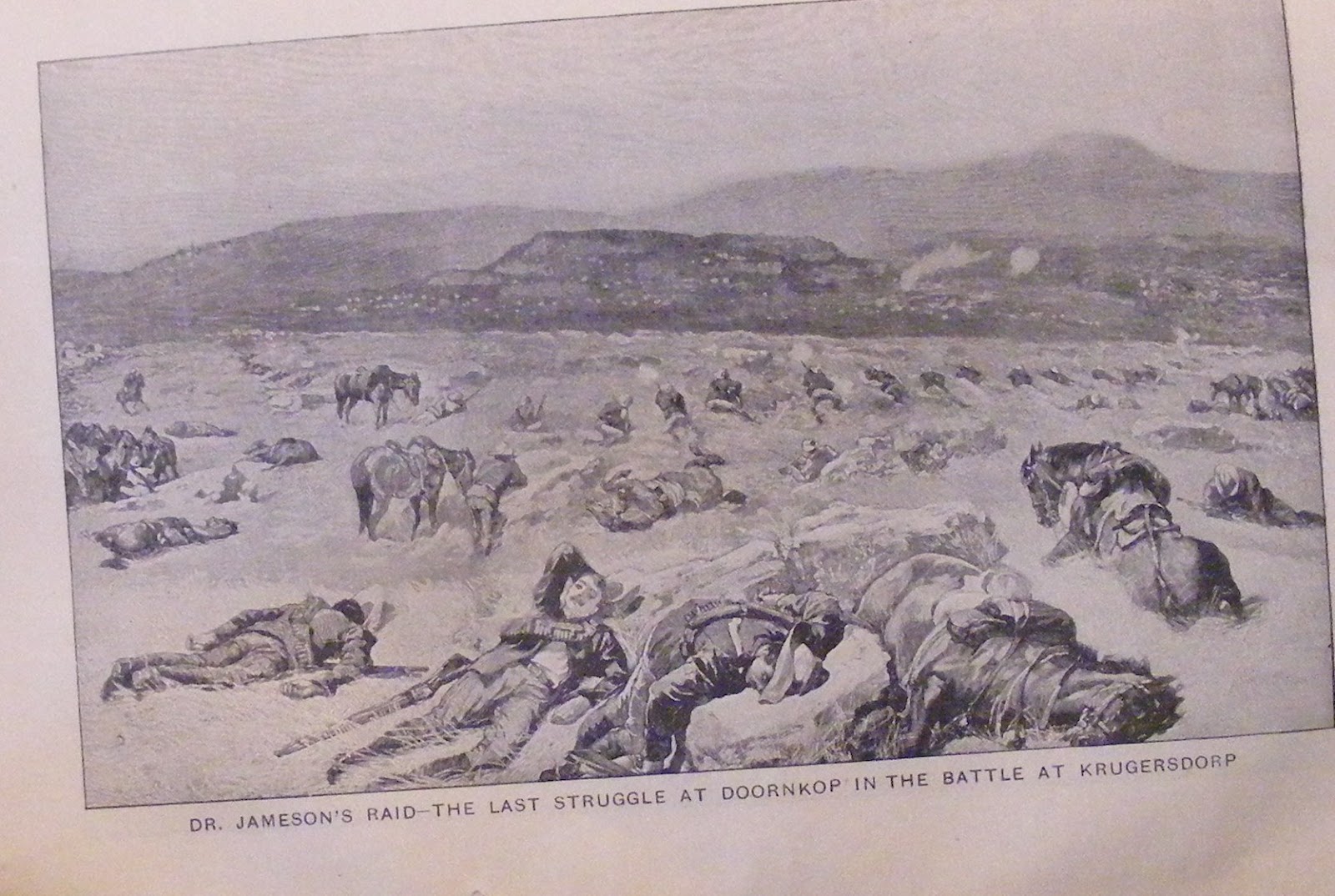
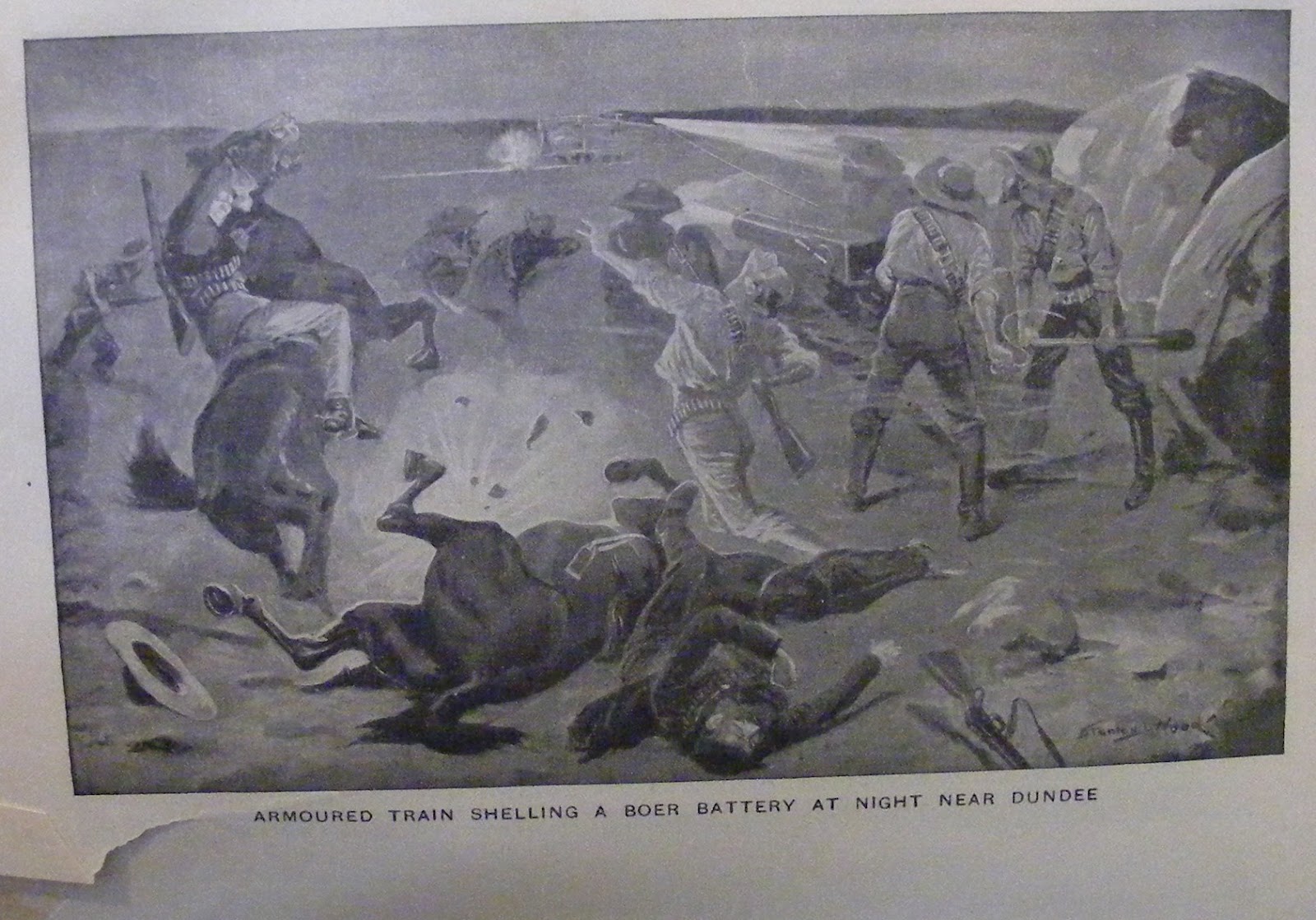
Hopefully this means no one will mind me including a couple of the lithographs from my copy, just to illustrate my point.. 


It is such  shame that my grandfather died when I was so young. If his health was better, I know the day would have come when we'd have played wargames with his collection of toy soldiers. (hmm its a little uncomfortable for me to contemplate that the Boer War was closer to me when I first read this book than the 2nd World War is now, almost as uncomfortable as watching the Caine Mutiny a few days ago and realizing the ships and navy in the movie were more like my brief navy days than today's)

Anyway, the wargames came regardless and it is not surprising that my thoughts turned to the Boer War. The problem was that the more I read, the deeper the gulf became between the war as presented in those late 19th/early 20thC books and newspapers with their dramatic lithographs of "gallant charges" and more modern works or even contemporary works by serving officers.
A few gallant wounded and dead, this wasn't represented as a picnic. 

To recreate the actual war in any real sense, I was going to need a large table, small figures and the games were going to be as far from those lithographs and stirring stories as they were from reality.(Check this Boer War wargaming site out)

Nor  was it all about gallant charges, there were pictures of British prisoners, pages of photos of Canadian war dead and so forth but even the desperate last stand of the questionable Jameson Raid has that gallant last stand aura. 

 If you've read  Duffers Drift (should be available on line if you Google it), I wanted war to be more like what the young lieutenant thought it was at the start,  even after dreaming the dreams! However, to game the illusion was going against what I thought and felt wargaming was all about then and was going to require more Chutzpah than I could muster to face down any detractors. So the Boer War still waits, but periodically I haul out that old book and I think about things.


I can still be fairly thin skinned on occasion but my foray into 54mm gaming at the end of the last century (ok and a few more decades of life outside of normal )  helped developed a lot more Chutzpah. So did the whole Old School thing.  (Charge! is still a wonder to me, so simple, so elegant, so wrong on the surface and yet still producing games that ring truer in their essentials than many games that I've seen that are more "correct" and thus should in theory produce more realistic games .)   I also have a much wider view of what and why wargames are. (Looking back, for a guy who prided himself on seeing the world in shades of grey, I used to hold some pretty strong prejudices). After struggling to free myself from the shackles of "ought", I think I'm almost ready to try to develop a game aimed at reproducing that other Boer War, the one of the lithographs, reporters and old soldiers sitting by the woodstove back home.  Almost.

Anyway, what brought all this on? There was an excellent discussion about some aspects of the theory and practice of developing wargames, dealing specifically with the Boer War but applicable in general,  on :Lard Island. If you have any interest in wargame design, go read it.


Wednesday, February 9, 2011

Too Big for Its Britches

I've started adding some illustrated examples to Hearts of Tin. Not being a graphics guru or computer whiz the results are neither professional nor handy to download. (Its up over a MB)

I have however added a pdf version with really reduced photo quality but much friendlier to download and they are clear enough to get the point across.

For the indefinite future, both formats are available, but yes this means that while I'm still  polishing, I'm starting to lock it the clunky bits and slowly getting ready to call the rules done. (I'm wondering if I would consider chisel and stone to be permanent, my experiences with rebasing would tend to indicate that nothing is really permanent.)