Showing posts with label Quebec 1759. Show all posts

Friday, October 17, 2025

The Same But Different

Growing up across the St. Lawrence from Montreal, and from the old fort on Ile Ste Helene where
re-enactors of Colonial French soldiers entertained visitors, I thought I knew what the Compagnies Franches looked like and how they fought.  They were trained as conventional line infantry, but those posted in more distant forts, adapted their dress and tactics to the woods and the winters, learning a lot from First Nations warriors.  

It was only recently that I learned that the Louisburg garrison companies, straight from France were only trained as line infantry, even when garrisoning some forts in Acadia. 


So for now, while the fight for Acadia is on, all of my tidy, close order units will represent Louisburg garrison units fighting in close order whether wearing their white coats or having left them in camp in 30C heat. The veteran detachments from New France, far from home, fighting alongside Acadians, Canadiens and First Nations, will be fielded as skirmishers, equivalent to Britain's rangers and dressed appropriately.

(A repeat of the colonial troops in the woods shot)

Now, time to get some troops on the table and roll some dice! Just need to come up with a scenario....hmm.... I think more coffee is required......,

Friday, May 23, 2025

Gorham's Rangers Take The Field

 This was a tricky lot, but they'll serve. 


Gorham's Rangers primarily served in what is now Nova Scotia from 1744 to 1759 (Some of them probably crossed what is now my yard!) and then joined Wolfe's expedition to Quebec,  Information on how they were dressed is scarce, and mostly speculative since no parts of their uniforms have survived, nor were there any contemporary drawings, just a very few vague descriptions in diaries etc.. Sooo, I decided to go with the most common descriptions, nearly contemporary drawings, and modern day reenactors who usually do a good job of digging into the history. I then crossed that with what I had to work with, decided to drop the sort of skirt or all round apron which wasn't always mentioned or sketched, especially in the early years.

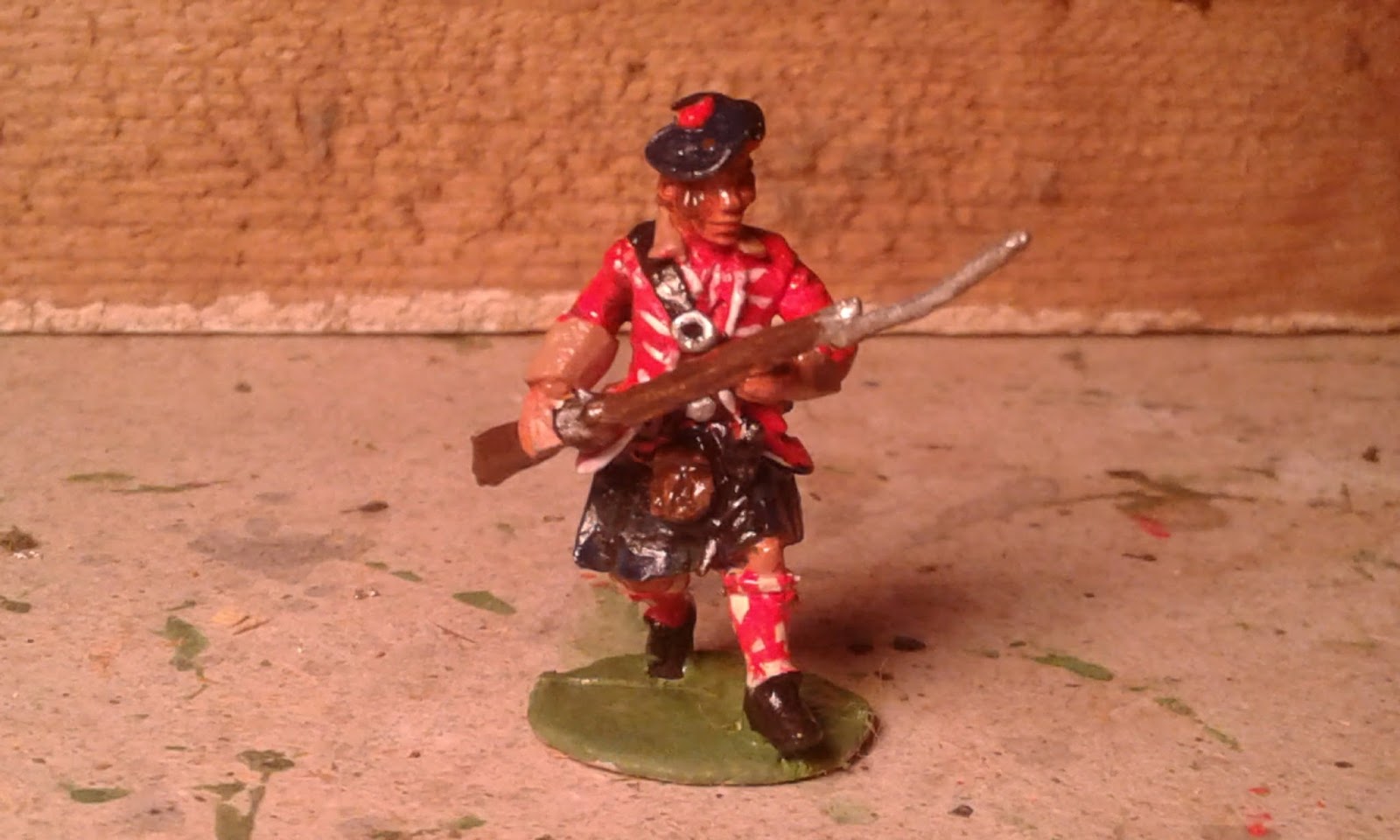
The Scots bonnets seem to be the best bet for headgear and recent(ish) study has decided that the same sort of bonnets were worn by Roger's Rangers despite the old NorthWest Passage movie. Luckily, I happen to have Prince August's SYW highlander mould which includes what we called a 'Balmoral' cap when I was in the Black Watch of Canada Cadet Corps in my teens. 

In the early days at least, many of the Rangers were recruited from First Nations in what is now New England, long time enemies of the Mk'maq and other tribes in what are now the Maritime Provinces, so, I included two of them by darkening their skin slightly. 

Leggings or gaiters to above the knee were common enough but the next bit was tricky. They seem to have worn short jackets and Prince August presented Russians in summer gear without their long coats, but I wanted more poses. I also happened to have the Austrian Grenz moulds. The coats were a bit long and had lace and swords but a bit of work with knife and file gave me a few rather rough conversions, including reducing swords to hunting knives. 

From there, I called heavily on the various interpretations and did my own to make it easy, after all, I want them to play wargames, not sit on display.

Thursday, June 29, 2023

A Project For This Fall and WInter

Having grown up an "Anglo" in Montreal, you'd think I'd have wargamed Wolfe's Quebec several times by now, but really, given the way it was presented in school, there was nothing to it. Wolfe had a brilliant plan, The British were gallant and the French all ran away. It was while I was studying at the Military College in St. Jean, that doubts started creeping in. 

I think the first crack came during  the American Bicentennial, as Cadet Curator of the Musee de Fort St. Jean, I and my 2ic Simon MacDowall, under the guidance of Dr Ruddy (as good a professor and friend as one could wish for), had the pleasure of coordinating a portion of the visit of the Brigade of the American Revolution to Quebec. Montgomery had besieged Fort St. Jean back in the day and the Brigade was following in their footsteps, putting on displays of drill and firing a few volleys etc.. I was invited to accompany Dr Ruddy for the finale on the Plains of Abraham, and that's where this becomes relevant to the matter in hand. 

OK, Hopefully the games will look better than this quick mockup.

While touristing around, I went to see the famous Wolfe's Cove/L'Anse au Foulon where the British soldiers scaled the cliffs, dragging cannon behind them to surprise Montcalm. Having wandered through the old Lower Town and followed the road up to the heights, I was confused. The map and some plaques indicated that I was there but it wasn't even a stiff walk up really. Eventually I shrugged my shoulders and decided that at some time in the past, someone must have blasted a road out of the cliff face. 

Then, a year or so ago, I bought a new book on the campaign: Northern Armageddon: The Battle of the Plains of Abraham and the Making of the American Revolution by D. Peter MacLeod. This Canadian historian has done some very thorough research, including digging through archives in France and Britain as well as Canada, and letters and diaries etc from various individuals including both armies, the Royal Navy, and les Canadiens and even a transcription of an account by one of the First Nations who was there. He also studied a lot of period maps. Turns out, the maps and French accounts all agree that there had long been a road running from the cove to the plain at the top, that's why the French used it for supplies and why the British were able to get the army up so quickly including artillery pieces. 

By studying current information etc in RN records and various diaries and reports, several things became clear. The French post was not at the top of the cliff, it was partway up the road. The advance party of Grenadiers and Highlanders was supposed to land at the cove but the current carried them past it. Not ones to quit, they landed and scaled the cliff to the top. By the time they got there, the main party was already making a frontal assault with little success, so the advanced party descended and attacked the French in the rear!

For the first time, it all made sense. I'd always wondered why the French had used a steep path up a cliffside to bring in supplies when they had plenty of more convenient landing spots with roads. There was another accepted story about the one volley thing which never quite rang true once I grew up, and it  was also debunked and explained but that's for later. The point is, its time I played out some sort of series of tabletop games based around the Quebec campaign 1759/60, and if I start planning and preparing this summer and fall, it'll provide a number of games this fall and winter.


Wednesday, January 23, 2019

Then They Were Twelve.

On the weekend, I took advantage of a storm day to cast up 5 more charging figures plus a drummer from the 'new' Prussian range to complete 'A' Company of the 28th Regiment.

The Yellow facings look more yellow in real life.

Of course no sooner had I based the first six when I spotted the bags of flexible metal bases I had bought several years so I could put my Prince August figures onto a slightly narrower frontage and use magnetized movement stands. So I had to pop the others off the old washers and remount them but there we are.

A prototype Grenadier painted up a couple of years ago, back when I hoped PA would do British figures for the 7YW within my lifetime.

Now to do grenadiers and another company of line plus a battalion command group. I quite like this charging figure but I had trouble getting both raised foot and bayonet to cast at the same time and the gate connects to their back at a spot where it is hard to get a hack saw at it and even harder to get a file in to smooth it.

So, the next unit will be using the newer Prussian moulds, not sure yet which heads I'll use. As a bonus that'll make it easy to keep the 2 line companies sorted.

Wednesday, January 16, 2019

The Glossy Shire Regiment

I stole enough time today to paint up some new Prince August castings from old moulds.

The Maritime Alliance training a new regiment or....
This is a mould I've had my eye on for 20 years but having discovered how diverse the Prince August Rosbach range is with regard to size and style, I have been reluctant to order  one until I at least saw some pictures. Its been in my shopping cart a dozen time but when the total was consulted, this was one of the moulds that kept being trimmed 'for now'. 
..perhaps the 28th charging at Quebec.
Well, at last I saw some pictures and here the lads are. As suspected, they are perfectly serviceable as late 1750's/early 1760's British infantry wearing their coats over the waist belt as seen in some prints. There is no cuff slash but the later style of small cuff with slash is easily painted on well enough for glossy toy soldier style.

Monday, January 14, 2019

Interlude

4 days without anything wargaming-ish to report on?
Can't last!

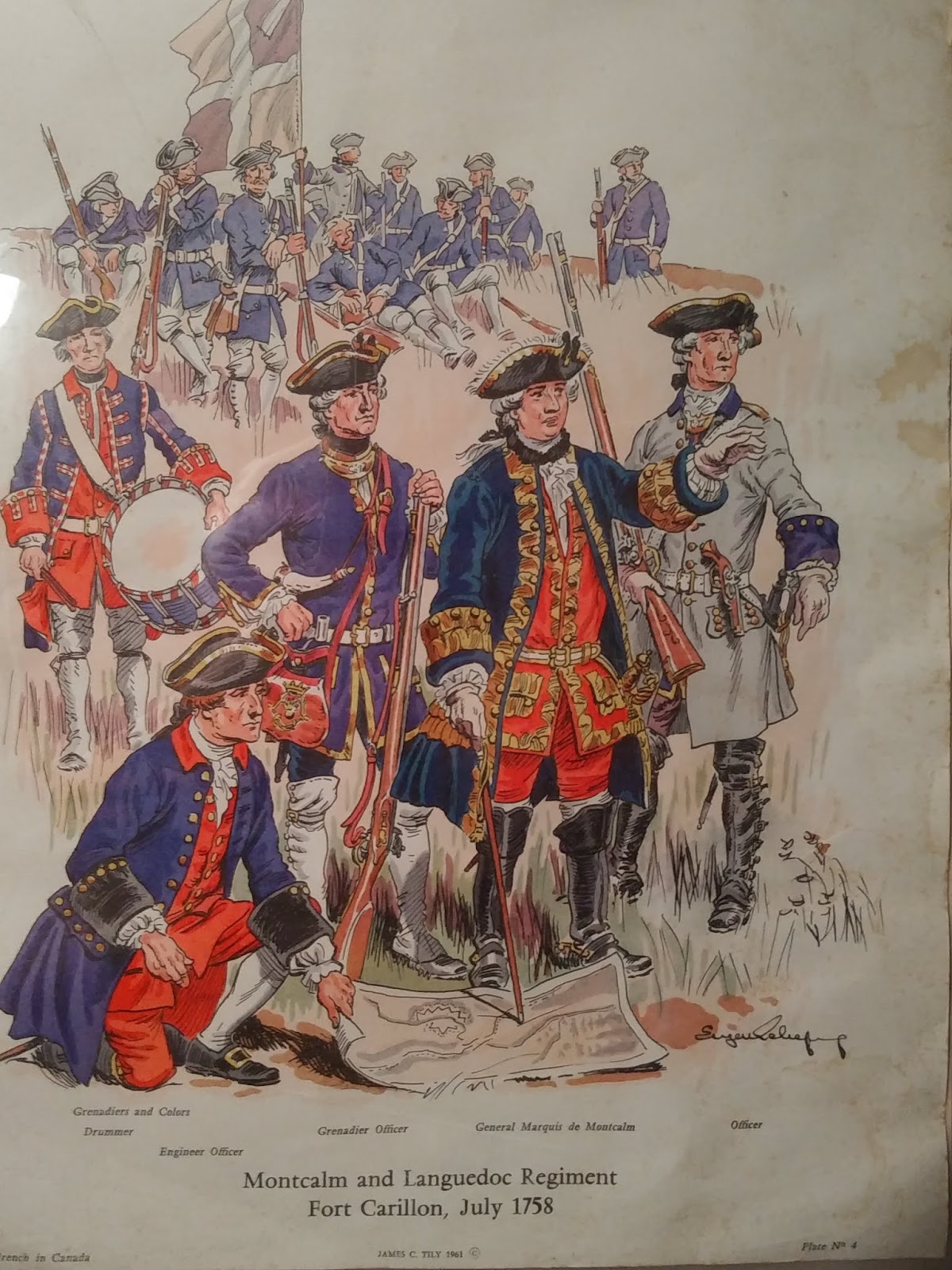
Meanwhile here's a print off my wall for your viewing pleasure.
Montcalm & Languedoc Regiment.
And a song to go with it.
(A favourite of my for over 1/2 a century)


Or two, this one is a relatively recent discovery.

Tuesday, January 9, 2018

Highlanders and History Books

One of the good things about turning my mind back to the Seven Years War in America is that its got me finally reading some of the histories that have been written this century. Its not that there is any challenge to the overall traditional story line, but there has been some correcting and explaining or expansion of detail and more inclusion of the Canadian rather than French point of view.

And here they are, my Willie Highlanders! I've seen better but I've painted worse! 
(I haven't decided on a basing finish for the collection yet so left these  plain green for now.) 
I used to wonder how the British so quickly dragged 6,000 men and 6 guns up such a steep wooded slope as described by Parkman and others and speculated how much easier it would have been if the road that now runs from the Anse au Foulon had been there. I also wondering why the defence was so inadeqaute and how a supposedly timid officer who had bungled the defence of a fort, could be exonerated and given such an important outpost, supposedly running away and being shot in the butt. Certainly Parkman does a pretty thorough character assassination of him but then one of his main criticisms of the French Aristocracy is that they liked brightly coloured clothes and were Roman Catholic.

Well, a slim history of Fort Beausejour I picked up in New Brunswick a few years ago presents a rather different picture of the Beausejour matter, which helps to explain why de Vergor, the decorated veteran who was twice wounded in defence of Louisburg in 1745, was  exonerated for surrendering an indefensible fort earlier rather than later. This year, Peter MacLeod's Northern Armegeddon helped clear up the Anse au Foulon matter.  It seems that the track followed by the main British army was actually a wagon road and apart from the camp at the top of the cliffs, there was an abatis and barricade across the road manned by an alert garrison with de Vergor at their head.  Too bad for him his authorities had ignored an engineer's suggestion that the entrenchments and abatis be extended in either direction to prevent outflanking because the advance party of light infantry and Highlanders drifted too far down river and instead of attacking up the road they had to pull themselves up the steep cliff, arriving behind the defenders while they were busy repelling a frontal assault. Rather than running off when awoken in his tent, De Vergor was at his post and again wounded twice and captured with half of his little garrison while the rest retreated and joined in the skirmishing that went on all day. 

Anyway, there are lots more such trivial bits including a fresh look at the details of the line infantry clash which lasted longer than the single volley of legend, the effect of the broken ground which the French regulars attacked through, more details and accounts of the fighting before and after the French assault and so on. The real meat of the book though is the inclusion of first hand accounts and more details about the summer and fall, the raids up and down the river including the scorched earth ones, the bombardment, the supply system, the naval issues and so on.

There are many excerpts from diaries from both sides, including Canadian civilians and a young First Nation's man, as well as British navy and army. These really seem to bring it all to life and make it easier to relate to, almost familiar in some ways. 


DOUGLAS & MCINTYRE BOOKS 2008
(Kindle version available)


His second book, Backs to the Wall, looks at the winter for both sides and the French counter attack. It is, if anything, even more interesting. Certainly some of the first hand British  accounts of the fighting during the St. Foye battle give a rather different picture of what it was like to fight in an 18thC linear warfare battle than your average wargame summary.

DOUGLAS & MCINTYRE BOOKS 2016
(Kindle version available)


Both books recommended by me.

Saturday, January 6, 2018

Middle Age and Guile

There is no doubt that my eyes are not as sharp nor my hand as steady as  they were when I was a young and enthusiastic 18. 

About 1/2 way through trying to paint a simplified version of diced hose as a break from painting tartan, I started to crack. Painting Old Toy Soldier Style on old 54mm toy soldiers, in batches of 4, is soooooo much easier and more enjoyable than even simplified detail on a batch of 12 30mm Willies!   

Still, can't quit now so I fell back on 2 old tricks: I broke the unit into two smaller batches and then painted one figure all the way through as an example and encouragement. 

Not done yet!
When I started to get interested in old toy soldiers, I was pretty horrified at Britain's habit of representing Black Watch kilts as dark green with a single black over stripe but to be honest the effect is actually pretty realistic, more realistic than any painting style that allows you to see the sett from across the table. However I wanted to match the way my first 30mm figures were painted over 40 years ago.  

Back then, armed with years of wearing one to Black Watch cadets and with a copy of Blum's Model Soldiers to hand. I did a DARK blue base with a wide over stripe grid of dark blue-green with brighter green squares where the green lines cross then added thin black stripes down the centre and edges of the green stripes and again through the centre of the blue squares formed by the green lines. 

That is not only a simplification of the actual sett (pattern), it is also waaay too complicated for a wargame model.
Not Master-Class painting but just fine for my table.(Oh my, those hose are cringe worthy at any distance!)
 This time I omitted the medium green squares and reduced the number of black stripes. At arms length I struggle to see the difference between the old and new figures but they give a good impression of my old kilt. 


Me in 1972! The old photo was faded a bit even before I scanned it a few years back and lost most of the rest of the colour! That's a dark green dress coatee for reference.

My kilt was a generous gift by the Black Watch Cadet Corps after my last parade as Corps Sergeant Major.  I still wear it on occasion. (It used to be a bit big for me....).

Friday, January 5, 2018

First Onto the Painting Table for 2018

Cha togar m' fhearg gun dìoladh!

(That's "Nemo me impune lacesset" for those who don't read the gaelic.)


The wounded veteran on the right has donated his arms and been pensioned.
(Yes, arms as in musket and arm, brave laddie

Yes, this should be Fraser's 78th for Quebec but the existing company was painted as the Black Watch at Ticonderoga over 40 years ago so the 2nd company follows suit. Anyway, recent evidence suggests the 78th wore government tartan not the modern clan Fraser tartan so with their buff facings they would look much the same as the Black Watch did before they went Royal.

I ordered these Willies about 10 years ago in hopes of taking them to a 1:10 Ticonderoga game in the US but it didn't happen. (I don't remember now if I didn't go because the game was moved or cancelled or if it went ahead and I couldn't go for some reason.) Since I have resurrected the 30mm 1759 collection and these are about the only full game-unit's worth  of ready-to-go castings on hand for any of my collections at the moment, I thought I might as well start with them.

There was a bit of flash and supporting sprue on the castings and they needed some serious twisting and animating to get them to hold their muskets  but they are very flexible and lively. I had of course opened a few of the packets ten years ago and despite my best efforts, a sword was missing  and possibly two muskets although I think that its actually that the 2 chaps with broadsword in hand had cast down their muskets before charging into the little plastic bag like their ancestors did before charging at Quebec. (Which is why Fraser's suffered the heaviest loss - men with broadswords in the open being at a distinct disadvantage when attacking sharpshooters in the woods). At any rate, I replaced a spontoon-less sauntering officer with a leftover original standard bearer and was able to umm "borrow" a musket from a wounded veteran who lost a leg in battle many years ago.


These figures would respond well to detailed painting with slightly exaggerated highlights and shading or to shading by ink washes or similar, BUT I like the simple, fairly clean, glossy toy soldier look that I used on the British Grenadiers and line infantry when I finally painted them a couple of years ago. Oh heck, why overplan? I'll trust to my guiding spirit when I sit down for another painting session!

Now, do I hold off on a game until these are finished, or do I give my eyes and back and hands a break from painting and just grab some figures off the shelf for a quick game while waiting for winter to stop alternating between arctic freezing and cold rain?   

Saturday, December 30, 2017

1759, A Minor Affair

This incident is not recorded in any history book.
This is the only period for which I have  an appropriate card deck.
(Note: the troops in the foreground are my own originals)

It was late summer in 1759 and Brigadier Murray had landed with a party of troops on the North Shore of the St. Lawrence, up river of Quebec. He learned  that French troops were approaching from the south and decided to await them at Petite Ile. His force consisted of detachments from the 27th and 58th Foot, Louisburg Grenadiers and Fraser's Highlanders along with two companies of Rangers and a field piece.

 The game began with artillery and skirmisher fire against the British positions, answered by the British gun but soon the French infantry began their advance. In the far distance Indian scouts can be seen hunting for a ford.
The French force, commanded by de Bougainville, had orders to  protect the inhabitants but above all, to protect the string of supply depots. Knowing that there was a major cache just downriver, he decided to force his way past the British.

None of the troops with him were local but he knew that many of the tributaries were fordable in places so he sent some of his Algonquin and Huron allies  to scout for crossing points. To keep the enemy occupied, he decided to deploy and attack the bridges on the main road. His force was comprised of 5 detachments of infantry, mostly Troupes de la Marine, 2 parties of skirmishers, 2 bands of Indians and 2 guns.

The French pinning attack on the Western bridge closes up and a long distance fire fight ensues.
The scenario was again an adaptation of "Holding Action (2)" from CS Grant's Scenarios for Wargames.

The British hold the Western bridge, repulsing 2 charges and winning the firefight.

Those who have been paying too much attention may have noted that the preview showed 30mm European armies on the full 4'x6' table but that here we have a 30mm French & Indian War game on a 4'x4' board. All will be revealed next year.

General Murray, alerted to the Indians fording the river and dispersing a company of Rangers, and noting the French movement to their right, begins to shift half of his infantry to block the ford.


The game was played using our Seven Year's War Portable Wargame based on the Ancient version. Line infantry count as "Heavy Infantry" in melee and have a range of 2. Light infantry have a range of 3 and do not suffer the -1 for fighting in woods.

The Highlanders  hold the Compagnies Franches after a protracted fight. 

The game lasted 9 out of a possible 15 turns and ended when the British became exhausted after heavy casualties. They were not in a position to block the ford and were no longer allowed to attack. There was really nothing they could do to prevent the French marching off.  It was one of those games where the British units decided that they would rather die than retreat while the French were very sensible and fell back quite often. This was of course, part of Bouganville's cunning plan, to wear the British down so they couldn't counter attack any troops slipping across the ford. 

The British are still holding but casualties have been heavy and Murray is forced to drop his planned counter attack on the ford. Instead, he will have to let the French pass and reembark when the fleet returns.

So that is it for 2017!

Thank you to all who have stopped by over the year and an extra thank you for those who took the time to leave a comment. Not only do comments help reassure me that someone besides bots are looking in but I confess that the comments even more than the viewing stats sometimes influence which games and periods get played or painted when I'm undecided.

Last, but not least, an even bigger THANK YOU to those whose comments occasionally contain suggestions, observations, opinions, questions etc. Not only are they often valuable in their own right but the two sided conversation aspect helps me feel connected from my old farmhouse on the far fringe of wargaming civilization.

May you all be blessed and enjoy life in 2018.

Friday, December 29, 2017

Setting the Last Game of 2017

Its time to think about my last game of the year. This is a new ritual since 2009 when I did my last Game of the Week on Dec 30th. (See Playing through Scenarios for All Ages). In some years there was a Gathering of Hosts last game of the year in other years it was a Battle Game of the Month last game and some years I seem to have squeezed in one of each! I seem to have gotten particularly wild and crazy as I "mature". Well, crazy maybe.

Anyway, since the table wasn't fully cleared after the last game, I decided to replay it in a different period and scale. Then I tried to figure out what my "least played with recently" collection was. I came up with just one "didn't get out this year" candidate! My old 30mm SYW troops!

30mm figures. I purchased these figures from Figurines Historique in 1973 after I got my copy of Charge!. They were leftovers from a bespoke range which were designed for a diorama of the Battle of the Plains of Abraham which used to be on display in a museum in Quebec back in the 70's. They were my first metal wargaming figures.


I had based these armies in 2013 for a  go at the Portable Wargame with Ron. Since they were least used and Bob had published the rules this year, it just seemed an ideal combination for my last game of the year.


Wednesday, November 9, 2016

Falllllll OUT!

Its a pity that the title "There and Back Again" has already been taken but yes I am once again "Home from the War(games)".

I'll skip over the travelogue except to say that it was a lonnnng drive with enjoyable stopovers with friends and an even longer drive home without the visiting. The convention itself was excellent, most enjoyable and almost worth the travel.  For those who are hoping for detailed accounts of games seen or played and awesome pictures, SORRY. Just more poorly lit cell phone snaps and few brief accounts low on details plus a few very brief observations filtered through the various games and long hours of driving. (For the curious, about 24 hours road time each way spread over 3 uneven days and that feels about like what it sounds like if you are also a person who is not fond of driving and Hates the periods of heavy traffic ).  OK lets skip to Day 1.

Fall In 2016 Day 1.

My Highlanders land on the north shore south of Quebec. These figures are my conversions of various Meisterzinn castings which were moulded and cast for us by John McEwan of Reviresco, somewhere around 2000.

Friday started with a walk about and visit to the dealer hall where I snagged a clearance sale on about a dozen 40mm 17thC Drabant Russian and Polish infantry. No, I won't be building an army around them, just adding them in as more Hungarian or other European levies in my 16thC Ottoman army-to-be which uses a Morschauser inspired unit organization of 4 infantry or 2 cavalry to a base. Imagination coupled with wilful ignorance allows such travesties and they are such beautiful castings, too beautiful to be passed up.  Later at the flea market an attempt to buy a used Osprey on Pavia from a friend turned into a gifting of said book which is pretty darned good no matter how you look at it.

There was, as usual, a vast assortment of games in various styles, periods and scales, bother historical and fantasy/scifi. Some showed daunting levels of talent and dedication with regards to figures and terrain, some were pleasingly basic of the "you too can easily do this and have fun.." type but most were  somewhere in between. Rules ranged from common published ones through new or old but uncommon ones through the gamut to homegrown rules while the games varied from well thought out scenarios tbrough semi role playing or straight forward punch ups to organized competitions and anything else. I always find the variety refreshing and well, reassuring,

By 2pm it was time for my first game as player.
Lil Britain's and Irregular 40mm Toy Soldiers . A gallant charge on my battery was narrowly repulsed by my RHA gunners who bravely stood to their guns and refused to take shelter with the infantry. (OK There was a 5/6 chance they were going to be over run but I mean very fashionable busbies and lace vs old fashioned metal helmets,  was there any doubt?)
 This was my preregistered game, a 40mm Toy Soldier game run by Howard Whitehouse using a simple but effective, fun set of rules which he is developing. I was one of three British players in a fairly straight forward encounter with our aim being to prevent the foreigners from being able to march farther up the road. Since neither of my teammates wanted to take the prime command I took it and we agreed to a general plan and fairly equitable distribution of force. I figured the centre was no place for cavalry in the 1880's so placed 2 light regiments on the left hoping they could exploit an open area while detailing some heavies to the right. The guns, infantry and guns were spread across the front.

Rather than having fixed turns the game runs in a continuous loop with actions triggered by the turn of a card with Jokers triggering chance effects and end of turn things including shuffling. To keep the game going each pair of players had a deck with the occasional cross-deck interactions being handled as they came up. This kept the game running smoothly and the players constantly acting with little or no respite for players to take a breather and look around so I had but vague impressions of what was happening on either flank except when the boundaries between sectors wavered. I did notice the gallant but futile charge of our light cavalry very few of whom ran away and eventually noticed that near the end of the game, the British troops on my left had been replaced by French ones. Luckily by then I had pretty much cleared my front and was able to shift forces. I also noticed when there were no enemy between my riflemen and the gun shelling our right wing and took that one out before taking out the gun shelling me.   Still, all in all, I was relieved when the rest of the French army decided to retire against the General's wishes.

Wonderful toy soldiers, great game master and fellow players, fun game, everything a convention game should be.
The end.  In my imagination a few stragglers from the Fusiliers are still guarding the flank of my gun until the Highlanders and some Engineers arrive.
Once Howard's game was done I had to hotfoot back to the HAWK's room to help Rob set up our game. This was based loosely on an historical event during the siege of Quebec in 1759. In an effort to draw Montcalm out Wolfe sent raiding parties up and down the river, burning farms and destroying or disrupting the flow of supplies bound for Quebec. In this particular case they had information about a warehouse and one raid had already been repulsed. The French began with a handful of militia on hand with reinforcements of picked units, Indians and regulars arriving on table.

We ran the game previously in 2005 but that seemed like a long time ago now and my partial tests had taken place as solo games on a table less than 1/2 the size of this one. It had also been 2 1/2 years since the last time I had GM'd this sort of multi-player game so I was feeling just a little bit rusty and apprehensive as the start time approached.   Its always a bit tense waiting to see if you have a quorum but between preregisters and walk ups we filled all eight spots.

Pregame. Picked units of militia and a company of Colony Troops arrive. Three units of Rob's Irregular Miniatures.

This may sound odd but I was so busy with managing the flow and resolving rules questions that I have only a vague idea of how the game went other than that, as usual, the advantage seemed to ebb and flow from side to side. When we finally ran out of time the British were occupying the target but were too hard pressed by the defenders to have managed to identify and destroy the stores cache. Losses were heavy on both sides but I called it a winning draw for the British since they held the objective and were not so hard pressed that they couldn't have fired the building before withdrawing. It was certainly a relief that the players seem to have enjoyed the game on the whole.
The bulk of the troops were conversions of homecast Prince August or Meisterzinn figures. About 1/3rd were done by Chris Palmer with the rest being Rob's. Only the Highlanders and boat's crew were mine.  Here Gage's Light Infantry are Rob's work while the Royal Americans were done by Chris.

The next game came Saturday morning. This was based on the Battle of Bloody Creek during Pontiac's Rebellion. The previous day's toy soldier game had gotten me thinking about play sequencing and while I didn't want to go that far I decided to unilaterally change the sequence slightly between games.

In Friday's games each player on a side activated one unit each time a card was drawn. That was actually a new idea I hadn't tried before the game. I had also introduced a new "final fire phase" which allowed units that had held fire to fire at the end of the turn if their fire had not been triggered by enemy actions. That was contrary to the original rule and muddled the play sequence a little. In addition, the original rally when activated rule which allowed player's to slowly accumulate hits before rallying had been replaced  by a rule requiring rallying at the end of every turn to avoid having to drag 'hits' around from turn to turn. Melee's had always been fought at the end of turn which was contrary to every other combat.

What I decided was to activate 1 player or "command" per card and have those active units conclude their action, any enemy reaction, melee and rallying right away. To my mind this not only fit my idea of how the game was meant to work but was smoother and felt more natural as the game played out so this will be the new standard.

Roger's Rangers and a company of Grenadiers form the advance guard. Rangers by Chris, Grenadiers by Rob.
The British mission was to make a night march across the board to Pontiac's camp and attack it. The historical action developed around two key things: the Indians got word of the attack and the camp had actually been abandoned months ago. The game began with reduced visibility which increased as the day went on. possibly more quickly than it should. Once the British Advance Guard had fought their way through to the clearing they were informed that there was no camp and that their new mission was to get as many men as possible back to the fort.

The Indians had been told that their sole mission was to kill as many British as possible, that they would receive reinforcements through out the game and that their own "casualties" did not matter (most casualties being assumed to be warriors who had slipped away rather than actual dead or seriously wounded).  What I didn't explain, on purpose, was that their losses were the main source of reinforcements, I wanted to encourage bold attacks but not not suicidal ones. Despite repeating the victory conditions several times, I don't think I ever made it clear enough to the players as most of them were quite cautious through out the game in typical Indian fashion, unlike Pontiac's men on the day who seemed to have displayed unusually aggressive and persistent tactics on the day. This wasn't a problem when we first brought the scenario out about a decade ago but if we ever bring it out for a third time, I will have to prepare a better briefing.


The set up prior to the hidden Indian units being placed.

As it was, the British were still hard pressed but not as hard pressed as on the day. The players handled the mid game change of orders well with only minimal delay for it to sink in and have them react effectively. One of my favourite moments came here as the remnants of the Advance Guard came stampeding back past the main column with a brief order from the senior commander to "cover me". Almost instantly a chance card was pulled resulting in a bayonet charge by said new rearguard. Perfect, though random, timing.    

We didn't quite play to the end of the gaming session as it seemed pretty clear that the British were going to be able to escape with the bulk of their units intact. If I'm not mistaken, the rangers of the advance guard were the only unit routed. All in all, despite some occasionally heavy casualties, the British did much better than they did on the day. To my mind this was largely due to not having been pressed closely and kept under close range fire as they were in the actual engagement however, it may also be because the British were too crowded without enough gaps for the Indians to infiltrate through. Using eight figure units instead of 12 for the British line units might have been a better idea. This would have made each unit more vulnerable to losses as well as making it easier for the Indians to find gaps. Extending the hours of darkness would also have helped encourage close in fighting. Something to keep in mind should we ever run the scenario again.

The end of the game.  Rogers himself and his oft rallied Rangers were still holding the road open as they did on the day. (These are Rob's rangers and this unit are Irregulars).  The gunboat has arrived to provide cover fire.
I was hoping to get away mid morning on Sunday after a round of goodbyes and a last sweep of the dealer hall and flea market so all that remained of Fall In for me  was to find a game to play Saturday night. There were some interesting ones to consider but in several cases beautiful looking games in periods of interest used rules I knew I didn't like. Luckily there was a spot open in Roy Jones' Sword & The Flame game set in German South East Africa. Tick! Tick!  It turned out to be a good choice and a very enjoyable game despite our utter failure to secure victory over the Herero freedom fighters.

25mm The Sword and The Flame German South West Africa game. A good relaxing way to end a convention.

So now its back to "what next?"  In the near future there are some Mounties and friends waiting as well as the re-awakened desire to add a 12 -16 figure battalion, late 19th Century, Toy Soldier game (thank you Howard). Mostly though I want to do more with my enlarged collection of Elastolin figures.

Huzzah in May is fast approaching and while it is likely to be 5 or more years before I make the long haul again, Huzzah is an easy drive and gives me everything I need in a con, esp if my partner in crime can make it. The traffic on Sunday was too heavy, hour after wearing hour, for me to think about future games but on Monday I was cruising north on easy roads and ideas, obstacles, memories and inspirations kept surfacing of their own free will  until a thought (no doubt fed by having flipped through the Pavia book and talked about the 2005 Haddington game) popped into my head: "Prince Valiant and the Relief of Haddington 2 - with magic and maybe some monsters."  In other words a reworking of our successful 2005 historical game in a different setting using my Elastolin collection. Needs a bit of work but that might just be where I'm headed.

Monday, November 25, 2013

Flight from the Ford

Along the banks of the St. Lawrence during the summer of 1759 there were numerous clashes between detachments of Wolfe's army and parties of Indians and Canadiens occasionally supported by French regulars. (See http://www.militaryheritage.com/quebec1.htm for some brief eye witness accounts of a couple of such actions. ) My 30mm armies were originally begun with larger battles, such as the Plains of Abraham, in mind but since the armies are incomplete and since I now have a few rangers and Indians, I decided to try a small game to amuse myself and to test the latest ideas for the Square Brigadier including a return to a slightly improved Orders Dice rule and some small changes to the combat rules. This was a smaller game than the rules were intended for but provided two exciting little games of just under an hour each.

The scenario was inspired by vague (not to say completely unreliable) memories of Brigadier Townsend's Memoirs which I read a few decades ago. The table is set up with a small river running across the table towards its eventual plunge, somewhere around the couch, 30 feet down to the St Lawrence. There is a narrow ford in the open, near the table edge, which is guarded by a small redoubt and farther upstream, inside the forest, the river is fordable along its remaining length.

I deployed a unit of Indians in the woods, a unit of Canadian light infantry in the redoubt, and another at the other ford. Two units of French infantry could arrive at the corner to the left once the British have arrived. The British units had to enter, in column, through the corner square to the right, one unit of rangers, one of Grenadiers, one of Highlanders and two of line infantry.  The British mission was to size a ford, including a safe path to it. The French  mission was to stop the British from getting control of a crossing.

Ross's Rangers and the Highlanders  head for the woods while the Grenadiers, 58th and 28th head for the ford where La Sarre has just arrived.

The first game was a little disturbed by rejection and replacement of some of the new combat ideas but even more so by some dreadful die rolling by the English and Scots troops. 

General Murray, in command of the British began to push for the main ford while sending the Rangers and Highlanders to clear the woods. The rangers proved incapable of pushing back the Indians  until the Grenadiers were dispatched to  support them and even then the Indians managed to pull back. As French reinforcements rushed up, General Murray decided to storm the main ford with his 2 battalions of regulars while the Highlanders attacked through  the woods and over the stream without waiting for the Grenadiers to regroup.  
The result of the attack on the ford. 

The assault by the Highlanders was a complete failure which left them falling back to rally while at the ford Murray was wounded, the 28th routed and the 58th badly shot up while La Reine (having wandered North from Ticonderoga to Quebec, doubtless in pursuit of the Black Watch) continued to calmly man the redoubt. 

Things looked bleak but once Murray had recovered a bit and the Highlanders had rallied and reorganized, he ordered the Grenadiers and Highlanders to storm the crossing again, this time in support of each other. The new assault went better for the British and La Sarre was looking shaky enough that Bougainville was forced to gallop across to steady them. The Grenadiers pressed forward scattering one bunch of Canadians but before they could flank  La Sarre they were attacked from the rear by those pugnacious Indians. Eventually the Grenadiers saw off the Indians then crossed the ford just as the Highlanders were again repulsed. 

A desperate battle followed with the grenadiers caught between La Sarre and a second unit of Canadians but just when things looked most desperate, Bougainville was hit by a musket ball and LaSarre collapsed and fled the field. The remaining French and Canadian troops followed. With his own army all but shattered, Murray had no choice but to abandon the hard won ford and fallback on the camp at Montmorency. 
The climax of the first fight approaches.

A few days later, with his troops refreshed and trained in the revised rules, Murray returned to the ford. This time the French regulars were tardy and Murray threw the Grenadiers at the redoubt, supported by the Highlanders. Once again the Canadians proved stauncher than expected (not to mention luckier) and once again the Grenadiers showed their preference for rolling 1's and 2's.

The odds were too great however and the Canadians broke just as the regulars arrived. As reinforcements came up on both sides, the Rangers faced off against twice their numbers of Canadians and Indians and were outmatched, falling back towards the 28th foot which was forced to turn and face the woods to protect the lines of communication back to camp rather than supporting the main assault.
The French counter attack laps the English column.

At this point, it became evident that the regulars on both sides were equally capable of lousy rolling. In a spiraling race to the bottom, with both commanders wounded, the French eventually ended up on bottom and were broken, leaving the ford in English hands. Shortly thereafter a message arrived calling the troops back to camp. Wolfe had decided on an amphibious assault on the mudflats at the foot of the Montmorency Falls.

So, two short but hotly contested games with a touch and go overtime ending. The  Quebec campaign is going to go back in the box for a while until more new recruits are added, but it will return. My 18th Birthday present is finally bearing fruit! 

Over the last 3 years I have experimented with various approaches to my gridded games but after reviewing not only the approaches but my thoughts on the good and bad aspects of each after test games and contemplating what makes one solo game more engaging for me than another, then re-testing those assumptions recently, the rough notes are now being slowly shaped into a complete set of rules again, or rather 3 closely related sets sharing a common approach. But that is a subject for a future post.


Saturday, November 23, 2013

Meanwhile back in the forest

30mm Scruby Native American Warriors. 

The first Boer War game is a ways off yet so I decided to tackle the handful of 30's from the Historifig parcel before they got shelved and forgotten. I'm not used to do this kind of backwoods figure in a glossy finish and it was hard to refrain from trying to weather and stain leather and cloth but I managed to contain myself and the resulting figures are pleasingly toy-like and ready to roll (dice).  


30mm generic Rangers, 3 Scruby's + 1 of my Plains of Abraham museum figures. The red toories are suspect but I couldn't bring myself to file them off or leave them blue.

I messed up and ordered 6 Indians instead of the required 8 but I can live with an empty spot on each of two bases until my next order. If all goes well these figures will see action on Sunday before going into winter quarters. In the meantime, the next batch of Boers is already primed.

Sunday, March 17, 2013

Reconstruction or destruction?

My old grenadiers, shiny and red at last!


I've finally finished refitting my old 30mm British grenadiers. At last they are sporting red coats and "real" grenadier caps and I have to say that they look better as glossy toy soldiers than they ever did as military miniatures. That's the last battalion of the old guys. There are 4 left overs that I could convert to a company of light infantry if I wanted to do the work of cutting down the coats and caps but I'll leave them for now, I've been eyeing a selection Willie and Scruby SYW & AR rangers, light infantry and Indians. In the meantime, I'm over due to get back to work on Fort MacDuff for Huzzah!

Its a good thing that I'm getting farther and farther into Toy Soldier mode. Trying to turn this old Barzso 54mm Davy Crocket fort into a usable prop for a 40mm 1812 game is even more trouble than I expected which is rare. In many ways it would of course have been easier to start from scratch but I am determined to make some use of it even if it is glue resistant.

I did have a reasonably easy conversion laid out until I realized just how much real estate the finished thing would occupy. OK for the main event but this is a game about Indians in the woods more so than the fort so I need to keep the foot print as small as practical. Forts are one thing that really test the imagination of 40mm gamers. Many of these frontier forts were tiny, given the ground scale I need to employ, the square bastion is not an reasonable size for a fort like Stevenson all by itself. but looks nothing like a stockade. I don't have the dimensions for Fort Meigs but it was unusually large, something like 9 acres and on the plans is long and narrow not square. A few calculations show that something like 6" x 15" or perhaps 8" x 12" would be not unreasonable for a foot print. That would have to include several blockhouses and batteries as well as log curtain walls, quarters and a ditch. OK for use with 10mm figures but its not going to work for 40's. Doing Marx Fort Apache style blockhouses that perch on a corner of the stockade was a tempting thought but at the end of the day it looks like I'll have to make do with one  vertical log blockhouse/bastion.


Remnants of the  Barzso wilderness refuge, practical meets proportion.


The bastion itself is a problem. The standard sort of square, roofed, horizontal log cabin construction blockhouse was used by both sides but the British  usually put them inside the walls while the Americans used them for corner bastions and gatehouses. The British used open palisaded corner bastions which is basically what the Barzso fort had although the angles are wrong. I looked at building a proper blockhouse and may do so yet but since the darned thing should only about 1"  square from a  ground scale angle while being big enough to fold a 40mm gun and crew plus infantry,  its going to take some compromises which I haven't worked out yet.  The roof also tend to make it awkward to handle the toy soldier garrison. At least my unlikely compromise is a formidable fortification holding 2 guns and a dozen toy soldiers with all around defence should the perimeter of the fort be breached..

Then there is the ditch. This seems to have been major obstacle in several cases, deep and fraised or combined with an abatis. The abatis might work but the combination of ditch and toy soldier stockade just looks wrong and would just distort the ground scale even more.  I think I won't waste any more time on ditch ideas, it can be assumed and built into any assault rules.

So there we are, I'm only using barely 1/2 of the original fort though I've destroyed it thoroughly in the process of experimenting. The result should be small enough to not dominate the table and give the impression of a stockade while holding 6 x 8 man companies of 40mm troops. Hope for their sake that it doesn't rain, there doesn't appear to be room for tents let alone barracks!

Thursday, March 7, 2013

We now return you to Raid on Pointe Aux Trembles

Having disposed of domestic duties, I turned back to the important stuff. Refighting the 1759 Quebec campaign was not really on my radar at the start of this year but somehow after refurbishing 2 English regiments it suddenly seemed only fair to let the armies fight. After all, they've been waiting 40 years for a chance to go at each other.  Somehow three line units against nine line and 4 light didn't seem like much of a line up and those 2 stand units weren't going to fit well on my gridded board anyway and I wanted to try it out again now that I have added a frame to take a bit of the warp out. I idly dropped one stand on the grid figuring it would look lonely but it actually looked ok as a unit. I must have been hanging around Bob Cordery and his Portable Wargame too long!

The British advance on the French supply depot as French reinforcements arrive.

Somehow six stands of 30mm troops don't really look like an army to me but then there were only a few army level engagements during the campaign so I'm quite happy seeing them as a detachment of a few companies engaged in the frequent clashes as the British raided up and down the St. Lawrence. I was going to just trot out a  Grant Teaser but instead did a trimmed down version of a scenario inspired by one of the raids on Pointe Aux Trembles. Rob Dean and I did a larger version of this as a 40mm  MacDuff game at Cold Wars 8 or so years ago and it went well. I was lacking troops and terrain but stuck with the basic concept that the British have to advance from the river, capture and destroy the French supply depot and then make it home.     The French start with a few militia and Colonial troops on table and roll for reinforcements. In this case 1 for regulars, 1 or 2 for more militia. I also rolled to see if any of the Canadian troops were in ambush positions as the British passed woods for the first time. The rules used were Square Brigadier.

 
The battle heats up as more French Regulars arrive.

With no enemy visible, the British lined up and advanced on the depot. As they neared it Canadian militia skirmishers popped up and began a deadly fusillade.  (over the course of the game they nearly monopolized the 6's) To balance the 6's rolled by the militia when firing, the French also rolled lots of 1's, for reinforcements of course. The British had their share of 1's though, mostly on Order rolls but then it was Brigadier Murray's 1st action as well as his 1st command.

The Highlanders charge and after a tough fight, break La Sarre while the 15th Foot drive back and then rout some militia..

I was a little uncertain on troop classifications and began by counting all the British as Elite, the French as Regular and the skirmishers as Irregular saving the Militia classification for close order ones. Upon reflection though I had no justification for that as the French regulars were not yet diluted with militia in the ranks and it left no room for combined grenadier units on either side. The skirmishers also proved nasty as they could almost always avoid shooting casualties by giving ground. Without artillery or rifles, the line infantry was reduced to huddling under their fire trying to rally or else being drawn forward in piecemeal attacks which pretty much sums up their situation on the day. So part way through the day I downgraded the British to regular and the skirmishers to militia but made the Highlanders shock troops with a charge bonus.  

A victim of their own success, the Highlanders follow up but fail to carry the house and the Brigadier is wounded. The remnant of the force pulls back and rallies but eventually breaks under heavy and accurate skirmisher fire and runs for the boats.

Six stands against four, growing to ten is about the minimum size for a game but it gave me an hour of enjoyable distraction and was just the sort of thing I had in mind for my card table games. (btw as a bonus, the frame lifts the board just enough to put the figures out of Iggy mouth reach even when standing on their hind legs and they had to content themselves with hoping I didn't see them trying to grab dice or markers from under the board or  jumping into my lap.)

At a pinch I could squeeze two stands into each square making the game look better but that would be double the number of troops to break out and stow away (not to mention buy and paint) for no change to the game itself unless I switched rules. When/if I finally collect enough 30mm troops to fight the bigger battles at roughly 1:30, I will shift to the full table upstairs but when using 1 stand "company" or "detachment" units for Teasers downstairs, I will have more than enough 1759 troops to keep me entertained once I add some 30mm Grenadiers,  Rangers, light infantry and Indians and build some 30mm terrain.

The only remaining question is, would this have been more fun as a MacDuff game using centimeters instead of inches. There's really only one way to find out. 

At some point during the mid 1990's I converted my unpainted British Grenadiers to French Grenadiers for service along side my 25mm French in Europe.  This largely involved carving the bobbles off the cap and texturing them with a knife to suggest bearskin. Today I took a stab at converting one back to British Grenadiers by filing the cap smooth, adding back a putty bobble and repainting. Luckily they are  fairly crude, toyish figures to start with and I'm quite pleased with the result. The rest will follow this week and then all of the original figures will be table ready at last.