Showing posts with label NYW. Show all posts

Sunday, April 20, 2014

Honing the Brigadier

General Eaton takes command.
(Airfix ACW meets Guardsman, Hat Russian meets Esci 24th Foot and Italeri ACW meet a paint conversion.)
When I decided to set about a definitive version of the Square Brigadier I was torn between 2 methods of determining how many dice to roll, both methods I had used in the past. One was to base the number of dice on the number of figures, the other was to have a fixed number which remained until the unit is eliminated. Each method has advantages and disadvantages. The number of dice of course affects not just the average effect but also the extreme ones. When combined with modifiers to the score and to the number of dice, the delicate balance can easily become either boring or too drastic.

The first two games gave me some qualms about my initial choice without clinching it. The Zulu game did. Initially I was tempted to dismiss it as out of scale and isolated but although it looked like a skirmish, if taken at face value it was on a similar scale to the battle of Gingindlovu so  I decided to pay attention. A quick fix made the situation worse and I began to worry and contemplate a drastic change but after more pondering I decided a small tweak was enough. The shooting dice are now fixed and the number of melee dice reduced to increase the odds that units will survive their first melee long enough to need to determine a winner.

As long as I had the rules open, there was another issue on my mind since answering some questions by Arthur 1815  and looking at a very promising draft he sent me of a version with divisions as units which has some interesting features added.  The Square Brigadier tries hard to gloss over what is happening at a lower level to allow the player to concentrate on managing the battle as a whole but long years of fiddling with unit formations, limbering and unlimbering guns and so forth has left its mark and these sorts of things were starting to creep back in. That's the business of unit commanders and non-player subordinates, not the over all commander and so an inspection was held to identify and banish as many such culprits as I could.

With that done I painted up some new Allied Commanders (haven't done many 1/72 head swaps in the last 30 years. Once I got started on these it was hard to stop myself from veering from toy soldier to model soldier mode but I held firm)  and a unit of Imperial Mounted Huntsmen, and set up a game.

The first attack is repulsed.
This game follows on from the last one with the 1st 2 rows being repeated from the last 2 on the other game.  The Hungoverians have fallen back and taken up defensive positions along a ridgeline by a vital crossroad. I meant to send away the mounted rifles and dig entrenchments but the new Allied commander arrived and launched his attack before entrenchments to fit the square grid could be constructed. I still meant to give the attackers an advantage in numbers but 1/2 way through realized that it was only 14 units to 12, a pretty narrow advantage. The game was frequently interrupted and did not involve much dramatic movement. Since the story is easily told and the score of pictures taken mediocre at best, I'll be quick.

The defenders set up their main position on the reverse slope of the hill with the artillery forward. Mounted rifles held either flank with volunteers and the Guard holding the vital crossroad. The attacker a planned a preliminary bombardment then an assault up the center by infantry with Guards in reserve and mounted troops protecting the flanks. It didn't take long to drive in the defending artillery but then there were no more targets. The infantry assault arrived unscathed but was shot apart when the assaulted over the crest and a cavalry sweep around the flank  fared no better. 

The defender looked pretty smug until they realized that they had no way to safely intervene and stop the attacker from rallying  in the dead ground. As the guns and Guards moved up, the 2nd assault went in and did better despite heavy casualties. The Guards pushed past and took the first part of the town. Continued fighting saw the destruction of several defending units and their General who had been holding his boys to their work. It was the perfect time for a counter attack but without an order die on the next turn it couldn't happen and then it was too late. 

A quick count showed that Blue had now failed its army morale after losing 3 units and a general but that gave no heed to the actual goal of holding the crossroad and I didn't feel like quitting so I tweaked the victory conditions and pressed on.  A counter attack on the Guards was repulsed but a second one drove them out and brought the Allied army to the brink of defeat. A final assault by the Imperial cavalry in the center as another infantry attack captured the contested building for good. As counter battery fire silenced the defending artillery on their right, the defending army morale broke. 

The Allied intervention will continue. The rules page has been updated to reflect the game as played. Now to go 3 games without changes.

Final Victory. After much slaughter the Initial Decision is confirmed, with great slaughter.


Saturday, April 5, 2014

NYW: Junction Pt2

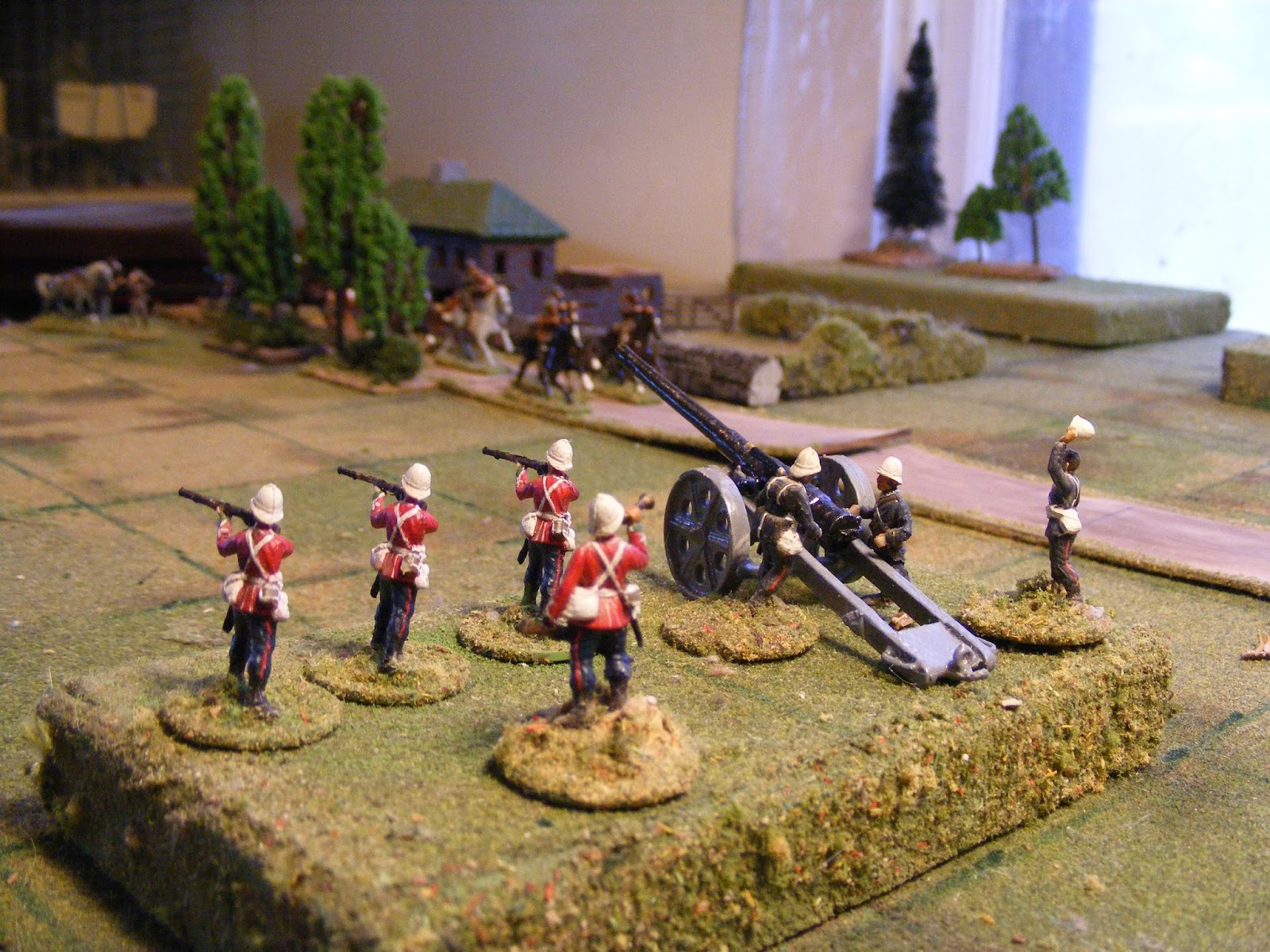
There I was, game all set and ready to play. Since the attackers were presumed to have just spotted the defenders, the latter were granted first move. There seemed no justification yet to move so the 4.7" opened up and blasted the head of the column with 2 hits. That was easy, splendid opening to the game. The unit cancelled 1 hit by falling back but had to take the other. Then it was time for the attacking Free State forces to move......ummmmmm suddenly I had a problem.

I hadn't taken any time at all to consider just  how the force available might carry out their mission and despite having written the rules, I wasn't sure of the unit capabilites in this situation or what the best plan of attack was. In fact I was probably feeling much like the inexperienced little plastic general on the table.


My first instinct was to send the mounted troops through the open country on their right  to turn the Nottinglish flank and cut the road. It was a good instinct but I didn't know when reinforcements would arrive and it seemed like the best bet was to move fast, seize the bridge objective and prevent the Imperial troops from crossing. So, off they went leaving the infantry and guns to handle the rest.

It didn't take long to realize that a defile made the approach difficult and the machine gun in town made it dangerous to approach. Worse, between the river and the hill there was no way to concentrate enough rifle fire on the enemy to drive them away. It would have to be done the hard way.

No sooner was the attack set in motion than the Imperials rolled a 6 and their cavalry appeared. It was going to be one of those days.

A fine mess.
Too late to back out, a unit of mounted rifles charged and to everyone's surprise, drove back the cavalry but not being cavalry could not pursue. On the next turn they charged back in while their supports charged the infantry. Both were repulsed but the enemy had been weakened. With sharpshooters moving up to support the attack and supporting guns and infantry pinning the enemy center, there was not going to be a better time to risk some casualties and press the attack.

Then, above the din of battle, could be heard the clear notes of a bugle followed by the sounds of men singing. "Come on Soldiers of the Emmmmpire. The day of gloryyyy has arrived!" The marching song of the Imperial Marines. (You'll have to imagine the tune, its very catchy, could bring a nightclub full of people to their feet).

In the Nick of Time
.

Rifle fire drove the Imperial artillery back, off the road and ..........into a good firing position, hmm. With the Free State artillery that was supposed to be supporting the attack stalled in the rear and the defenders around the bridge now outnumbering the attackers in that sector, the attack turned into a pinning action.  

The focus switched to other flank where an artillery duel was in progress with honours even. The Colonial Mounted Rifles had been switched to the right to backstop against the first attack but with the gun with its escort now being attacked by 4 infantry, a gun and sharpshooters, they were quickly shuttled back and the 2nd Guards ordered forward as well.

 At this point I seem to have forgotten the camera so here is a wider shot at the same point in time as the last shot.
Before the reinforcements could arrive the first assault rolled in on the gun but was repulsed with losses. Supports were close behind but suddenly the Free State orders dice hit a cold spell. As the supports edged forward piecemeal, the sharpshooters opened a heavy fire on the gun. To relieve the pressure the Guards came forward with the bayonet and were stopped dead by accurate fire. Repulsed, they spread out and returned fire without effect and were forced to give ground to avoid being decimated. Their sacrifice was not in vain. By the time the Free Staters were ready to resume the attack, the mounted rifles had galloped forward to flank it, dismounting, and pouring in a hot fire supported by infantry swinging down off the hill to protect the gun The Free Staters were shot to pieces and forced to give ground.  The general rode forward to steady them but was struck by a bullet.

The sharpshooters continued their fusillade against the 4.7 and forced it to limber and retreat but there was no one to follow up. Taking advantage of the confusion in the Free State ranks, and with the gun safe, the Nottinglish infantry and mounted rifles fell back into dead ground, daring the enemy to come and get them. As the wounded General climbed back into the saddle he contemplated doing just that but his army was battered and now the enemy was in position with equal numbers and fresh units. The opportunity to keep the enemy allies apart had slipped away. He ordered a retreat.


The scene at the end.
What? I had become so used to games ending with 2 men and a dog rallying for a last stand that it didn't seem right to end a game with NO units destroyed.  What could be wrong? Should I renew the assault? The game had already run nearly 2 hours instead of the one I had planned but an extension was possible, I just didn't feel like it. Hadn't it been fun? Yes it had. What were the odds of a final attack succeeding? Slim to nil. Oh. Was that due to the troop mix? The victory conditions? Partly yes and yes. If this was an actual campaign and I was playing the Free State though, I wouldn't throw more men away so why should I do it now? Oh. Ok, that actually worked then.

So was it fair? Since the Free State sharpshooters and mounted rifles were originally Boers I had thought about giving them superior firepower but hadn't, was that a problem? No, they had actually done quite well. Was it just a string of bad luck? The timely arrival of reinforcements? Partly, but, looked at after the fact, it had been a battle plan that was dependent on luck that ignored terrain and the enemy's strengths while minimizing the attacking unit's mobility advantage and the ability of the sharpshooters and dismounted rifles  to win firefights in the open. It also ignored their inability to take heavy casualties.  When the Free State units started taking hits early on, instead of pressing forward to take their objectives before the Imperial troops could arrive, they gave ground to avoid the hits but at the cost of lost time.

In other words, it was a risky plan carried out in a cautious manner. That's not usually a recipe for success even though it came close twice. It was a recipe for a good game though!

Note: No changes were deemed necessary to the Square Brigadier rules (not often I say that!)

Friday, April 4, 2014

NYW|: JUNCTION PT1

Free State cavalry on the march.  
For some reason when I look at this image, I hear the instrumental version of 13 Days of Glory from the opening scene of John Wayne's The Alamo.

This Nine Years War will be what I call a "Narrative Campaign". In other words, no maps, no logistics and record keeping, I just make up a story to explain how we got from the last game to this one. 

For example, the first game was the opener so I did an encounter between advance guards. Since Sawmill Village is an old favorite and only requires 6 units on each side, I prepared that many units. The invading Nottinglish lost so I saw the next game as some sort of rearguard action with reinforcements.

Before I got the game going I decided to make the reactionary forces an alliance. That suggested a game involving two poorly coordinated armies trying to join up with a pursuing force trying to separate them and assume a central position. 12 units a side happened to be what I had available so I started there crossed with the useable terrain on hand.

Up to this point I hadn't even thought about where the Imperial troops came from but if there was a shared border why hadn't the Emperor sent a division or more over the border rather than a brigade of Colonial Marines? 

With one army wearing  red coats and blue pants and the other wearing blue coats and red pants, there also lurks the possibility of a left side/right side sort of tension. I decided that since the armies hadn't actually joined yet that there would not be an over all General and that commanders could not order allied units yet.

An overview of the table at the start of the game.
This table is a mere 1/6 of my main table a couple of years ago. Hmm. 

After some experimentation I ended up with a small town at a T junction. One end of the road running through the town ran over a bridge towards the Imperial landing area while the other end ran off towards the Nottinglish camp.

The Nottinglish started deployed in and around the town. In order to win, the allies have to join up and control the road joining the two camps including the bridge, town and road exit. The on table force is a General, heavy gun, machine gun,
mounted rifle unit, 2 Guard infantry units (shock), 2 infantry units.

The Imperial forces start off table and need to roll a 6 to bring on a unit of shock cavalry. Once that is on they begin again to dice with a 6 bringing on a general, a gun and 3 infantry units.

The Free State forces enter in column on the road. First a commander and 4 units of mounted rifles, already on table then moving on, the General, a 2nd brigade commander, 2 units of sharpshooters 2 guns, and 4 infantry units including 1 Elite. Their goal is to sieze the road junction and prevent the enemy from joining up.

The armies will have an equal number of units but the Allies will have more infantry and artillery if the Imperial troops ever arrive. The Free Staters are more mobile, have better command control and will be more concentrated with a bit of luck. They also have a faster force which can hold its own or better in a shooting match but which is weaker on the attack in melee. Since so many of the figures are Boers I thought about giving them superior firepower but decided to go with the basic unit types from the rules trusting that they would work as is.
Burghers Sir! Dozens of 'em! Bugler, sound Alarm!

Next post, the game!

Wednesday, March 26, 2014

The Little Nine Years War: The Story So Far

Yes, I know, I said the next post would be that Crysler's Farm report and it will come, it was a good game and deserves something,  but there were ideas in my head, new troops to paint, old ones to refurbish, terrain to prepare, rules to clarify and a card table game to play. In due course, after checking for painting information in Andrew Rose's guide to Toy Soldiers as well as Kannick, Funcken and others, ransacking the cupboard for surplus painted ACW and Zulu war infantry to refurbish and looting the nascent Boer War project, I was ready to begin a late 19thC Cardtable Campaign using The Square Brigadier as rules. (Essentially a late 19thC version of the 20thC one ).  The rules will appear as a blog page before long.

The game took somewhere between 1 and 2 hours to reach a final, surprise, conclusion and turned out to have just the sort of look and feel I have been working towards since deciding to do a permanent downstairs card table game, based on  Bob Cordery's Portable Wargame with an improvised ACW version of Sawmill Village, back in November of 2012 .

And so dear readers, let me take you back 130 odd years, to a land far away......

_______________________________________________________________________


King Egbert, ruler of the small island Kingdom of Nottingland was, through his mother, the grandson and rightful heir of the Duke of Hungover, an even smaller Duchy on the coast of the Mainland. Unfortunately the good Hungoverian burghers got tired of paying taxes to someone who didn't work for a living and didn't conduct public policy in a way to maximize the wealth of his subjects. After a heated public debate, the Council proclaimed that the Duchy was now the Hungoverian Free State and asked the old Duke to please hand over the keys to the treasury and ducal palace and retire to his country estate. He chose instead to take a fast ship to visit his grandson. Shortly after an Nottinglish fleet appeared off the coast. The Council called the citizens  of the Free State to arms and with just a roll of the drum, the Nine Years War was begun.


The initial Nottinglish landing party, commanded by Brigadier Steele, consisted of the 1st or Grenadier Guards, the 2nd or Fullstream Guards, the 1st & 2nd Infantry battalions, a machinegun battery and a 4.7" gun with Royal Marine Artillery crew. (Please note that the tail of the column which snakes up the side of the board is technically off table following the small, unmarked path)  

The Hungoverians did not at the time have a standing army, apart from the  City Guard, but the Customs and Internal Security departments maintained several well trained paramilitary units. There was also a strong tradition of citizen soldiers  with the rural gentry and their tenants providing Mounted Rifles, the City Volunteers providing artillery as well as garrison troops and villagers everywhere being expected to turn out parties of riflemen for local defense.

The armies clashed at the little town of  Grant's Mills. Moving quickly, the mounted Burgers seized the town and their accurate fire forced back the MG but its return fire soon drove them from the town. 

The Hungoverian Infantry was slow to follow up and the Nottinglish Guards pushed forward seizing a farm on their left as well as the center of the town under the cover of their heavy artillery. The City Guard was at hand though and pressing forward through a horrendous storm of shell and bullets, took back the town in a fierce hand to hand struggle,  wiping out the stubborn 1st Guards.

As the Hungoverian City Volunteer artillery deployed between the town and the farm, an assault by the Nottinglish line infantry took back the town  despite heavy losses. A counter attack by mounted Burgers  and City Guards was wiped out  but their own losses were heavy. A final counter attack by the Border Police  took back the town and Brigadier Steele was forced to order his last Guardsman to cover the retreat of the artillery.


The battle was over but the war was just begun.