Having got back to painting again, its easier to set to on a larger bunch (technical term).

Once these are done, I'll finally make a go into the new PA British Infantry molds, but will probably wait till spring before pouring in the wood shed!
Having got back to painting again, its easier to set to on a larger bunch (technical term).
Once these are done, I'll finally make a go into the new PA British Infantry molds, but will probably wait till spring before pouring in the wood shed!
 Born and raised in the suburbs of Montreal 7 decades ago. Began playing with toy soldiers at 5 years. Started painting & converting at about 12 yrs and wargaming about 15 yrs. Never really stopped.
5 years in the Black Watch of Canada Cadets, 5 years at the Collège militaire royal de Saint-Jean followed by 4 in the navy. 25 years with CPC in IT simultaneous with 23 years running a boarding kennel. Inherited my love of toy soldiers from my mother's father. Married with a pack of litle Italian Greyhounds and a cat. Prematurely retired and enjoying leisure to game, maintaining our 170 yr old farmhouse and just living.
Well, I've managed to get a piper and an ensign painted at least:
 |
| "Ensign! Where are the colours!??" "Not yet arrived sir!" |
 |
| A close picture of my simplified version of the sett of the kilt which at this point, was the same as the Black Watch. Like my old kilt, from across the room, or when on the table (them not me), they just look dark, but if you are closer you can start to make out the variation of 4 colours/shades and the pattern. (There was a time when stripes would be straighter on 40's and a bit more regular in width etc., but these days, if I can make out who a unit is at arms length, thats good enough for me. I have a growing feeling that I'd better get all my painting down before this decade is done! ) |
Right! Next up: a stand of grenadiers are primed and on a painting 'stick' and the final stand of highlanders are assembled and about to be primed. Will I get them painted before the next game?
Born and raised in the suburbs of Montreal 7 decades ago. Began playing with toy soldiers at 5 years. Started painting & converting at about 12 yrs and wargaming about 15 yrs. Never really stopped.
5 years in the Black Watch of Canada Cadets, 5 years at the Collège militaire royal de Saint-Jean followed by 4 in the navy. 25 years with CPC in IT simultaneous with 23 years running a boarding kennel. Inherited my love of toy soldiers from my mother's father. Married with a pack of litle Italian Greyhounds and a cat. Prematurely retired and enjoying leisure to game, maintaining our 170 yr old farmhouse and just living.
I haven't been doing much painting recently but life is starting to slow down again, so today I finally turned my attention back to the next company of Fraser's (78th) Highlanders, the grenadier company.
 |
| Recruits for Fraser's Highlanders |
I can't fit a 40mm Siege of Louisburg game, or even the Plains of Abraham, on my little table but they'll get their share of tabletop fighting in my alternate universe Acadian war. Won't be right away though, the coats on the first batch of highlanders dried darker than I intended and seems to have darkened even more since, so I'm going to have to get the grenadiers right, then go back and fix the coats on the first highlanders.
I'll need six more Highlander after than but they don't need to be a full battalion to get in some action. When the time comes, it'll be a matter of deciding whether to paint or play on some quiet day.
Born and raised in the suburbs of Montreal 7 decades ago. Began playing with toy soldiers at 5 years. Started painting & converting at about 12 yrs and wargaming about 15 yrs. Never really stopped.
5 years in the Black Watch of Canada Cadets, 5 years at the Collège militaire royal de Saint-Jean followed by 4 in the navy. 25 years with CPC in IT simultaneous with 23 years running a boarding kennel. Inherited my love of toy soldiers from my mother's father. Married with a pack of litle Italian Greyhounds and a cat. Prematurely retired and enjoying leisure to game, maintaining our 170 yr old farmhouse and just living.
It was a cold January day in Acadia, the festivities were over when word came of an English column marching towards Belmont. The church bells began ringing and the women, children and old folks headed for the woods, carrying supplies and driving what livestock they could manage and a messenger sent to the local Mi’kmaq camp to ask for their support. Before long the beat of the British drums could be heard.
 |
| At last the British columns came into view along the snow covered road while rangers could be seen flitting through the woods and on the hills. |
 |
| The Acadians watched the British battalions deploy and advance towards the village and listened to the sporadic fire from the woods. Soon the Acadians, supported by some Compagnie franches from Canada, joined the battle as the Royal Americans and a battalion of provincials advanced. |
 |
| The 60th suffered heavy casualties and was forced to fallback having done little harm to the Compagnie franches in the stone church, but the provincials halted and kept up a heavy fire. |
 |
| As the Acadians began to suffer casualties, they turned and retreated despite the Priest's admonishments. |
 |
| The Provincials pursued but the Acadians rallied behind another stone wall and the Provincials stopped to pour another volley into them before crossing the wall and preparing to charge. |
 |
| As the Provincials advanced across the open field, a deadly stream of fire came from the Acadians in front of them, but another hail of bullets also poured into them from the flank. Compagnies franches and Mi'kmaq warriors had moved into position to support the Acadian militia. Their Colonel ordered a charge, but he was shot down and seeing that the 60th foot had broken, they voted to carry their commander to safety. |
Born and raised in the suburbs of Montreal 7 decades ago. Began playing with toy soldiers at 5 years. Started painting & converting at about 12 yrs and wargaming about 15 yrs. Never really stopped.
5 years in the Black Watch of Canada Cadets, 5 years at the Collège militaire royal de Saint-Jean followed by 4 in the navy. 25 years with CPC in IT simultaneous with 23 years running a boarding kennel. Inherited my love of toy soldiers from my mother's father. Married with a pack of litle Italian Greyhounds and a cat. Prematurely retired and enjoying leisure to game, maintaining our 170 yr old farmhouse and just living.
When Brigadier Ross, the British General in Pisiquid, heard that the Duc d'Anville's armada had arrived in Chebucto Bay (now known as Halifax harbour), he ordered Brigadier Turner to lead an expedition to cross the bridge over what is now known as the Meander River, and block the only direct routes from Chebucto to either Pisiquid, or to the Acadian settlements along the Minas Basin.
(Where Highway 215 crosses the Meander River near the current NS town of Brooklyn if anyone wants to look at a map, but don't expect even a close representation of the actual geography of any particular point!)
 |
The opposing forces collide. The British force consisted of 1 battalion of veteran Royal Americans and 3 battalions of provincials as well as 2 companies of rangers. The French had 1 battalion of Colonial infantry from Ft. Beausejour and 2 companies of veteran Colonial infantry from Canada, 2 companies of militia and two parties of Abenaqui and Mi'kmaq warriors. |
 |
| While the main forces moved up and deployed, the light troops were already trading fire. |
 |
| Soon, the fighting spread across the entire battlefield. |
 |
| Casualties were heavy and both sides had to pull back their right flanks. |
 |
| Eventually the French infantry, fighting twice their numbers, had to retire, but at the same time, the 60th Foot (Royal Americans) also had to retire after heavy casualties while the rangers were forced back by superior numbers and heavy losses. The sun was sinking and it seemed that at the end of the day, neither side would have fully achieved their orders. |
 |
Brigadier Turner, leading his first detached command, was torn between not fully completing orders, even if he held the bridgehead and could be reinforced by night fall, or having the glory of winning his first battle, especially as the French appeared to be on the verge of breaking. At last he flipped a coin and decided to order his New Englanders to charge again. |
Born and raised in the suburbs of Montreal 7 decades ago. Began playing with toy soldiers at 5 years. Started painting & converting at about 12 yrs and wargaming about 15 yrs. Never really stopped.
5 years in the Black Watch of Canada Cadets, 5 years at the Collège militaire royal de Saint-Jean followed by 4 in the navy. 25 years with CPC in IT simultaneous with 23 years running a boarding kennel. Inherited my love of toy soldiers from my mother's father. Married with a pack of litle Italian Greyhounds and a cat. Prematurely retired and enjoying leisure to game, maintaining our 170 yr old farmhouse and just living.
At last I found some 'me time' and the battle surged forward to the music of fife and drum and the rattle of dice.
 |
| Click on the picture for a larger view. |
Battle report to follow.
Born and raised in the suburbs of Montreal 7 decades ago. Began playing with toy soldiers at 5 years. Started painting & converting at about 12 yrs and wargaming about 15 yrs. Never really stopped.
5 years in the Black Watch of Canada Cadets, 5 years at the Collège militaire royal de Saint-Jean followed by 4 in the navy. 25 years with CPC in IT simultaneous with 23 years running a boarding kennel. Inherited my love of toy soldiers from my mother's father. Married with a pack of litle Italian Greyhounds and a cat. Prematurely retired and enjoying leisure to game, maintaining our 170 yr old farmhouse and just living.
At last! This little skirmish has begun.

Stay tuned!
Born and raised in the suburbs of Montreal 7 decades ago. Began playing with toy soldiers at 5 years. Started painting & converting at about 12 yrs and wargaming about 15 yrs. Never really stopped.
5 years in the Black Watch of Canada Cadets, 5 years at the Collège militaire royal de Saint-Jean followed by 4 in the navy. 25 years with CPC in IT simultaneous with 23 years running a boarding kennel. Inherited my love of toy soldiers from my mother's father. Married with a pack of litle Italian Greyhounds and a cat. Prematurely retired and enjoying leisure to game, maintaining our 170 yr old farmhouse and just living.
Its that time of the year, getting ready for winter, cutting and stacking firewood, trying to manage water supplies after more than 3 months of drought, sorting out and reorganizing miniatures for North America from the 1740's to 1760, casting, painting, and on and on.
Its time for a game! The rest can wait.

 |
| "Army commanders, meet in my tent to discuss scenarios, then draw cards for sides" |
Everyone, else....Stand by!
Born and raised in the suburbs of Montreal 7 decades ago. Began playing with toy soldiers at 5 years. Started painting & converting at about 12 yrs and wargaming about 15 yrs. Never really stopped.
5 years in the Black Watch of Canada Cadets, 5 years at the Collège militaire royal de Saint-Jean followed by 4 in the navy. 25 years with CPC in IT simultaneous with 23 years running a boarding kennel. Inherited my love of toy soldiers from my mother's father. Married with a pack of litle Italian Greyhounds and a cat. Prematurely retired and enjoying leisure to game, maintaining our 170 yr old farmhouse and just living.
Not my best painting ever, but these days, its often as good as I can manage. (I know 70 isn't really old but there are days when it feels like it.)
Anyway, these are Compagnies Franches de la Marine from Canada, dispatched to Acadia to help drive out the English. The full uniform is left behind in the heat of a muggy summer day, especially when moving quickly through the forests. (In winter a warm woolen, hooded, coat would replace the uniform coat.)
 |
| The figures are a mix, mostly formed from various Prince August moulds but with a few modified Irregulars and one 3d printed sample from Day of Battle. |
The rest of the Highlanders are finally cast and next on the painting list!
Born and raised in the suburbs of Montreal 7 decades ago. Began playing with toy soldiers at 5 years. Started painting & converting at about 12 yrs and wargaming about 15 yrs. Never really stopped.
5 years in the Black Watch of Canada Cadets, 5 years at the Collège militaire royal de Saint-Jean followed by 4 in the navy. 25 years with CPC in IT simultaneous with 23 years running a boarding kennel. Inherited my love of toy soldiers from my mother's father. Married with a pack of litle Italian Greyhounds and a cat. Prematurely retired and enjoying leisure to game, maintaining our 170 yr old farmhouse and just living.
I needed to add 2 more of Gorham's rangers to fit the plan, so now that's done. In the early days the friendly 1st Nations warriors were a large part or the Rangers so they make up 1/2 of my rangers.
 |
| While I was at it, I rechecked my thin sources (no pieces of clothing remain and no contemporary paintings have been found so far), and lightened up the facings, tams, and small clothes. |
While I had the camera in hand, I took a quick shot of some of the existing and in progress casualty markers.
 |
| The two First Nations warriors were done on purpose more than a decade ago, but the rest are actual casualties injured on the tabletop or in transit and are going to be touched up and used as removed stand markers on table. |
On the table now, is a refurbishing of some of my Compagnies Franches skirmishers.
 |
| The unpainted ones are fresh castings, the two painted Irregular Minis loading their muskets, have had their odd mini-bicorne heads removed and Prince August replacements attached. |
More Highlanders are next!
Born and raised in the suburbs of Montreal 7 decades ago. Began playing with toy soldiers at 5 years. Started painting & converting at about 12 yrs and wargaming about 15 yrs. Never really stopped.
5 years in the Black Watch of Canada Cadets, 5 years at the Collège militaire royal de Saint-Jean followed by 4 in the navy. 25 years with CPC in IT simultaneous with 23 years running a boarding kennel. Inherited my love of toy soldiers from my mother's father. Married with a pack of litle Italian Greyhounds and a cat. Prematurely retired and enjoying leisure to game, maintaining our 170 yr old farmhouse and just living.
While the Germans and Emigres were tackling the redoubts, the British infantry enveloped two sides of the central village while leaving a clear line of fire for the Royal Artillery.
 |
| The fight for the town was bloody and sustained while the opposing cavalry units eyed each other. If either had charged and won, the victorious horsemen could turn the tide in their side's favour but if they lost, all might be lost. So it was that neither General ordered them in and the opposing cavalry stared at each other, ready for pursuit if their infantry triumphed, or to cover their army's retreat if needed. |
 |
| A balloon's eye view of the battlefield, 1/2 way through the day. |
 |
| With the redoubts cleared, the General ordered his left wing to detach a battalion to join in the attack on the village. He also ordered the redcoats to side step to give the artillery a clean line of fire to the stone house. The Black Watch, having suffered heavy casualties was ordered to fall back and guard the flank of the infantry in case the French cavalry charged. Slowly, the allied infantry fought their way into 1/2 the houses in the town. |
 |
| On the far left, the German battalions stormed the town and, despite heavy casualties, they drove the French out with the points of their bayonets. The Republicans themselves had taken even heavier casualties and there was no chance that they could attempt to take the town back. The Republic still held two of the objectives and the sun was sinking low. Was it time to gamble with the cavalry? |
 |
| There was no need. The allied infantry manged to take most of the town and after very heavy losses, the remaining Republican infantry broke and ran. The Republican cavalry covered their retreat and the Duke decided not to risk his cavalry in pursuit when there were so many of these French Republicans to fill the ranks of their infantry. (ps this was the 3rd last turn.) |
Born and raised in the suburbs of Montreal 7 decades ago. Began playing with toy soldiers at 5 years. Started painting & converting at about 12 yrs and wargaming about 15 yrs. Never really stopped.
5 years in the Black Watch of Canada Cadets, 5 years at the Collège militaire royal de Saint-Jean followed by 4 in the navy. 25 years with CPC in IT simultaneous with 23 years running a boarding kennel. Inherited my love of toy soldiers from my mother's father. Married with a pack of litle Italian Greyhounds and a cat. Prematurely retired and enjoying leisure to game, maintaining our 170 yr old farmhouse and just living.
The 1st Coalition armies were getting restless in the fall of 1793. The campaign seemed to have stalled but eventually the Duke of Belmont had received orders to advance with an allied force of British, Emigre and Brunswick units and seize the strategical town of Notenoy where the road splits, and either the town on the North road or the redoubt blocking the South road.
Cavalry scouts reported that the Republicans had occupied the town and both exits but with a smaller force. After a quick council of war, a plan was decided on. The British infantry would seize the central town and road junction while the Emigre and German brigade would storm the enemy redoubts and seize the smaller town. The cavalry would guard the flank of the infantry while the light troops would work their way through the forest and try to silence the enemy artillery which was holding the third objective.
 |
| The British infantry headed straight forward to the main objective, supported by all of the artillery and were quickly engaged. |
 |
| On the left, the French musket and canon fire was causing serious casualties. The Emigres were first to reach their target but they were blown back by cannister fire. |
 |
| The veteran Brunswickers also took heavy casualties but they cheered and swarmed over the redoubt, capturing the French guns and raising the morale of their experienced supports. |
 |
| "Advance The Guns!" came the order. The bombardment against the redoubt had done little damage so they were ordered to advance to a more effective range. Supported by infantry musketry, the artillery did its work. |
 |
| On the Southern flank, the German Jagers slowly forced the French skirmishers back towards the redoubt beyond the woods. In the clearing between the woods and the town, the opposing cavalry sat and faced each other. If either side charged and drove off their enemy, they could wreak havoc on the already engaged enemy infantry or exposed artillery, but it was a dangerous gamble, one to only be used if absolutely necessary. |
 |
| After a brief bombardment by the British artillery, the Royalists charged again and captured the second redoubt. Now it was time to move on the crucial goals but the day was half spent and not one objective had been taken. Could it still be done? |
Born and raised in the suburbs of Montreal 7 decades ago. Began playing with toy soldiers at 5 years. Started painting & converting at about 12 yrs and wargaming about 15 yrs. Never really stopped.
5 years in the Black Watch of Canada Cadets, 5 years at the Collège militaire royal de Saint-Jean followed by 4 in the navy. 25 years with CPC in IT simultaneous with 23 years running a boarding kennel. Inherited my love of toy soldiers from my mother's father. Married with a pack of litle Italian Greyhounds and a cat. Prematurely retired and enjoying leisure to game, maintaining our 170 yr old farmhouse and just living.
This was a tricky lot, but they'll serve.

Gorham's Rangers primarily served in what is now Nova Scotia from 1744 to 1759 (Some of them probably crossed what is now my yard!) and then joined Wolfe's expedition to Quebec, Information on how they were dressed is scarce, and mostly speculative since no parts of their uniforms have survived, nor were there any contemporary drawings, just a very few vague descriptions in diaries etc.. Sooo, I decided to go with the most common descriptions, nearly contemporary drawings, and modern day reenactors who usually do a good job of digging into the history. I then crossed that with what I had to work with, decided to drop the sort of skirt or all round apron which wasn't always mentioned or sketched, especially in the early years.
The Scots bonnets seem to be the best bet for headgear and recent(ish) study has decided that the same sort of bonnets were worn by Roger's Rangers despite the old NorthWest Passage movie. Luckily, I happen to have Prince August's SYW highlander mould which includes what we called a 'Balmoral' cap when I was in the Black Watch of Canada Cadet Corps in my teens.
In the early days at least, many of the Rangers were recruited from First Nations in what is now New England, long time enemies of the Mk'maq and other tribes in what are now the Maritime Provinces, so, I included two of them by darkening their skin slightly.
Leggings or gaiters to above the knee were common enough but the next bit was tricky. They seem to have worn short jackets and Prince August presented Russians in summer gear without their long coats, but I wanted more poses. I also happened to have the Austrian Grenz moulds. The coats were a bit long and had lace and swords but a bit of work with knife and file gave me a few rather rough conversions, including reducing swords to hunting knives.
From there, I called heavily on the various interpretations and did my own to make it easy, after all, I want them to play wargames, not sit on display.
Born and raised in the suburbs of Montreal 7 decades ago. Began playing with toy soldiers at 5 years. Started painting & converting at about 12 yrs and wargaming about 15 yrs. Never really stopped.
5 years in the Black Watch of Canada Cadets, 5 years at the Collège militaire royal de Saint-Jean followed by 4 in the navy. 25 years with CPC in IT simultaneous with 23 years running a boarding kennel. Inherited my love of toy soldiers from my mother's father. Married with a pack of litle Italian Greyhounds and a cat. Prematurely retired and enjoying leisure to game, maintaining our 170 yr old farmhouse and just living.
Its been a busy week, but not on the hobby front. I've made some progress on refurbishing the Belmont Fusiliers but they aren't ready for inspection yet, let alone a battle. However, nearing 2,500 posts over the last 14 years, I figured there must be an old battle report or two worthy of a rerun.
The following game report was of a 2012 solo game using homecast Prince August figures and Lawford & Young's Charge! rules. The armies were raised for participation in "Not Quite The Seven Years Wars" convention games with the H.A.W.K.S from Maryland who adopted me as their Canadian mascot around the turn of the century. Since I don't have the time and money to make the 3,000 km round trip for an evening game, I decided to build enough units for solo games at home, and postulate periodic civil wars in my "Kingdom" of Rosmark.
(Note: I'm not up to those long drives these days so last year at Huzzah!, I handed over a number of my NQSW units for the club to use and most of the remaining figures have been absorbed into my British and French armies for my Acadia and Quebec campaigns.)
__________________________
 |
| The game begins. |
Note: The game was Scenario 1 from Wargames for All Ages by Stuart Asquith and Charles Grant. The armies were Prince August semi-flat 40mm homecast figures. The scenario calls for the attacker to control the ridge and be able to advance past it with at least 2 units by the time limit which they suggest might be equal to the amount of time it would take to cross the table + 50%. In Charge!, infantry in column of 4's can move 15" per turn, I calculated 6 turns to march on, cross the 5 ft table and exit. Not liking a definite limit or a diced ending and being notoriously forgetful at ticking off turns, I made a deck of cards the first 8 in order, the next 5 shuffled with 1 being a joker which would indicate last turn. With hindsight, this may have been generous by a turn or 2, perhaps 7 + 4 would have been fairer but at any rate the game ended with turn 11.


 Night falls on the pass.
Here are the 4 original blogposts on this game:
Battle-of-wentworth-pass-teaser.
Comments on playing Charge! solo
1st Half
Conclusion
Born and raised in the suburbs of Montreal 7 decades ago. Began playing with toy soldiers at 5 years. Started painting & converting at about 12 yrs and wargaming about 15 yrs. Never really stopped.
5 years in the Black Watch of Canada Cadets, 5 years at the Collège militaire royal de Saint-Jean followed by 4 in the navy. 25 years with CPC in IT simultaneous with 23 years running a boarding kennel. Inherited my love of toy soldiers from my mother's father. Married with a pack of litle Italian Greyhounds and a cat. Prematurely retired and enjoying leisure to game, maintaining our 170 yr old farmhouse and just living.
When word arrived at Annapolis that General Ross's force was cut off and in need of supplies and reinforcements, a relief column was assembled. Given that the sea route would require navigating up a winding tidal river with strong currents that could drop 15 feet during low tide, exposing or hiding shifting sand banks, without a pilot! The Admiral declined to risk his ships. The relief column would have to go overland from Grand Pre to Fort Edward even though it was still under construction.
In the meantime, Brigadier Ross's force would have to forage off the local farms in the Pisiquid area.
At last all was ready and the relief column, under Colonel St. Michael's command, set out. It did not take long to become clear that they would have to fight their way through.
 |
| As the column approached a small Acadian village, musket fire broke out ahead and to their flank. The advance party of Rangers and Highlanders deployed and pressed on to gauge the strength of the enemy. |
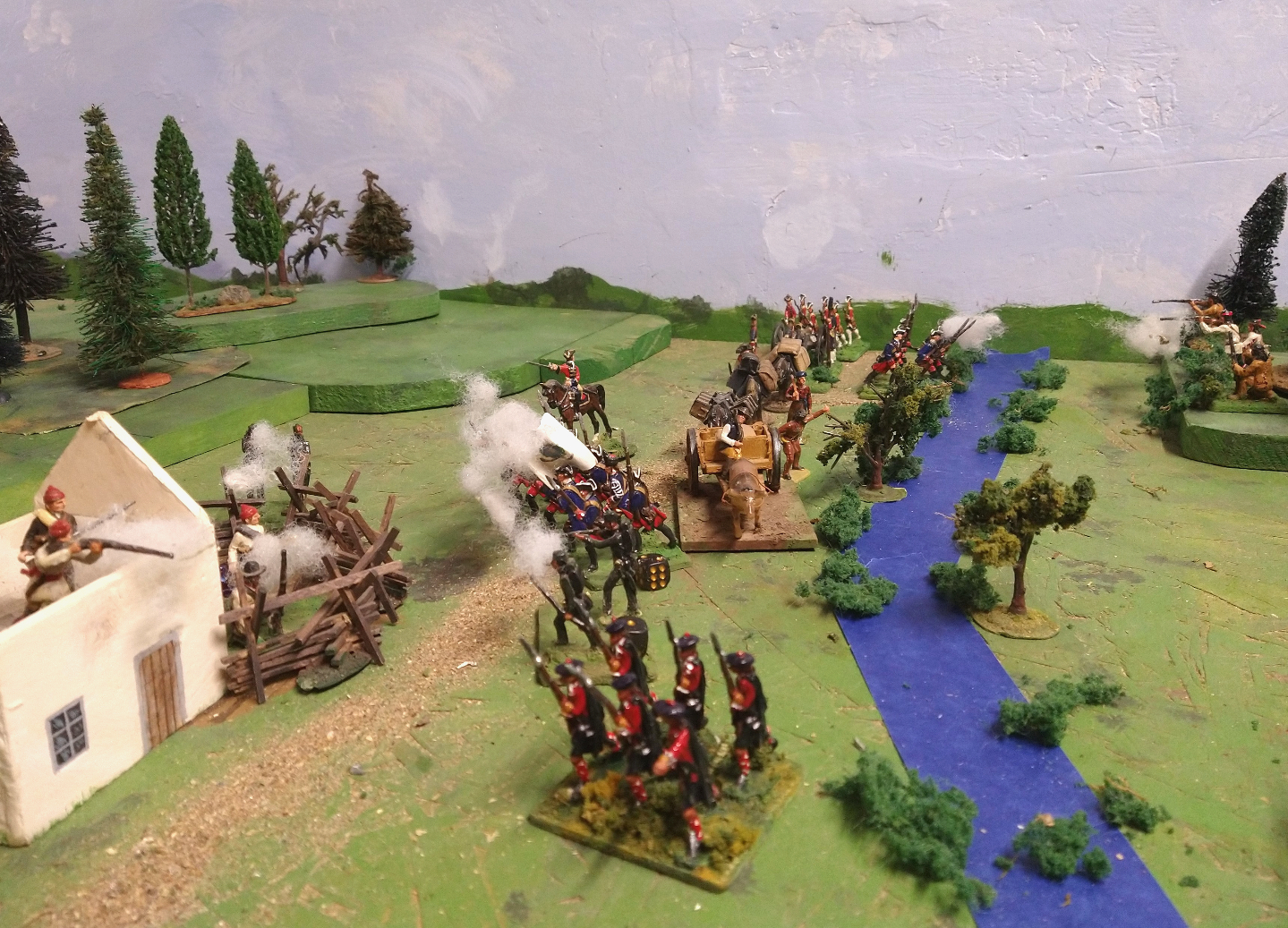 |
| The firing from the far side of the little river was scattered but the steady trickle of fire began to take its toll while the reply from the Massachusetts battalion seemed to have little effect. The word came down to leave a company to screen the convoy on the river side, while everyone else pushed forward, keeping between the enemy and the convoy. |
 |
| It was soon obvious that the French intended to stop the convoy here. Every farmhouse was defended and soon a company of the Compagnies Franches appeared on top of a low ridge running parallel to the road and river and with them came a man in long black robes. It was soon evident that this Priest was directing the ambush, soon he would be known as le Renard noir or the Black Fox. |

 |
| A patrol of rangers were sent to see if the way to the bridge was clear but the answer came back " French soldiers are defending the approaches to the bridge. |
Born and raised in the suburbs of Montreal 7 decades ago. Began playing with toy soldiers at 5 years. Started painting & converting at about 12 yrs and wargaming about 15 yrs. Never really stopped.
5 years in the Black Watch of Canada Cadets, 5 years at the Collège militaire royal de Saint-Jean followed by 4 in the navy. 25 years with CPC in IT simultaneous with 23 years running a boarding kennel. Inherited my love of toy soldiers from my mother's father. Married with a pack of litle Italian Greyhounds and a cat. Prematurely retired and enjoying leisure to game, maintaining our 170 yr old farmhouse and just living.

