Showing posts with label onehour. Show all posts

Friday, November 25, 2022

He Marched Them Up The Hill ......

 At last!  Today I got to play a OHW scenario through in one, roughly an hour, session! 


The French launch a speedy attack, but the Allies reaction was even faster. 

I will admit that earlier this last week, I played the scenario over several days, a turn here and another there, using With MacDuff to the Frontier but the fit just wasn't right and the games went too slowly with the wrong kinds of decisions needing to be made. (Low level details were over shadowing the formation and execution of a battle plan.)  So, I looked back to the "Whiff of Dice" rules that I had been working on for these French Revolution scenario games.

The French fire caused heavy casualties so the allies fell back to reorganize.

The rules still needed honing so I under took that, once again delaying a proper game, then reset the table.

The French followed, but not fast enough, and casualties were heavy on both sides. The British commander decided to take a chance and threw the 11h Light Dragoons at the French Hussars which had been working their way around the allied infantry's flank.
It was a gamble, but the dice were kind and the 11th LD won honours in their first action!

The result was worth it. For once I managed to play a One Hour Game in roughly an hour. More than that, the game was loaded with critical command decisions and hard to predict combat results, keeping me engaged right down the  last die roll which broke the French morale at the end on Turn 14 of 15.

The French made a desperate attempt to hold their own till dark, but it was not to be.

Of course, there'll have to be more test games.......oh well, if needs be.....


Friday, December 6, 2019

Opening Scene

I'm getting closer!

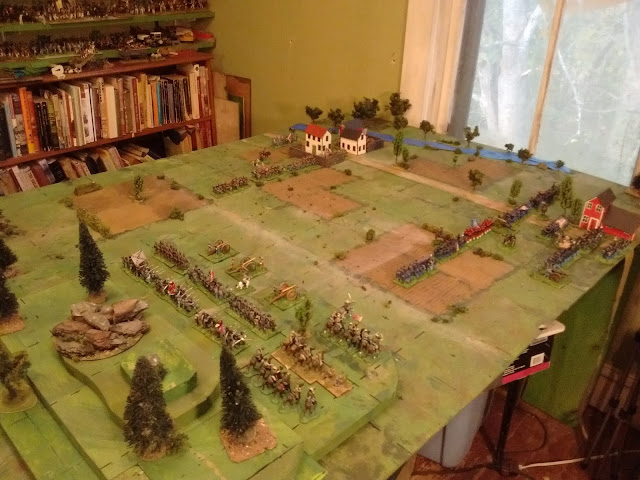
Haven't had enough free time yet to play but I have managed to finally get the table set for a Saturday War of 1812 game.

I randomnly chose a One Hour Wargame getting a surprise river crossing from the South by Blue.  Wasn't hard to decide which army was going to be "Blue".

Thursday, April 4, 2019

A Minor Affair

Well, I got my game in!
The new guns proved surprisingly accurate.
The scenario selected was another boiled down CS Grant scenario with both sides rushing reinforcements to reinforce/eliminate a bridgehead over a river.  My original intention was to use my gridded rules but since I will be running MacDuff games at Huzzzah!, I decided to add the 19thC weapons in and use them , after all the original Colonial version was aimed at just this period. I did find myself using the grid to estimate ranges and movement instead of measuring and I may pursue that thought.

The Rebels have seized an unguarded crossing and both sides are rushing troops to the scene.
The game was  pretty much  what the book claims to offer: a quick, easy game. However, it also settled into an extended firefight again with little scope for manoeuvre,  This is not wrong for a clash between two small 1870's forces but  its not as engaging a game as one might want though it was as fast as desired. It may be a case "You pays your money and takes your choice" but  it may that a different set of rules or different period might have given a more satisfying game. I'll leave the table as is in case I get a chance to put the question to the test.
Casualties were heavy on both sides but eventually the Rebels were forced to retreat.

In any case, I wanted to get my 54's out and have a game and I did and I enjoyed it! Mission accomplished. 

Wednesday, April 3, 2019

An Hour! An Hour! My Kingdom for an Hour!

I managed to get my table cleared today and set up a One Hour Wargame scenario.


However, I didn't manage the hour needed to play. Maybe tomorrow.


Friday, June 8, 2018

Zulu's? No mostly I won.

Every time I get the old Britains' out, I seem to get the urge to paint more of them and to play another game. It occurred to me that by expanding the One Hour game to full table size and using double the number of units to maintain the ratio of unit foot print to battlefield, I was robbing myself of the opportunity to have a simple, clear, distinction between really quick, simple  OHW scenarios with  a handful of units  in a corner of the table and longer, more complex Grant Teasers with larger forces on the full table, all while drawing from the same armies with the same campaign background. By adopting a scale of 1 square per 4" on the OHW table instead of 3" as in the previous game, I could use a 1:1 ratio of units equating to the smaller 4" frontage suggested by Thomas for his scenarios.

I reset the table using 81 squares instead of the previous 144.
"Zulus sir! Dozens of them!"
 Since only my Zulu War units are set up for my planned 6 figure infantry units, and haven't been out in over a year, I decided to go to South Africa.
The shrunken layout with hippo instead of a cat.
 Once I got the troops out I remembered that I hadn't gotten around to adding spearmen and the like to the Tin Army and decided that I was over due for a Portable Wargame anyway.
One unit of Lancers tried to deal with 3 Zulu units but they zoomed past them and bounced them and, well, I think they did manage to stick one Zulu in 5 rounds of melee before they were surrounded and cut down.

The line gets pushed back but thank heavens there was a Taboo preventing the Zulus going into the woods. The British are also grateful that for 4 turns the Colonel single handily held off 2 units of Zulus in hand to hand combat after the Naval Brigade was cut down. 

Turn 15 of 15.  A desperate, last half of the last turn  British counter attack got the Rutlandshires to with 6" of the road thus earning a technical but cheesy win.

As usual,  the Portable Wargame  served well and the game came out at roughly an hour so the whole thing can be considered a success.

Now I want to play a full Grant game but I need to get back to bringing the armies up to scratch since a few of the existing units are short a few figures  or are temporarily mounted on slightly wider bases which won't allow 6 figures in a 5" square and I need to add a few more units to both Canadian and American armies.

We have work to do!

Wednesday, November 1, 2017

(UPDATED) Rainy Day Games and their Consequences.

Monday was a windy, rainy, day and the table was all set ..... obviously it was time for another game.
Blue's Lancers rally back in disorder after a clash with Red Dragoons. (Game 2b)
The first step as to decide what to play. I still had an urge for Old School Shiny and bright red coats. I was tempted to stick with 54mm but I'd would 'kinda' like to get away from the Canada-US thing but at the same time I'm not sure exactly where else to go with what I have and don't want to duplicate Atlantica.  Needs some more thought or possibly less thought. Anyway, having mentioned Atlantica.........
Game 2a. Same terrain, different armies, different rules.
I rolled up 1870's Square Brigadier armies using the OHW lists giving Red 2 Cavalry and 4 infantry. (Technically 3 infantry plus either a skirmisher or zouave unit but I kept forgetting to give the Rifles their sharpshooter bonus.) Blue got a gun, 1 cavalry and 4 infantry.

The game worked OK but wasn't particularly interesting as it quickly bogged down in house to house fighting and it didn't feel quite right for the period. In theory the support rules should allow a group of adjacent "companies" to feel like 'battalion" but they don't, especially since the rules don't differentiate between a company of the same battalion or any adjacent friend. Works OK for the 20th C where companies were larger and spread out, being forced to some degree to act as separate units tactically  while being coordinated by battalion or brigade HQ. It didn't quite look and feel right here though and never quite seems to for this sub-period.

That was only part of it though. I went back and looked at the scenario again and realized that I had screwed up the translation of map and forces to the table. The scenario was designed for  a 36"x36" table with about a 6", maybe 9" wide town in the middle and 6 units each of a 6" (recommended) or 4" frontage. I had increased the table to 48"x48" with an 8"x8" town and reduced the unit foot print to 4".  Instead of being able to hold 1 unit or 1/6 of an 'army', my town could absorb 4 or 2/3 of an 'army'. Ah. When I tried this with my War of 1812 troops a year ago, I had doubled the number of units to compensate.

The linear problem was really the same one as had bothered me with the War of 1812 using 40mm figures and the same easy solution suggested itself. Skip the grid and break out Hearts of Tin. I was going to leave the game till another day but, you know, it was still cold and wet out and ...........
Game 2b. The unit footprints have been enlarged. 

The game had much more of the look and feel that had been in my mind. Of course, since the rules have not yet been updated and these troops have been resisting the orders to conform to 20thC standards and so the infantry were using two different basing systems, the game was a bit loosey-goosey at times, but it still felt right and worked.

One example of the indecision was whether the typical 1870's/80's deployment as a heavy skirmish line for firing with supports and reserves to the rear was better represented by a single line or double line since I had rejected my old way of doing it with a firing line spread out in front  with supports in column 6" to 12" behind them. Looked good but was a pain to track in action especially in armies without distinct regimental uniforms.

Note: (After more a more thorough post game review of both theory and practice, the "2 ranks with 3 companies per standard battalion, each with 4 bases of 2  figures" solution has won out despite the fact that this is consistent with my 1812 armies and my 20thC armies will use the same 2 figure stands albeit with only 2 of them per Square Brigadier company.)

Anyway, the game worked well with larger units and more of the action took place outside the town. Red had some disturbingly low die rolls and eventually both armies were exhausted but clinging to at least a quarter of the town so when the dogs signalled that dinner time had rolled around with three turns left to go, I called it a draw.

It would seem that the 1870's/80's is back in 40mm and I need to expand my list of active collections/"periods" back up from 9 to 12, refurbish and complete the troops, and finish the update to Hearts of Tin. I'll add all that to "The List".

SEE NEXT POST FOR UPDATE!

Tuesday, July 19, 2016

Garden Encounter 1814

The plan for today did not actually including cutting two dozen bases, re-basing 150 or so figures and playing an outside One Hour Wargame scenario using The Square Brigadier.  That's what happened though.
The New York Dragoons get cocky and are repulsed but the 104th Foot are doomed anyway.
It was such a perfect summer's day that I decided to take the day off house and garden chores. Somehow that ended up with me, an offcut of 1/4" board from a previous reduction in my wargame table and my bandsaw. In no time at all I had a stack of bases already painted green. Since the 1812 figures had only been lightly tacked on temporary bases it took no time at all to pop them off and re glue them in their original 8 man companies. I touched up the edges and decided that flocking could wait.

So there I was with the 20 odd stands needed for Crysler's farm and beautiful sunshine streaming in through the window. I didn't really feel like another refight of Crysler's so decided to grab One Hour Wargames and move the Square Brigadier outside. I intended to still use the 10x12 as close to Thomas's 3ftx3ft  table if considering each square equivalent to 3" allowimng me to field 2 stands per scenario unit but saw my 9x9 travelling mat and decided to grab it and use 1 base per unit just to see if that would work.
The setting: my shady corner between the woodpile and the Lilacs (and other assorted bushes).
Not terribly good lighting for photos at 6 in the evening.
Th scenario was an advance guard clash over a hill in the middle of the table. One unit per side on table and the rest dicing for arrival. Since it was supposed to be Canada in 1814 I added a strip of woods along one edge and assumed an off table river on the other. Rolling for the armies gave me:
Americans: 4 infantry, 1 riflemen, 1 cavalry. British: 4 infantry, 1 light infantry, 1 artillery.

The game started off with the advantage swinging back and forth but slowly started to swing towards the British and then suddenly the American line collapsed.

To my surprise the game went 12 out of 15 turns and lasted 1/2 hour excluding set up and take down. Using the larger board with 12 stands instead of 6 would probably have given a full hour of play but for a quickie it was just fine as it was.
As dusk sets in (OK I'm shading the table with my body) the American forces rout leaving the British in possession of the hill.
In summary: Bases: Check, Rules: Check, Grid: Check, Ability to handle scenarios: Check.
All systems go!

The rules as played are available here (click)

ps.
For those with an interest in history, this game is a direct descendent of this 2011 portable 1812 wargame (click) using my adaptation (click) of Bob Cordery's portable wagame.

Friday, December 18, 2015

Still Fiddling (Updated)

A few days ago I decided I had time for a quick game. Flipping open OHW, I found myself looking at Scenario 22: Ambush. Six Red units poised to attack 1 Blue unit in a town. 

Except Red isn't allowed to attack the town. Blue has 3 more units in the woods ready to attack. For 3 turns no Red unit may move or shoot and after that they are allowed to shoot at the town but can't assault it. OK, why not? I suspect one isn't supposed to ask why not but I hate games that don't look "right" so I postulated that perhaps the town was protected by a high wall and a wet ditch, not very War of 1812 ish. Perhaps Fort MacDuff? Sounded like work, then my eye fell on my New Orleans redoubt from Barzso and suddenly I "HAD" to haul out the pirates which in turn meant leaving the War of 1812 for Atlantica. By the time I was set up my hour was long gone so I took a picture and left it.

Hey Johnny Cope!
Over night I started wondering why Red couldn't react for three turns, not even in self defence. The  only thing I could think of was a dawn assault on a sleeping camp. When I scraped up an hour it took five minutes to fold some paper tents and I was ready to go. Some chance of waking and reacting seemed reasonable but I decided to play it straight up except with my rules. 15 minutes later Red was routed and the game was over. Not terribly satisfying but a large part of that was with the rules.

It had been bothering me  that despite some period rules,  formed 1812 or 1830's line battalions seem to be either as flexible  as skirmishing 1900 infantry deployed in companies or as very brittle. I experimented with various things and managed to stretch the game to 5 turns but in the end, the only thing that seems to work right is to just make them stronger so that they can ignore occasional hits when they are fresh. I'll test that this weekend but I'm also going to allow Red to attempt to wake guys up once the shooting starts.

The Blue Menace! Oberhilse troops over the mountains! 

I unexpectedly found an hour this evening to play. The increase in number of hits made all the difference. All I ended up doing for reaction was to allow units that were fired on or meleed to shoot before the 4th turn. It looked pretty close at times but Blue had some terrible dice and Red pulled 3 chance cards in their favour including a rally. At the end, Red had 4 units only 1 or 2 hits from breaking and had lost 3 Commanders but they had only lost 2 units out of 10 on Turn Nine when Blue broke after losing 4 units.  Blue's biggest error was probably committing the Brethren light infantry to close combat with massed battalions of regulars. I should also note that some of the combats got a bit confusing and I trotted out some extra rules for things like multi unit column assaults etc which aren't in the quick summary.

As for the scenario, although there were some tense moments during the combats, there was so little room to manouver and too few options to make it a really interesting game. For a dimilar situation I'd go back to the Grant Attack on a Camp scenario, always an engaging game if slightly longer and more complex.

Monday, October 19, 2015

Finale. Trying a One Hour scenario the Impractical Way.

Having concluded partly by experiment and partly by listening (sic) to comments and looking at other blogs, I am satisfied that Neil Thomas's One Hour Wargame does what it set out to do, so, Kudos to Mr Thomas.

Catching up on and experiencing something new while it is still 'the buzz' is a rare pleasure for me these days and since it seemed to fall in one of my corners I admit to having been curious so I wish to thank the generous and always inspiring Bob Cordery (wargaming miscellany blog ) for his gift to me of Thomas' book. Of course one must be careful of who you give gifts to and in a week or so I will be trying out and reporting on the brand spanking new copy of Bob's When Empires Clash which came with it!

But first, since I normally play impractical games (not my definition) and have normally played scenarios for the last thirty years and since OHW includes a few new ones and some variations of some old favorites, I decided to see if a OHW wargame could be expanded to suit what I've been calling my little table.
The Zouaves prepare for their first action.
I started by selecting Number 28 where a larger defending force is hampered by having 1/2 of its army frozen. A situation I've encountered all too often by chance using rules like Black Powder or BKC, but not often otherwise.

I started by converting the map. Ordinarily I would usually stretch the map but since part of the defending force was parked on a big hill on one end of the table, I decided to square the board up by using some impassable terrain.  I thought about ignoring the grid but decided to stick with it which gave me a field of 9x9 squares. Easy peasey, each of the 9 squares on the map became 9 squares on my table. (hmm as I type this, it occurs to me that if I shrink distances and use 1 table square per map square, I  could deploy 9 scenarios on table simultaneously forming a sort of on table mini campaign, but not today).

The Opening Positions. The Rebs can only activate one unit from the force on the hill but if it is destroyed they may then activate another.

Next I turned to forces. It felt like time to get my 1/72 ACW troops out. If nothing else there were Cesar's Zouaves who had not yet 'seen the elephant'. Since my units are nearly 5"  wide, 3 such regiments nicely take up the same ground as 1 unit in the original so I deployed a three regiment brigade for each scenario "unit". Another option would have been to roll 3 times on the unit chart but I didn't think of that at the time. Since it was not uncommon to go into battle without cavalry but very rare for a division to engage without artillery, I only rolled for options with artillery for the 4 unit attacking force. I then attached 1 battery to each brigade. For the 6 defending units I rolled twice on the 3 chart instead of once on the 6. Since they were supposed to have an incompetent commander, I let the dice decide whether or not the artillery was present.

The Rebs deployed Featherstone's Elite Brigade of veteran Airfix figures in town supported by Taleri's Brigade. Kinch then deployed a scratch brigade of cavalry and 2 brigades of infantry on the hill in support of a mass of 3 batteries with orders to open fire and keep it up until there were no Yanks left.

The Yanks sent 1 brigade against the town with another in reserve while sending an elite or Zouave brigade to screen the flank and drive off the supporting Reb brigade.

The Zouaves launch their first ever charge, driving back the Rebs and  capturing General Kinch during the pursuit.
They kin fight!
The attacking Yankee regiments took a pounding coming forward and the lead regiments had to be pulled back and the reserves sent forward. The defenders had been somewhat weakened though and the attack eventually cleared the town and held against repeated counter attacks.

Seeing the supporting Reb brigade preparing to counter attack the town to its flank, the Zouaves lowered bayonets and charged. The sight of the colorful metal Zouaves must have unsettled the enemy and they broke one unit and sent a 2nd one packing without taking a scratch. They even managed to nab General  Kinch before he could see what was happening through the pipe smoke.

On the flank one lone regiment and a battery stood threatening the Reb massed guns to deter them from firing into the flank of the division as it attacked. The Reb guns were on fire and even after growing support from more Yankee batteries, at the end of the day the Reb guns took out an elite regiment and 2 batteries in exchange for 1. They couldn't stop the attack though and the Yanks, despite heavy losses, were no where near collapse when the sun went down.

I couldn't help but wonder if I should have activated an infantry brigade first but that will have to wait for the next play through of the scenario.

Yes that means that even though this was an impractical game (some folks just don't know when to let things go!) played with 400 1/72nd miniatures on a 4 ft x 5ft temporary table over the course of an hour and a half, the scenario provided the basis of a fun, engaging game. I look forward to playing it again and trying more of them. I might even try Thomas's rules on the bigger surface using triple size armies. Maybe.

Around turn 10 of 15.  The Yanks have taken the town and the Rebs are running out of troops to counter attack with. It may come down to whether or not the artillery can break the Yankee morale by itself.
There was one troublesome note to the game, not scenario based. This is the 3rd or 4th Hearts of Tin game that I've played in the last few months and its been the same issue each time. I've gotten used to not removing casualties and having combats resolved quickly (as in 1 or 2 turns not as in how long the playing takes). The whole process of marking hits, removing stands, then reuniting units later as I put them away has become a chore where it used to be a joy and I get impatient for a result (I blame Morschauser and Borg!). In other words, "it's me", I've changed. Only 1/2 the Rebs and 1/3 the Yanks were out yesterday so it was ok, but it doesn't make me want to get them all out. (Plse note that 1/2 the troops were a group donation of retired veterans looking for work. The troops on table exceed my initial planned count).

I probably won't have time until the weekend but I think I'll replay the game using an ACW version of Tin Army with each unit being treated as an entity rather than as 3 stands grouped together.

Sunday, October 18, 2015

Alexander the Quick

This post is a continuation of my review and exploration of  the rules and scenarios in Neil Thomas's  book One Hour Wargames.

Having confirmed my suspicion that I had done something wrong during the first set of games I decided to do an extra game of the 2nd test scenario. I was going to use the medieval rules again but decided instead to use ancients which are very close ruleswise. Scanning my remaining handful of ancient figures I decided that I could fudge a Macedonian vs Persia game. The Persians ended up defending with 1 cavalry, 1 archer and  2 infantry (Greek Hoplites) against a Macedonian army with 3 infantry, 1 skirmisher and 2 cavalry.

With the Granicus in mind I was tempted to defend the river bank with cavalry but resisted. I think it would have worked though.


After a prolonged fight at the ford the Macedonians advanced. Since the skirmishers were the only unit on either side that could enter the woods, they were sent that way. The rest of the army attacked piecemeal since time was short. The lead phalanx was taken out by a flank attack. Corner contact vs flank, not sure if that was proper or not but it worked.

In danger of being flanked by the skirmishers, the hoplites then fell back to the hill. The question of how the pivot is supposed to work came up again. If the ends of the pivoting unit had to wheel through the full 180 degree arc, they could not have done it without violating movement rules and the Greeks could not have retired. I decided to allow units to about face without worrying about the arc since the arc wasn't mentioned and with it a player's already limited options become even more limited.

Anyway, to keep this as short as the game itself, the last phalanx attacked uphill while the skirmishers flanked them, not that that helped much. Finally, at the end of turn 15 there were still units whaling away at each other on the hill which means neither side met the conditions for a victory.

Anyway, the rules were perfectly acceptable for classical ancients and the game took almost 1/2 hour to play all 15 turns. There was a certain amount tension watching the dice fall but with no decisions to make once locked in melee, it wasn't exactly mentally stimulating so OK but not my thing. Three stars for the Ancient rules.

During the game I noticed that I was having 2 major personal issues with playing the rules. The first was trying to break the habit formed over 4 decades of having both sides roll dice in melee. Habits are hard to break!

The second was minor and is a result of a very personal condition which Wikipedia tells me affects between 3% and 6% of the population; Dyscalculia. Actually until I did some googling this morning I didn't realize that it was a recognized condition with a name so this is self diagnosis but most, nearly all actually, of the symptons fit to some degree and they apply to my sister as well (actually she is much worse than I am) but not to my brother. In essence some things that involve calculation, whether spacial, time or numeric, don't come instinctively so they take a little longer. This affects things like instantly judging left vs right, doing basic arithmatic, reading analog clocks quickly, judging distances, relating names and faces (we use spatial patterns to recognize faces) etc. and with holding them in my mind rather than redoing them every time. Words and logic, no problem, numbers and spatial relations, like the impossible, take a little longer.  The condition, is the main reason why I'm pretty useless at sports, don't like driving in heavy traffic, especially at speed in unfamiliar surroundings and prefer rules where I don't need to do arithmatic or refer to charts.

Let me bring this back to the game and illustrate the issue with an example. Skirmishers subtract 2 from their die, hoplites add 2, the score is halved against hoplites and halved again against an uphill enemy. I have friends who could have instantly worked out that for skirmishers a 1 or 2 was a miss and anything else was 1 hit while for the hoplites attacking 1 or 2 was one hit while anything else was 2 hits. It took me several turns of calculating (d+2)/4= (etc depending on the unit and situation)  each roll before it sunk in. So, more work, less fun, for me but not for 94-97% of gamers.

Anyway I also realized that for Greeks, Romans and Carthaginians since  skirmishers with javelins have the same effective range as bows, they can just substitute peltasts, italian allies etc for archers using the same shooting and melee factors as archers. That resolves the army list problem.
Up next.

Last but not least, I was planning to try another scenario and the WWII rules but I feel that I have a good idea of how the rules and scenarios play and feel that they deliver what  they  promise but can't see me choosing to use them since they deliver a different sort of quick game than the sort I prefer. So instead of playing another "as written" scenario, I am going to try expanding one of the new scenarios to a 4x5 table and dress the table up a bit. If that works the book will add a dozen or so new scenarios to my bag of tricks.

Saturday, October 17, 2015

OHW The Second Period

Having flipped through the scenarios and finding a few different ones that looked interesting, I chose Number 26. Since it was inspired by Bladensburg I was briefly tempted to use 1812 miniatures  but instead decided to go with the glossy 40mm troops. These armies were designed for small, quick  games ( 2 hour ones) and they are now on bases which fit nicely into the parameters of the game. I contemplated trying the Rifle & Saber rules but after rereading the scenario and the rules I decided to try the Machine Age rules including the entrenching option.

Seriously? You are going to play with your stupid little men again instead of cuddling with ME?
(sorry Minnow my girl, a man's gotta do what a man's gotta do!
 ?
  
This scenario is a good one for solo play since the defender basically isn`t allowed to move any units for most or possibly all of the game. He just sits and shoots at whatever walks into range. Units are freed to move if an enemy comes within 6" but with a 12" range and no close range bonus or melee options, there is no reason to ever get that close so it only arises if the defender emerges from the wood on their flank. This would of course be different in an earlier period with melee but then they can`t entrench so it all evens out.  I also decided to use the chance cards since I often use them myself anyway.

The end of turn 2. The Allies have suffered from the pre game barrage but have taken a toll of the Germans as they marched on table.
Since the river is impassible apart from the bridge and there is no close assault, the only real option for the attacker was to form  an arc and pour in as much fire as possible into the first defender who just had to take it because of the 6"scenario rule. Eventually the French unit was taken out and the Germans poured over the bridge and into the woods while trading fire with the defenders. In order to make room for units to pivot and move to the flank the lead units had to breach the 6" rules allowing the enemy to move but entrenched with an enemy to the front there was no reason to do so and indeed they won the following firefight. (Lucky for them that the attackers had no artillery!)

The attackers had the numbers though and managed to work forward through the woods while feeding more units into the meat grinder in front of the trenches.  To be honest, the game was almost decided by the chance cards, the poor attackers pulled a never ending stream of bad cards and backed that up with unlucky dice causing heavy casualties, poor rallies and in one memorable moment, freezing two units that were trying to slip past the defending MG to get into the woods. The defenders on the other hand were not bothered by cards stopping movement, rallied well and got double shots when it was really useful. The decks are the same though and eventually the attackers got a few which helped them.

It was certainly a better game than the first two and lasted about 1/2 hour and about 12 turns. If you included time to choose a scenario and armies, set the table, play the game and then clear it all away, then it would live up to the One Hour Wargame moniker.

These things are subject to a fair amount of personal preference and interpretation but it seems to me that adding a tactical option beyond getting into extreme range then shooting until one side goes away would  help make the games more interesting. There may not have been a lot of bayonet charges in the age of firearms but battles were hardly ever, if ever, decided by long range fire, especially when one side was entrenched. It always required a close attack and any first hand account of the time is full of  close quarter fighting. It may be more about the mix of deadly close range fire and psychology than bayonets  but it needs to be represented to give a good period feel and in my opinion would make then games more mentally stimulating as one tries to decide which tactics to choose and work how how to survive the enemy fire to get to decisive range. It doesn't have to be complicated it could be as simple as  a 3" shooting bonus or just allowing infantry charges as per earlier horse and musket cavalry rules including the fall back if you don't wipe the enemy out. That way it would be a risky move indeed until the enemy was worn down.

Still the rules were OK. 2 stars out of 5.

*** I just reread the medieval rules for the nth time and discovered I'd made an error jotting them down to reference during the game and was rolling too many dice in melee. I'll play another game but I am confident that the correct rules would have resolved my complaint about the speed of the game and would also have rated 2*.


As the clock ran down the German  dice improved. They ended up with 4 units left. Cavalry (off screen by the road) and a badly wounded unit hiding in the woods. 

Since I want to test the scenarios separately from the rules I again reset and played with my usual rules for the same period, also very simple but based on Morschauser and the "roll multiple dice to hit" approach rather than the Scruby "read the score off the dice"  approach which was adopted by Featherstone and including an assault option.  I could have played with the same 2 stand units but the game would not have had any depth so I counted each stand as a unit as usual and fielded the same number of stands as the previous game.

Turn 3 and the Germans have only now cleared the way and have lost 2 units doing so due to the ferocity and tenaciousness of the  Zouaves (or the dice, take your pick)  
It soon became obvious that the entrenchments were providing better cover this time around and that units were more vulnerable. Turning the Zouaves out of their trenches by shooting was liable to eat up the whole game. One unit had suffered from the pre-game barrage so a company was sent storming across the bridge and finished them off but took heavy casualties doing so. On the next turn the remaining defender was flanked and also assaulted in front by a fresh unit. Against all the odds it managed to wipe out the already damaged flanking unit and badly damaged the other attacker as it was itself destroyed. The game proceeded with the Germans again pouring over the bridge and into the woods while some units advanced to screen the first line of trenches, losing heavily in the process. I began to fear for the attack!

With 25% losse and 30% of the remaining attackers in danger of destruction things looked bleak. 
This game had several twists and turns though and one of the flanking units freed the reserve unit as well as the front line. The defenders survived a flank attack by and pulled back the  front line while sending the reserve to threaten the attacker's flanks in turn. Both sides were only a few hits from hitting their 50% army morale. Ironically it was another failed flank attack that turned the tide. (Technical rules comment: the flanked units were rolling 4 dice looking for 1's to hit, the attackers 4 dice looking for either 3's or 4's or less depending on circumstances, the defenders aren't expected to regularly win or tie! That's dice for you!)  The chance cards, my own version with more "no event" options and only 1 per turn not one per player per turn, were less intrusive though they did play a role for both good and bad.

It was closer than it looks and I was tempted to let the defenders fight to the death but resisted.
OK that's the second period done. Lets have a look at the score so far while we wait for the Third period to start.

Regardless of rules the games took about the same time and provided a close game. That seems to take the rules out of the equation as being merely a matter of taste.

What about the scenario? Well, it gave a good short game as intended. Just the thing for running a mini campaign in a full evening or a best 2 out of 3  in a short evening. The fact that I'm not usually (ok ever )  looking for that doesn't detract from their ability to perform as planned. Since some of the scenarios are cut down versions of full scenarios it will be interesting to see if I can enlarge this scenario or some of the others to provide a good longer game.

But first, the Third Period and a new scenario.

***************************************************
and for Canadian readers, who haven't been disenfranchised for living abroad, if you haven't already voted in advance polls, DON'T FORGET TO VOTE ON MONDAY!!!!  

Thursday, October 15, 2015

Half Hour Wargames (Amended]

There has been a lot of buzz on the Blogosphere about Neil Thomas' One Hour Wargames.  I've been increasingly in  favour of simple wargames over the last two decades and have been a fan of scenarios for a decade or so before that so I liked the book's concept and have been curious about the implementation.

Game 1 set to go.
Sometimes, what someone is trying to communicate can get distorted by how they present it or by our reaction to the tone and I admit that he managed to get my back up with his assertion that the sorts of wargame that I have been playing for over forty years along with hundreds of my friends and acquaintances, as well as by thousands of people that I don't know personally, are impractical because some people live in circumstances where they would have to use a bit of  creativity and effort to play. Now during those over 40 years I have lived in barracks, in apartments, flats, mobile homes, and small houses  and have never had great difficulty finding a way to play a conventional wargame. I have played on surfaces as small as a card or kitchen table to as large as 6 ft x 10 ft at home, not to 6 ft x 20 ft at conventions. I have played on  temporary or shared surfaces as well as having been fortunate enough to have a dedicated table for many of tbe last 20 years. I've even played on a homemade folding board in the bar car on an overnight train trip using 15mm figures.

 I admit that during the times that I was living aboard a destroyer at sea I was too busy to bother trying to find a place to play but this book would not have helped and I'm sure its of little help to the homeless and many other people in society so his claim that his game is the one that can suit "everyone" really doesn't hold up any better than his claims that other games are not practical.

OK enough on that,  there is certainly room in the world for yet another small gaming system.

A card table game using 1/72nd figures from 2 years ago.

The first part of the book is a slim primer for beginners and does an adequate job though I've seen better. It did strike me as a bit odd that when he mentioned 1:72nd plastic figures, the only manufacturer he could come up with was Airfix. Really? Airfix, much beloved but who have released 1 new set in what 30 years? However, as I went through the other resources, books, rules, figure manufacturers, etc., I noted that they were, with the possible exception of WWII history books, exclusively British. So, basically, One Hour Wargames for very British Wargamers, I'm not sure if this indicates ignorance of the rest of the wargaming world or disdain for it but it does help explain some of the short comings.

On to the 2nd part, the rules. I like simple rules but I am not in agreement that "Simplicity is at least guaranteed to produce enjoyment". Some of my most enjoyable games have been played with simple rules but so have some of my least enjoyable.  I like some of the ideas behind the rules but have issues with some of the period specific choices partly because I feel they detract from the player's options and partly because I disagree about their appropriateness for that period.

My first hurdle, a very small one, was that while a shared army list works fine for the many periods of symmetrical warfare where both sides used similar tactics and weapons, it works less well for asymmetrical warfare. For example, he begins with an acceptable survey of Persians, Greeks, Romans, Gauls etc and claims the rules are good for almost everything from 500BC to AD 100. The lists however give every army whether Greek, Gaul, Roman, Carthaginian or Persian the possibility of being 1/3 massed archers even though of these armies only the Persians typically used such troops.  I pity the poor novice who goes shopping for a Parthian army to use against the Romans and can only find cataphracts and horse archers, neither of which  are covered. It might have been better to give each army a basic unit type, archers for Persians, Warbands (from the dark age list) for the Gauls and Infantry for everyone else, and substitute a different universal unit type, perhaps elite infantry to fill the 4th spot or else just replace the archers and specify that the rules and list were just for Greek, Roman and Carthaginian wars.

My second hurdle may be due to having played too many different games and having introduced too many novice gamers to the hobby but some simple illustrations of manoeuvres would have been useful.

I admit that I'm not a fan of the spin around the center turns. In life and in wargames, a wheel is easy, that's why even poorly trained troops and novice gamers can manage it. Wheeling about the center is hard in real life which is why its usually confined to marching bands and demonstration teams.  On the table I soon had two questions relating to turns. Since units may not move through other units and since the arc of the outer edge of a unit that pivots about the center will  extend past where the flank was, was the intention that units too close to another unit cannot turn? or is the slight interpenetration excused? I decided to do the latter.

The next arose because units which are charging may only turn before moving, not after. So does this mean that as long as a corner is in contact the units fight or does a unit have to manoeuvre to be exactly parallel  before moving and if so how m6ch of the frontage has to contact given that only 1 unit can contact each face? It struck me that a valid delaying tactic might be to twist your unit back and forth so the enemy couldn't quite line up perpendicular so I decided that upon contact I would align the units and place them face to face for simplicity.    

The third hurdle was period specific again, in the early periods no unit may retreat from melee. If skirmishers get caught, too bad, they should have manoeuvreed to keep out of harm's way. Fair enough. The Saxons at least would have been happier if the Norman cavalry hadn't been able to do the repeated charge thing.  Both hurdles cleared without changes.

The fourth one I haven't had a chance to try out yet. In the ACW period there are no charges by anyone, nor is there a close range. Since it is fire or move I see no way to avoid all battles being fire fights carried out at extreme range which is not at all typical. I haven't tried the ACW rules yet so it may be one of those "suck it up" things if the result works.

In 2012 I played Platea, from Grant's Ancient Wargaming, scaled down to 30" x 36" using 25mm figures. 


OK onto the scenarios. A lot of the scenarios are stripped down versions of already published ones, especially those by Grant and Asquith. Given that I have at least 200 published scenarios in various books, magazines and rule sets, including some of my own, these stripped down ones are less appealing than they might be to someone without the resources and experience.  I have found that many existing published scenarios scale down well to small tables without changes and to my eye, these maps are a little bit too empty,  probably to avoid the sin of having to make an effort to make terrain, but it was time to put them to the test.

I decided to start with one of Thomas' original scenarios and chose Pitched Battle Number 2.  Having just rebased my Turanians I decided to pit them against my Midlanders using the Medieval rules. The Turanians rolled 3 knights (clibinari etc), 1 archer and 2 levies while the Midlish rolled 3 knights, 2 levies and 1 men at arms. Since the Midlish normally rely heavily on archers, I had to scramble to find enough spearmen but managed it. Each unit was 2 of mine giving a 120mm frontage. Each side began with each side holding 1 objective but needing to control both. The first game lasted a little over 10 minutes and 3.5 turns out of a possible 15. The Turanians had 4 units still on board.  ***OOPS, I just discovered an error in how I resolved melee, I rolled too many dice ! That resolves my issues with the medieval rules. ***


The end of the first game.

At first I didn't see what other tactics that the Midlish could have used given their lack of missile troops but eventually I figured it out and reset the table.  A unit of Midlish knights was detailed to ride down the Turian archers if they dared to advance into range. The armoured foot, best able to stand a volley, were on the vulnerable flank. The thinking was that the infantry would wear down if not defeat the Turanian cavalry leaving the knights to mop them up and then ride over the levies. It didn't go quite like planned  but the game lasted an extra turn and ended up with a 1/2 strength Midlish man-at-arms unit in possession of the field.

Game 2, Turn 2.

The next day I reset using the same forces but with my own Gathering of Hosts rules where each stand is a unit. This time the game lasted 5 turns and nearly 1/2 hour with the advantage  switching back and forth but the Midlish finally managed a narrow victory.

In none of the games did the victory conditions come into play since 1/3 of a game was plenty of time to rout or destroy the enemy. (Playing the rules correctly solves this issue but although my rules are slightly more complex they are faster and more decisive so the issue remains for me.)
Game 3 finished with the Turanians hitting their break point just before the Midlish hit their's

At this point I have no idea how to make the game last longer other than by adding a chatty friend and a supply of beer and pretzels but I'm going to choose a less straight forward scenario and change periods. A report on that will follow.