Showing posts with label siege. Show all posts

Thursday, July 14, 2011

Once more unto the breach. The 3rd siege and the Relief (or not) of Adelheim

The sort of damage a Ricochet Battery can inflict. This also shows the sort of compromises that are often necessary when making practical terrain for 40mm games. The Ravelin needed a gateway, wide enough to admit a wagon. To include a gun port on the same wall would have threatened the structural  integrity beyond tolerated standards and so we simply sealed the gateway with gabions once the siege got under way. The gabions, by the way, are solid wood doweling cut to lengths with wicker work being suggested with paint and a coating of sand filling in (sic) for the earthen stuffing. 

One of the things that happened to me during my solo test was that I placed the 2nd parallel too far from the fort, at a range where there was no serious threat of a sortie. When it came time for the 3rd parallel, either it would be too far from the covered way or too far from its supports. Digging 4 parallels would be time consuming and smack of not knowing what I was doing. I opted to go too far from  my supports and was hit by a sortie. Looking at the 2nd game, where the defenders hadn't chosen the location of the 2nd parallel, I realized that we had inflicted the same difficult choice on them, They had taken the same option as I did and suffered the same fate. Hmm How about that, again very simple rules gave the right results. The first team, those who had placed the parallel had chosen the first option and extended their siege by several days. When it came to the 3rd game, I suggested that we push the second parallel forward slightly and let them start from there.


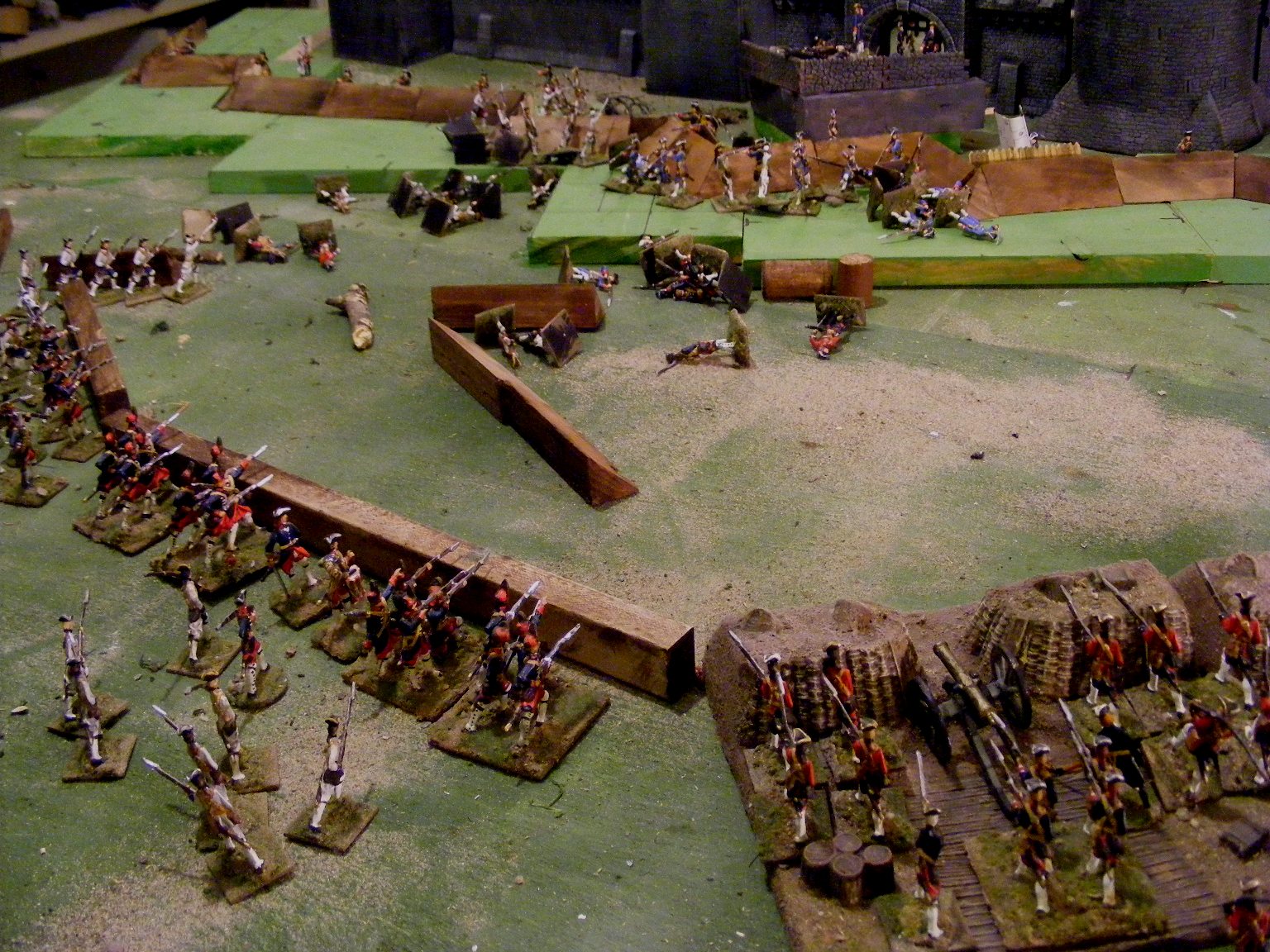
The 3rd game proceeded smoothly with the attackers advancing methodically, alternating batteries with partial parallels and giving the defenders no opening for a successful sortie. At last the 2 armies were entrenched within a grenade toss of each other. It was time to "crown the covered way". The front parallel filled with troops and at the assault went in.
Losses amongst the infantry on both sides had been relatively light to this point and the resulting battle was fierce and bloody. The attackers were not successful every where but they drove enough of the defenders back that they were able to rally then storm two of the redoubts.
On the next siege turn they succeeded in digging breaching batteries into 2 of the redoubts and alongside one face of the Southern bastion. At that point, time was up and we decided that if the fortress was not relieved, it would have to surrender.  
We cleared the rear 1/2 of the table and set up a prison depot for prisoners taken during the storming of the covered way and a small supply depot. Four squadrons were deployed to defend the depots and 1 company of infantry split between the 2 compounds as a garrison. Two additional companies of infantry were detailed  to march from the trenches as a reaction force.

The relief force, an advance guard presumably, was composed of 4 squadrons of cavalry and a light infantry battalion. Their goal was to free the prisoners, destroy the supply depot and inflict more damage than they suffered. The more of these tasks that they accomplished, the more likely that the siege would have to be broken off.


We weren't sure that this was a large enough force but a very interesting little game ensued.  


The relief force caused itself a little trouble by having a squadron ride between the light infantry and their target, the prisoner compound, and then back again, but they managed to throw a squadron of heavies against the heads of two  columns of  light cavalry. After 2 turns of melee, the light cavalry which had been unable to exploit their numbers, were defeated and removed from the game for 3 turns. Beyond them a series of charges between the Allied Hussars  and Fitzjames Horse finally resulted in the Hussars being driven from the field.

Once the way was clear, the light infantry showed its worth by shooting up the garrison until it was understrength  and had to retreat. Unfortunately, the time lost meant that supports were entering from the back just as the jaegers went in the front. An even melee resulted in the light infantry being narrowly evicted.

A squadron of cavalry, slightly weakened by previous shooting, now tried a frontal charge on the remaining company of infantry. A risky business but necessary. The infantry won the toss, fired at short range and fired well. The cavalry did well in the melee but only well enough to draw. They pressed ahead and were suddenly  faced with overwhelming numbers of infantry. By the end of the melee they were understrength.

It was all down to the light infantry. As they deployed to fire on the cavalry, a squadron each of the rallied Carabiniers and Fitzjames Horse crashed into them. Firing high, the light infantry broke and ran. There was to be no relief for Adelheim.


So that was it, another HMGS con over and done. I greatly enjoyed my part in this series of games. Many thanks to all those who played and to my comrades in arms who worked so hard on the fortress and on running the game. Discussions are already underway for next year. The NQSYW may appear again, then as well as before, but look for pikes and cannon the next time I head south.

Unto The Breach - Friday's Siege Games


The Colours of MacDuff's Fusiliers wave proudly as the grenadiers move up for an assault.

When we started out to stage a siege game, I wasn't sure it could be done as an interesting convention game, or an interesting game at all for that matter. The solo play test was enough to alleviate fears on both scores but many questions remained.

Friday Afternoon, the 1st saps are planted.

The original plan called for a 10 foot wide fortress front with 3 bastions and enough pieces were cut to allow for that but once it became apparent that the fortress was going to need over 3 feet of depth, we became uncertain that the remaining space was sufficient for the besiegers. After my play test, I was afraid that a 6 feet front would not be wide enough  for zig-zag saps and batteries but a depth of only 3 feet for the attackers would mean starting at the 2nd parallel at best, in other words skipping the beginning of the siege.  After discussing the pro's and con's we ended up agreeing to lay out a 6 foot front and start the 1st parallel 6 feet from the walls. After the play test, we moved the parallel slightly forward to put it 5 feet from the ravelin, allowing effecting fire by the besiegers from turn 1 (well, for most of the besiegers.)  One thing that became obvious during the playtest, was that the compressed front made it difficult to plant richochet batteries against any point except the ravelin but that the saps were easily enfiladed if the players weren't careful. Both items went into player briefings  and didn't seem to present any great difficulties during the games though some of the saps were less zig-zaggy than our test ones had been. (it was easier to just point them off table and sap forward in leaps and bounds, the end result and purpose was the same.)  We were also afraid that a single 3-4 hour game might not be enough so allowed for a 2nd game to follow on from where the first left off.
Friday afternoon, a second parallel has been planted and the saps continue.

As we prepared for this game, it became obvious that many things had been glossed over or assumed when the brief rules were laid out. How many troops and guns should be used? How many engineers? Could you pack several into a sap? Why are the tactical rules so close to Charge! without being precisely the same? Abridgment or amendment? Can you fight from a sap?

To avoid confusing people, we opted to follow Charge! where ever possible. This meant that guns firing from over 2 feet were inflicting 1/4 casualties rather than 1/2 but, on the other hand, it looks like we might have fielded more guns per foot than Duffy did.

Initially we planned to limit the supply of engineers so that the siege might be ended by losing them all but in the end, we treated them as a limited but inexhaustible supply. The besiegers had 3 each turn, 1 and only 1 of which could supervise a battery or sap. If a parallel were to be dug, even a partial one, each engineer could supervise 1/3rd of it. That  meant that a few lucky 6's wouldn't end the siege but the loss of an engineer meant the loss of a day's work on that section of work.  Rather than fussing about where the engineer was placed and dicing a la Charge! to see which figures were hit, we merely rolled a die with a 6 indicating that the engineer was hit. We did the same for gunnery officers.
Rob and his son, Norman who did the finishing work after Duncan's wizardry with power tools did the basic construction, watch the besiegers sap forward.  (My only input this year was in planning)

When a sortie or assault was announced, we made players declare which troops they were committing. Only committed troops could fight and only against other committed troops. Any troops committed to a tactical turn were not available when we got back to the siege turn. We did consider not carrying out a siege turn if there was a tactical but that seemed like it might encourage the besieger to launch feeble sorties every day so we laid out digging and did troop moves, then resolved tactical combat then finally did the siege bombardment. Troops who had been deployed to dig were not allowed to fire but were allowed to defend themselves in melee. (For that matter, no firing was allowed from a sap and only 1 rank of figures allowed to occupy it. Parallels included a firing step and had room for 2 ranks.) If enough survived the sortie, the sap etc was built. In practice, it was up to the supports in the parallels to drive off the sortie and as in play tests, attempts to drive forward too quickly without supports tended to be costly to the attackers. If an attack, or counter attack, went beyond the initial goals then more troops could be committed once the situation changed (for example, an escalade following a repulsed sortie)

    Friday afternoon, the 3rd parallel is placed  
Once again, Duffy made no mention of reduced moves if "obstructed" or firing but we adhered to Charge! on both accounts. In retrospect, I am interesting in trying Duffy's simplified tactical rules as written to see of it picks up the pace and captures that desperate scramble aspect that I imagine for sorties and especially for forlorn hope assaults. On the other hand, the sorties and assaults were exciting as it was so why mess with something that works?

The last game had to be called shortly after the relentless advance of the siege had led to the defenders being forced out of the covered way with insufficient reserves of men and guns to stop the attackers from planting Breaching Batteries and forcing a surrender  within a few days time. Another hour of play would have reached a more satisfying conclusion but we just didn't have it. Unfortunately, the game had progressed too far to start the 2nd game at that point. After a quick huddle, we stripped every thing back to the 2nd parallel and started the 2nd game from there. All that would be lost would be a few turns of relatively ineffectual fire and some practice at digging. (yes this means we probably could have played across a 3 bastion front, starting from the 2nd parallell, maybe next time.)

 The Grenadiers of MacDuff's Fusilers have moved forward for the Big Push. Supported by the Queen's Brigade, they wait for the word to go........

 "Over the Top" 

So far, the first game had been quite different from the play test apart from the ability of the besiegers to smother the defender's fire. We were eager to see if the next game would be different again.  Oh...yeah! Unfortunately, while I had had my cell phone in hand to take a few snaps of the 1st game, I got too wrapped up in the 3rd game and completely forgot to take pictures!  I'm trusting that Rob who had his real camera out during the weekend will be able to provide some.

Its always hard in a system like Charge! to figure out the exact impact of potentially widely varying combat results dice. In the 2nd game, a pair of veteran gamers, each claiming a reputation for "Cold Dice"  were matched up against two younger but not inexperienced gamers defending the Family Fortress.  I have to say that as far as I can tell, the attackers rolled just as many 6's as the defenders but the defenders rolled 6's while trying to claim special effects or officer casualties while the attackers seemed to like to roll them looking for say "2 or better" to hit, saving the 1's for when they wanted to destroy a gun or do some real damage with a volley of musketry.

The end result was that by the game's end, the attackers who had started with 12 guns to the defender's 9, (hmm wasn't that supposed to be 8?) were out gunned by the end.  That doesn't tell the whole story however as the attackers, despite heavy losses,    sapped forward,  planting a parallel almost crowning the covered way. The defenders launched a massive sortie but the attackers reacted with full force, rushing reinforcements up the saps and across the open ground. The ferocity of the counter attack and the doggedness of the defence of the saps, catching the fortress commanders a bit by surprise. Two thirds of the parallel was delayed by a day but the sortie took such heavy casualties that it restored the balance of power between attack and defender.

Undaunted by losses of time, men, guns and engineers, the siege continued. The parallel was finished and the saps pushed forward. As the defenders evacuated the covered way to conserve manpower, the attackers launched  a surprise escalade of the now undefended ravelin (they had expected it to be lightly held).  It was the turn of the defenders to be caught off guard and forced to choose between abandoning the redoubt and covered way thus allowing the attackers to place their breaching batteries, or counter attack with every available man. Like a ant's nest that had been stirred, men came racing to the defence of the ravelin. A confused melee took place in the gorge of the ravelin, a series of 1 to 1 combats. Its no wonder that I forgot to take pictures, amid such excitement of sorties and assaults. Perhaps if the Rosish troops hadn't been evicted from the ravelin in the end.... 
 
In the next post I will conclude with the 3rd siege and the Relief game.


Wednesday, July 13, 2011

Rolling, rolling, rolling, keep them wagons rolling. Game 1.

I would love to be in a position to present 5 detailed battle reports but alas I took few pictures, no notes  and wasn't on the ball enough to grab the order pads, therefore as memory's lamp is already dimming, only the most vague and disjointed accounts are possible. The only saving grace is that some interesting tactical and gaming lessons remain reasonably clear and hopefully may be of some interest. (More pictures of the games may be seen at Rob's blog and Norman's blog.)  BTW, if any of the players are willing and able to add a comment explaining their plan or relating their experience of the game, please do so) 


The Situation.  Notionally, this year's games comprised a reprisal for last year's Raid on St. Michel.  The Northern Alliance led by Rosmark, has invaded Schoeffen-Buschhagen seeking compensation for damage done. To enforce their demands, they are planning to lay siege to the fortress of Adelheim.  Some of the Pragmatic Allies who had composed the raiding force last year came to the defence of Adelheim,  one joined the Northern Alliance, and the rest stayed home.  (in reality based on what troops were required for the games rather than on any political machinations)


GAME 1. Stocking the Fort. The 1st game was a variation on the Wagon Train scenario from CS Grant's Scenarios for Wargamers played as a straight up Charge! game with 3 infantry or 2 cavalry or light infantry companies/squadrons per scenario unit .  The goal for the Pragmatic force was to get 4 or more wagon loads of supplies into the fortress. The goal of the Northern Alliance was to capture at least 4 wagons.  Their force was the largest but they were scattered and marching on at randomly selected times and places.  As it turns out, they came on in a remarkably compact fashion with only 1 gun arriving from the North.    1 cavalry regiment failed to show but alas it was due to GM confusion rather than the dice.  (Sorry lads!)


The only picture I snapped, Not exactly an ideal shot. There is at least 1 more on Rob's blog.


Four notable things stand out in my memory. 


Light Infantry vs Cavalry. The first was a charge by 2 squadrons of Dragoons upon the Pandours, a light infantry battalion. The authors's commented that a unit of light infantry must shoot well to survive a cavalry charge, and the Pandours had heeded their advice. Winning the toss, they fired at short range and scored incredibly well, despite the 1/2 casualties for cavalry. In the melee, they did quite well in the 2:1 combats and at the end of the 1st round, the melee was drawn with the cavalry being only a few figures above being below strength. I think I would have pulled back, content to have done damage to the light infantry and  tying them up for two turns but the cavalry commander was made of sterner stuff and demanded a 2nd round of melee. Being heavily outnumbered, these combats were all even up. If the dice in the 2nd round hadn't favoured the cavalry, they would have been wiped out but as it was, the final result was a drawn melee with the cavalry being 1 figure above under strength.     


Grudge Match.  The 2nd was a clash between old enemies the Allied Hussars and Rosmark's Yellow Hussars. Last year the Yellow Hussars won every encounter hands down, filling the prisoner cages with Wachovian Hussars. This year, in a straight up fight,  the Wachovians and their Schoeffen-Buschhagen allies routed the Yellow Hussars in 1 turn of melee taking several prisoners and driving them under strength. OH the humanity! At least I now have a reason to paint up a new light cavalry regiment, I'm thinking Uhlans.  Anyone want to buy 20 slightly used Hussars?  I suppose I could just melt down every 1oth man........


Infantry Tactics. The 3rd was an example of simple rules working effectively. It just doesn't pay in Charge! to be in a hurry when the enemy is nearby unless you are pressing an assault.  On several occasions, Northern Alliance infantry, in their rush to get at the enemy, moved forward full speed, in penny packets, either in line, or deploying from column as they went, when the enemy were advancing in good order at a measured pace (i.e. 6") towards them from outside musket range. The result? The Pragmatic infantry were able to unleash their initial volleys without reply. On the other side, the infantry had not only been unable to fire, they had also been unable to close to the point where they could charge next turn without defensive fire.  Luckily for the Northern Alliance, numbers told as wave after wave was fed in  but either an orderly advance in line in 18thC fashion, a massed assault by overwhelming numbers or a rush in column from beyond musket range to within in 3"  would likely have served their purpose  with fewer casualties and more effect.


Command & Control. The last was  an example of how command and control rules aren't really needed in a multi-player setting.  The Carabiniers were tasked with protecting the left flank of the Northern infantry. After some bumping and shuffling, they eventually cleared the way and took up positions just inside cannister range from the forts guns, facing down any attempt to sally from the fort onto the flank of the infantry.  Despite some increasingly less subtle hints that the rules allowed them to fall back the necessary inch to reduce their losses, they stalwartly maintained their position.  Even the approach of the undefended convoy, moving past their flank and towards their front was insufficient to elicit a squadron to run them over. Finally the rallied remnants of the  Schoeffen-Buschhagen Dragoons hit them in the flank just as more cavalry finally sallied from the fort, hitting them as they rallied. 


In the end, the Voluntaires de St. Lambert, under the command of the same player,  pushed through a gap in the lines, nabbed the last 3 wagons and beat off a rescue attempt by the Pragmatic Hussars.  A draw despite the best efforts of both sides.
    
I think this is long enough for 1 entry so tomorrow I will start on the siege games.


Saturday, April 9, 2011

The siege game, after thoughts

There are too many thoughts to squeeze into one post so I'll stick mostly to the rules for now.

Actually the term  "rules" is a bit strong for the Fire & Stone appendix, they are more like guidelines.   At first glance, the rules appear to use Charge! for the tactical rules but it didn't take long to realize that they were just a few charge-like suggestions for basic movement and casualty infliction. Fine if running a game as a sort of kriegspiel with an umpire or Game Master (GM) but if played straight up it calls for 2 amiable gamers who can talk there way to a consensus.

As it was, I changed my mind on interpretations several times during the game, something which changed the details but may not have changed the outcome. Luck certainly played a strong role in this siege as well but I think the result was still largely the result of player decisions, like planting the 2nd parallel too far from the covered way so that it was unable to support the sap heads when they got within sortie range and not taking advantage of the lack of enemy artillery to storm the ravelin.  

At first I wondered if the incompleteness was just an off the cuff summary of Charge!, not meant to be taken as complete, however, considering his comments on how wargames have to be fast paced and that most rules are too complex,  I suspect that it is more likely that he ruthlessly cut out any minor distractions like "obstructed moves", long/close range musketry, or how one decides how long a melee lasts and who won, relying on an umpire's judgement or reasoned consensus. I suppose one could ask but its really just nosy curiosity.

Some further discussion with my co-hosts is needed before Historicon but I think we are aligned with staying as close to Charge! as  possible. Here is a brief list of some of the rule issues and decisions that I made.

1. Artillery.

  • Can guns fire over trenches?  No, except mortars. The saps, parallels and batteries have to be arranged in such a fashion that the guns have a clear line of fire. (This is one of the rules I changed  partway through after doing some reading to support the decision. The No seems to make a better game as well as suiting the evidence as to common practice vs absolute possibility)
  • Can guns move and be fired in the same siege turn? Not the besieging guns which have to be dragged forward along saps or at night through the mud etc. The defenders however will be allowed to move their guns along the nice clear pathways of the fort and still fire.  
  • Does the Charge! rule of 1/2 effect for shot & shell apply (ie at ranges over 2 feet)? Yes.
  • Does a sortie cancel all other firing for the day or can guns not involved in a sortie  still fire or can they fire every tactical turn which is implied? Yes. A battery that has line of fire to a sortie or assault can fire subject to the usual rules but no battering or counter battery fire can take place during a sortie or assault. (again a mid-game change and again one which favours the defence but makes for a better game encouraging an active defence). We are considering introducing 2 grades of artillery and limiting battering walls to siege guns which will not be allowed to fire during tactical turns, not even in self defence.
  • Do the usual Charge! rules for infantry movement and deciding melees apply? Yes. I opted to consider all melees, even those against breaches or saps  to follow the special rules for fortifications rather than those for assaulting breastworks. In essence, this is single combats and no need to rally after a drawn melee. Once an assault/sortie is launched, it will continue until 1 side loses and is forced to retreat, or runs out of men!
  • How is the covered way crowned? This seems to require sapping and assaulting at the same time, otherwise the assault is left standing in the open if it wins or else the defender can just reoccupy the covered way, and that is how I played it with a sap being laid out along the crest of the covered way within 1/2" of the defenders and then an assault being ordered simultaneously.   If the defenders had won then the sap would have been destroyed as well as the attack being thrown back. It was kind of messy though. Next time I think I might play it that the attack has to go in first but that the turn is over once the melee is ended and that attacker can dig in during the next turn.
  • What about light infantry? Light infantry are very powerful in Charge! Not only can they shoot farther, but they get the same protection creeping spread out across the open as their bretheren do crowded into the trenches. Good for Sebastopol with its rifle pits, not so good for Lille. The jury is out on this for the fictional setting but I'm inclined to limit their numbers severely at the very least and the no over head firing rule would apply. 
This was an interesting and enjoyable game and I intend to do more sieges in future, in particular Fort Erie, Bhurtpore, Mooltan and Delhi come to mind. The problem is the old pendulum between elements rules and single figure rules. This has been set swinging again as I contemplate my born again small table, gaming styles and scenarios. 

By rights, given my interests and preferences, I ought to be a typical "Colonial" gamer playing small skirmishes on the outskirts of empire, whether British, Roman or Persian empire, but I keep getting stuck on planning to for bigger battles, especially historical ones, which I rarely play. It is very possible to play enjoyable skirmishes between a couple of companies of troops (or small actions to distinguish them from the 1:1 semi-role playing style of skirmish) using element based rules but the genre is the forte of figure based rules and since one doesn't need to put 500 men on the table, neither movement trays not tedium are major issues.

There is a lot to be said for each way of playing and I see no way to make a sound decision except to play a bunch of games in each style, and luckily, I am equipped for the task.

Ah well, so be it. if I must, I must. Reset the table!


Thursday, April 7, 2011

The Siege of St Lambert: Crowning the Covered Way

After the fury of the melee, both sides took a day to assess the situation while the bombardment continued. On the 7th day the remaining engineer led the sappers forward onto the glacis while the defenders crammed into the covered way. A furious storm of grape and musketry failed to stop the progress.


Sensing that an assault on the covered way was imminent, the defenders stripped the walls, and formed a reserve in the place d'armes, militia, volunteers, regulars, all mixed together. Through the night, volunteers from the Irish company sapped left and right along the crown of the glacis, mere yards from the defenders. At dawn, a fierce struggle between the Irish and the Queen's men broke out as MacDuff's Grenadiers and the remnants of the King's company leapt over the parapet and stormed forward.

The fighting was fierce and bloody but neither the attackers nor the defenders would give way until finally, numbers told. (3 drawn rounds of melee). The defenders used up their reserve and gaps began to appear in their line to be exploited by fur capped grenadiers.  At last, the casualties were too many and the remaining defenders fell back to the redoubt. For a moment it looked like the grenadiers might try to storm the ravelin but they were sternly called back to the trenches.
Over night gabions were dragged forward and a battery position dug in to the glacis to allow a breaching battery to open fire. At long last though the defender's mortar had the range and combined  with the fire of the last gun and the muskets of the ravelin's defenders, the last engineer and all but one of the digging party were struck down with the battery unfinished. There would be no breach, but the defenders had been bled dry and no help was coming.

 
After surveying  the bloody ground and contemplating the losses to his people on both sides of the trenches and the losses to come if the bombardment was to continue until there was no one left to resist an escalade. The King decided to offer generous terms to the Queen Regent, seeking to heal the rift rather than crush the opposition. After pondering the odds (1,2,3 yes, 4,5,6 be damned) she decided to accept.

The Siege of St. Lambert was over.

Thoughts on the game and rules to follow another day.

Tuesday, April 5, 2011

The Siege of St. Lambert : The Grand Sortie

On Day 4 the saps crept closer while the artillery bombard included more sound than fury.


Dawn on Day 5 found the saps starting to climb the glacis but behind the covered way, the Germans and Picard's company were massed with fixed bayonets.


With a roar the Queen's men leapt out of the covered way and stormed the heads of the saps. The besieging artillery unleashed a hurried blast of grape while the sappers grabbed their muskets.


A short but sharp melee ensued. When the dust settled, the bodies of the attackers littered the covered way but both engineers had been cut down and the sapping parties driven back in disorder and the new section of saps destroyed. While the melee was in progress the besieging guns turned their attentions to the walls again and dismounted 2 more defending guns! With their final shots, the defenders managed to inflict 3/4 of a casualty! sighhhhh.


._________________________________________________________________________________

This was a trying turn, the rules are frustratingly vague about exactly how sorties  are conducted, points such as whether or not the siege batteries get to fire at the walls each tactical turn or not aren't addressed and while the rules are very similar to Charge!, the sketchy rules don't match  precisely. For example, in Charge!, leaving the covered way would be an obstructed or 1/2 move but there is no mention of such things by Duffy, nor is there any indication of how a melee lasts or how it is decided. Not big issues if running a game as GM and making off the cuff rulings, but with a group of us running the games  and with both players and GM's being used to using Charge! it made sense to me to stay consistent. I reset the sortie and played it again as straight Charge!.

So now we have a garrison with almost no guns facing besiegers with almost no engineers. Hmm.
You may also notice that the old saps have been torn up to provide new ones. I'm going to have to make more!

On to Day 6!

The Siege of St. Lambert : Days 1 to 3

The Germans and Volunteers man the covered way while the militia assist with the guns.

On the morning of April 3rd, the King's artillery opened fire to be met by the roar of the Queen's guns. The massive mortar nicknamed the Tyrany, proved its worth, dropping a huge shell into the Ravelin from 5 feet away and dismounting the gun  within. The sappers worked their way forward then as night fell, began laying out a short second parallel and a battery, well positioned to enfilade the Ravelin.

The Royal company digs while the Pandours stand ready to meet any attempt to sally. Unfortunately the smoke hanging over the battlefield has made it hard for my cellphone to take a clear picture. 

Over night, the defenders dragged a new gun into the ravelin and prepared to open fire. At daybreak the guns opened again, the defenders focusing their fire on the new battery, pounding it hard and killing or wounding 1/2 of the infantry assigned to dig and narrowly missing the engineer. (1/2 of the diggers and the Engineer must survive to complete the work). Once again the Tyrant proved its worth, dropping another shell into the hapless redoubt, dismounting the replacement gun.

The King's company suffers heavy casualties

On the third day, as the attackers dragged 2 guns and a howitzer forward into the new battery and extended the parallel. The Volunteers tried a few long range pot shots but the enemy were just out of rifle range from the covered way..Having considered a sortie, but deciding that the risk was too great, the defenders hunkered down and decided not to replace the redoubt gun again. It was no use, a torrent of fire against the Round Tower soon dismounted yet another gun. There were loud cheers from the garrison when their return fire smashed a gun in the new battery but the worried Queen took to the tower to survey the scene and ponder the loss of nearly 1/2 her artillery in 3 days.

  The Queen-Regent laments the loss of her guns.

The losses in guns was beginning to worry me too! With a 5 or 6 to hit then a 6 to dismount a gun, the attackers had destroyed 3 defending guns with 27 shots. I didn't keep exact tabs but something like 1 in 3 hits was dismounting a gun rather than 1 in 6. On the bright side, the defenders have lots of gun crews available!

The siege continues!

Monday, April 4, 2011

The Siege of St. Lambert : Back story and Order of Battle

The origin of the dispute between King Michael of Rosmark and his step-mother, the Queen Regent, goes back to the vague terms of her Regency which could be read as meaning that she was to be Regent until the end of her days. The King's party, of course, maintain that her Regency ended when he came of age. in 2010.

The old army, which contained many foreign soldiers, tends to favour the Queen, herself a foreigner while the newer native Rosmark units follow the new King. The dispute surfaced in 2009 at the Battle of Notquitelobositz when the newly raised The Crown Prince Carabiniers and the Ostmark Hussars fought alongside MacDuff's Fusiliers with the Pragmatic Alliance while the Queen's regiments fought alongside North Polemburg. At the time, Prince Michael claimed that these troops were fighting in accordance of the old contract that had seen Macduff's fight for Alliance pay on many a battlefield. 


After a brief clash at Belmont, the two factions came together to repel an invasion in 2011  But now, amidst plans for a retaliatory strike, conflict has broken out again.   The Queen has taken refuge in the city of St. Lambert, the capital of the Dowry Provinces. An interesting development is that both the old Queen's and King's Brigades appear to be split in their loyalties.


________________________________________________________________________________


Having sent her cavalry out into the countryside, the Queen Regent's garrison is composed of the following troops:


6 guns and 1 mortar,
3 Artillery officers,
10  gunners
the Queen's, German and Capt Picard's companies of infantry
the Volunteers of St. Lambert light infantry,
The St. Lambert Militia Battalion.


The King's army musters:


9 guns,
3 mortars/howitzers
6 Artillery officers
20 gunners
3 Engineer officers
12 Sappers 
MacDuff's Fusiliers (1 Grenadier and 3 Line companies)
The King's, Royal and Irish companies
The Pandour Light Infantry (these will not dig trenches but will man them) 


________________________________________________________________________________

The Siege of St. Lambert : Setup

The day began simply enough. Having failed on Saturday to finish the rearrangement of furniture and shelves around the newly shortened table, like a Great War bombardment, the plan moved on towards the production of a 2d cardboard mock up of a possible trace of an 18th C wargame fortress. This was to be followed by a test of the rules in the back of Duffy's Fire and Stone. 

Now I have a fairly weak imagination so a 2D mock up didn't cut it for long, especially once I laid out a few soldiers and guns to test whether or not battalions would hold four guns, each  with their crew of 5. So I dug out some scraps of wood  and raided the bastions and then decided the covered way needed to come up. For years I have recycled those little wooden Moroccan orange crates as storage units and scrap bits for building so I soon had a very abrupt glacis and low covered way. The mitre box was just downstairs so I tried a few cuts so the angles would fit together.  I'm not the one who will be making the actual fortress to be used in July (TG)  so after making some observations and taking a few cellphone snaps, I was ready for phase II. Almost.    

A mock up, just to get an idea of how a wargame fortress might fit onto a table.

A mock up like this didn't seem like a very appealing setting for a game and in any event, it didn't seem "right' to just pitch NQSYW troops on the table without knowing who was fighting who and why. I mean, its not like I could later pretend it didn't happen, is it?

Last week on the spur of the moment, I had postulated a revolt in the city of St. Lambert so I thought a bit more about this and hauled out  my all purpose GW castle that for a dozen years has served as everything from a 54mm Roman fort to the walls of Quebec. As I fiddled  with the covered way, I decided  on earthworks being used to modernize the old city walls and it started to come together. Not having a glacis to match the angles on the earthworks but wanting something to raise it all up, I threw ut some of the off cuts of shelving that I used for the Hook's Farm game and intend to shape into hills once the room settle down and I know what I have left over to work with.

I wanted some form of ravelin in front of the gate so postulated a later attempt to modernize the defenses, some scraps of 1" pine and some toy stone walls did the trick.

The wall looked altogether too regular  and the towers just didn't stand in well enough for bastions but there was that old Hudson & Allan Keep which I had picked up cheap from an Armati opponent at Cold Wars '97.  It doesn't quite fit the GW walls due to the flare at the base (hence the  very noticeable gap) but it looks right. I think I may notch the tower slightly to allow the wall to fit, once refinished, the resulting gap will be passed off as a sewer outlet when serving as a stand alone tower, something for Prince Valiant to use to break in perhaps?

The King's force  sap forward.

Proper fortress guns have been on my to-do list for years, just waiting for me to settle on a period and scale. So instead my usaul make shift clutter of an old Britain's AWI gun (that still fires though weakly),  2 souvenir guns and 3 Barszo guns. None of them are quite right and all but the Britain's need paint but all will serve for now. (There seems to be an improved version of the Barszo gun which may be my solution once I'm solvent again, its that or make one and cast it, I can't afford a full roster of nice 40mm kits.)

Time to consider the besiegers. I had already used many of my sap pieces for the earthworks outside the fort so didn't want to use more. I have some BMC Yorktown battery pieces on hand for the siege batteries as they move forward but the scraps of 1x3 and 2x4 that were left and they just didn't fit. Then I remembered the Barszo New Orleans cotton bale field works. Perhaps wool bales had been used in Rosmark in the previous century?

At this point, it occurred to me that this might have worked better on my now defunct 6x8 table, (The Historicon game will be played on a 6x10) or if I still had my 15mm WAS armies and the vauban style fortress that Dave Wilson left with me but this is my chosen path so I best be able to make it work.  I had deployed the city wall across a 5 foot end, maximizing the distance to the first trenches but still this is barely over 4 feet. I considered doing the first turn on paper with an exchange of fire at 6 feet but decided that it wasn't worth worrying about and shall proceed from this aggressive 1st parallel. It would be good if this game, somewhat smaller than the planned convention one, could be wrapped up with 3 houts of playing time. On to troops.

Charge calls for a minimum gun crew of 4 figures including at least 2 real artillerymen as well as at least 1 officer for 3 guns. Duffy pares this down to an artillery officer and 4 infantrymen per gun with no penalty for untrained gun crews. As I began to allocate militia to help man the guns, it was obvious that I was no where near 2 gunners per gun. I decided to modifiy Duffy's variation to 5 crew per gun of which at least 1 has to be a real artilleryman plus an officer for 3 guns. The defence musters 6 guns plus a mortar, manned by the personnel of 1 field battery and a full battalion of militia. the attackers 9 guns plus 3 mortars (ok 1 huge mortar and 2 howitzers) manned by 2 field batteries and 2 companies of infantry. Not quite the recommended 2:1 but what can you do? As it is there aren't quite enough gunners or room for that many pieces so some are in reserve. The available infantry consists of 1 company of grenadiers, 9 of line, 3 light and 2 militia, nicely dividing into 5 and 10 giving the roughly the recommended ratio for the attackers.

The game was now laid out but my "playtime" was about used up, as I surveyed the table, the tan of the unpainted wood glared at me. Silly to paint it until I know what I'm going to do with it, and I need to cut more angles, and....ok. I quickly gave a wash of Walnut paint onto the eathworks/saps and a bit of grey onto the face of the redoubt. Hardly a finished look but less jarring.

Next post, a short history of the fictional who and why and an order of battle then reports as I find time to play.
The garrison reserve gathers by the mortar to defend the open gate and the tower gap as the enemy saps start to creep across the plain. (hmm must fix those broken gate hinges .....)

Sunday, April 3, 2011

The Siege of St. Lambert : Teaser


The defenders of St. Lambert stand to arms.

This game began as a simple desire to test out the siege rules in Duffy's Fire & Stone but as so often happens, it began to take on a life of its own. It is still an improvised set up cobbling together various bits but now it is a recreation of the famous siege of St. Lambert in the Second War of Accession. 


More to come.