Click on pictures for larger size. Depending on your machine, you can use your figures to enlarge or shrink the picture, or there may be a '+' on the picture which will expand again and allow you to slide the large picture to see all of it. Click on the header arrow pointing left to go back to the regular screen.

Showing posts with label Rosmark. Show all posts

Friday, October 19, 2018

Clearing a Road Block

The scenario chosen for this  game was Triple Line from One Hour Wargames. Since I was still on the fence a bit about the exact plans for these figures, I kept the game small, but increased the army sizes slightly so that I could  use more than 1/4 of my table. The rules were Hearts of Tin using variable moves but no command control mechanisms.  

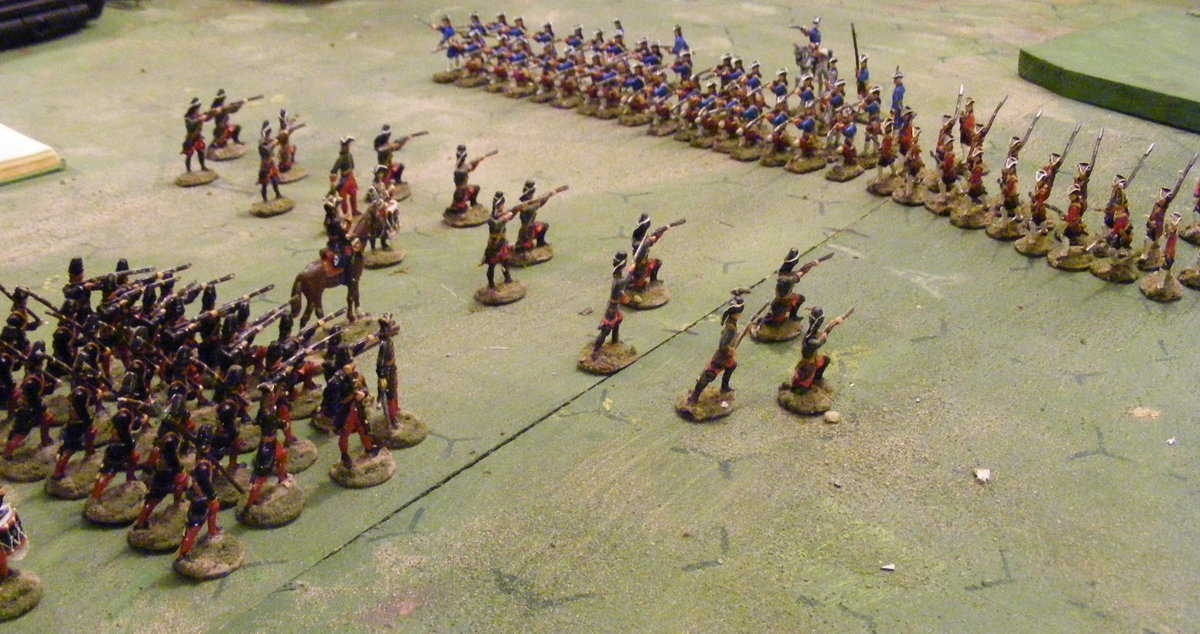
The Rosish forces have forced the bridge but crossing over the bridge and deploying for battle is taking longer than expected though the Maritime forces are content to wait.
The game wasn't bad though the Maritime Alliance forces thrashed the Rosmark army without even trying.  As far as practical matters, my preference for fixed multi-figure stands over loose figures on trays, magnetized or not was confirmed. Its not all physical or logical though there are some psychological and emotional or aesthetic aspects to my preference.

Anyway, this game helped confirm my decision to leave a contingent organized as proper Charge! units to join in NQSYW convention games in the US while once again organizing the rest for my own use at home rather than having the whole collection organized for Charge! games when I don't have room at home.
The Rosish general gets desperate as the day slips away and throws his army in piecemeal as they come up. (At this time my battery went out and I had to grab an old phone which just can't cope with the bad lighting.)
Anyway, I still like the variable length moves in Heart of Tin but...... given that all the units had a 6"  frontage and would thus fit the table grid, fussing with measuring and finding the tape and all hardly seemed worth the effort.

The Marshal's Horse braces for the 3rd charge by the Yellow Hussars while the infantry fight gets fierce and bloody. 
So, once the game was over, I removed the cloth and reset the table.

So....Hearts of Tin on a grid or SYW Square Brigadier?

Tuesday, July 11, 2017

Awkward Squad

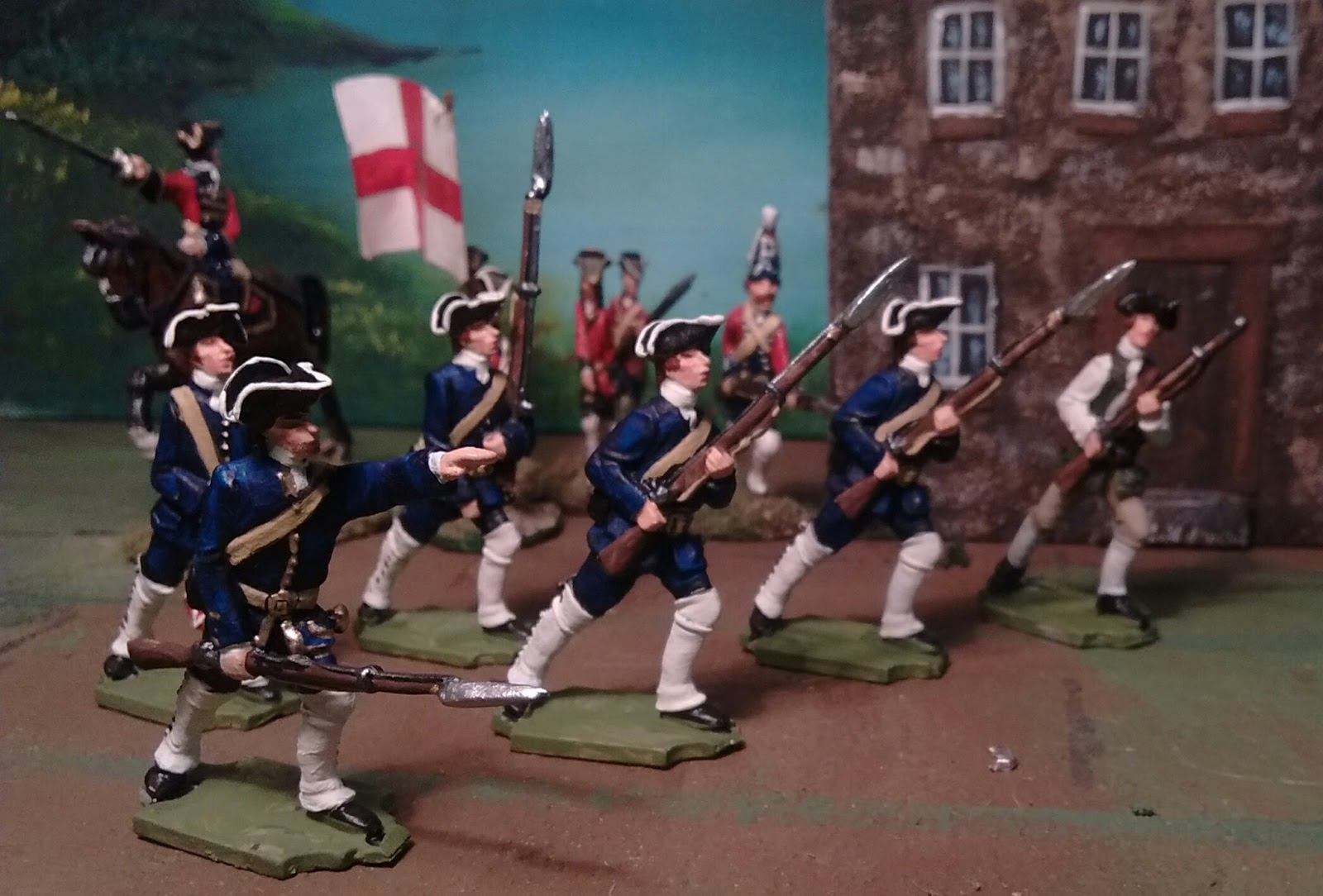
These lads have just been recruited into the First Provincial Regiment of Rosmark. Unlike the Household Regiments which are largely recruited from abroad, the Provincial regiments are raised in each province and provide garrisons for its fortresses and towns as well as providing troops to assist Customs Officers and Magistrates. They even provide a service battalion for the King's field army if called upon in time of war but traditionally only for service in Rosmark.
Rosmark First Provincial Regiment in training.

Every now and then a new unit just seems to struggle into existence.  The trouble with these lads goes back to the accidental order of an Austrian infantry mould when I had meant to order the Hungarian one. In order to make use of it I decided  to raise a Rosmark Provincial regiment. I also decided  to use the Russian tricorne head which is clean shaven with a nice pointy tricorne but of course, once I got busy casting I forgot why I had pulled out the Russian mould......

The moulds poured well with few faults but once I started cleaning up the castings, I found an uneven number of poses amongst the good figures. I'll have to even it up with the last batch.

Then I primed them and noticed the mustaches. Oh dear. So I scraped the faces and reprimed, not perfect but I was in a hurry to get started painting, hoping to finish before I went away for the weekend. Things just continued from there with all the sorts of little errors and difficulties, awkward angles, missed bits, stray brush strokes etc that can occur. Anyway I ended up putting them aside until I got back and finished them today.


Not exactly my best work ever but they'll serve. Now to cast 6 more with the right mix of poses to have a 16 man unit with rear rank supporting arms and front rank charging.

Thursday, June 15, 2017

Meanwhile, bubbling away in the back ground.

After a thorough examination of various organizational and rules options for this upcoming campaign, I have decided that the optimal choice is to conform with my existing Charge! units and work the rules and scenarios around that organization.
A skirmish from 2012 (click for report)
I envisage most games being skirmishes, like the most recent game , and the "Anything to Declare"  New Year's Eve 2012 game (shown above), with around six units and detachments  per side, with the occasional pitched battle game, like the 2012 Wentworth Pass game (shown below). having double or even triple that.

The Battle of Wentworth Pass from 2912.

To be more specific, each of my Charge! Regiments which are formed by two 19 figure "Companies" plus an HQ group will form a "Brigade" with two 18 figure "Battalions" plus an HQ  including the colours and drummers. I will also allow small detachments for garrisons, wagon escorts and the like. For light infantry, I plan to add three command figures to each Charge! company and field them as two nine figure detachments. These are of course paper strengths.

The Old King's Brigade, 15 year veterans of many a stricken tabletop,  using temporary movement trays. 
With an organization and level of scenario in hand I turned back to revisit rules options. After much rereading of old battle reports and old rules and much pondering about the desired "feel" for this campaign I have forced myself to narrow it down to two choices:
  • Use Lawford and Young's "Charge!" 
  • Update the 20th Anniversary edition of "With MacDuff to The Frontier" to include explicit "Skirmish" and "Battle" options as I was considering in 2014. 
Luckily, since these rules will both work with my organization and basing, the choice may be made game by game  according to my mood and the scenario.

Flexibility is good.

Tuesday, June 6, 2017

Battle of Newlanding: War comes to the Colonies

What follows is an extract from MacDuff's "Illustrated History of the First Furland War" .

Once the picquet on the bridge opened fire on the approaching Chasseurs, any hope vanished for a peaceful resolution to the confrontation between the Duchy's mercenary garrison and the King's Advance Guard.
"It was on the 6th of June that Colonel Konrad led his Pandours out of the North Pass and appeared just south of the little port of Newlanding. The settlement at Newlanding is small and only the presence of a small Duchy fort gave any hint of the outport's importance. It is the only seaport East of the Hye Mountains and west of the Great Marsh. The port is connected by road both to the North Pass which leads to Rosmark during the eight months of the year when the pass is clear of snow and to the villages scattered throughout the interior of Furland. The Colonel's orders were to seize and hold or destroy the bridge over the Blough Taip* to prevent all trade not licensed by the King."

*Note: Many large streams and small rivers in Furland are called Taips by the settlers. It is derived from the native term Tae Ap or fast running water.

Unable to stand the combined fire of the Pandours and Konrad's artillery, the bridge picquet fell back as the relief companies arrived.
"As reinforcements rushed forward, a bloody firefight developed with heavy losses on both sides. The King's Pandours seemed to be made of sterner stuff than their Irish mercenary opponents and time after time their companies reformed after heavy losses and returned to the fight. "

In the face of a fierce fire from the Irish Grenadiers, supported by local volunteers, the Pandours begin to waver.
"Finally Colonel Konrad stirred himself. He sent his lancers over the Taip to flank the stubborn Irish Grenadiers and led his last reserve forward for an all out assault. "

Victory hangs in the balance.

"The Lancers dashed across the Taip at a gallop but were met with a hail of roundshot from the fort's artillery and a volley from the rallied piquets and were driven back. Under a hail of fire from the Grenadiers and Volunteers, the Second Company of Pandours began to waver and Colonel Konrad had to rush to their head and hold them to their work with oaths and coarse words amidst a cloud of smoke."

"The steadest volley of the battle then erupted from the two remaining Pandour companies and the Grenadiers broke and ran. A round or two from the gun was sufficient to send the remaining Picquets flying back to the fort while the volunteers ran back to get their families and valuables on board ship."

With the bridge destroyed the Pandours fall back.
"Judging his remaining force insufficient to take the fort or silence the guns and uncertain of what enemy reinforcements might arrive by sea, the Colonel ordered his men to break down the bridge which they did under a desultory canon fire. With that done he retired to the crossroad and made camp."

Saturday, June 3, 2017

Imagineering is hard work

A rainy Saturday? Perfect. Time to let MacDuff out for some exercise, just have to pick a scenario and grab some units. Now, no more Acadia, this will be using my Rosmark troops against...ahh.....hmmmm..uhhh...oh. The planning hasn't got that far yet. Hmmm.

After rejecting various scenarios and since I was tired and fuzzy headed, I decided to nip out to the shed to cast up some of the new PA French and then do some painting instead of playing a game. Once I had enough figures for two MacDuff companies, I started thinking about uniform colours, choice of hat styles and campaign factions. Which side are these going to be on now? Will they be regulars or militia?


Bright Harbour on a June Afternoon.
(What is up with this f@$#@Samsung? I may have to try to teach myself how to use the manual camera settings on it.
)

Wargaming in a known setting is so easy. You've got a selection of units from known opponents,  just plunk 'em down and this little skirmish won't affect known history. But with a not yet defined campaign where you're not even sure who is fighting who let alone what their uniforms are, well that's a different matter. Every skirmish and battle to date has affected and shaped how the backstory has developed and its all on record and so will all future battles.

Some days it does seem as if I like to make life difficult for myself. Keeps it interesting though.

After a considerable period of pondering uniform colours and hat and coat styles as well as my stock of moulds and planned, possible future purchases, I decided this all needed more thought and planning.

So far, all the Rosmark Wars of Succession games have been fought using my normal Rosmark units on both sides. Going ahead I would like to develop a distinct style for each opposing faction without negating any of the reported facts to date if possible.

There are three possibilities that I am considering:

a) Have all native troops on both sides continue to use French styles with mercenaries and allies in foreign styles and with a mix of coat colours on both sides.

b) Reconcile the Maritime Duchies with Rosmark and invent a new enemy in distinct uniforms.

c) Return all the original Rosmark (French) units to the King leaving only the 2 units of brown coated militia which used the old PA Rossbach generic musketeer figures with open coat and some cavalry and gunners, then add new Maritime Provinces units from new Austrian and Prussian moulds reinforced by British should they appear.

So I turned back to the table and started pushing terrain and ideas around until....

Pandours! Sound the alarm!

Somewhere East of the great Hye Mountains, a detachment of the mercenary Irish Regiment, still in the pay of the Maritime Provinces, form the garrison of a fort guarding a Maritime Province trading post.

All is quiet until a column of the King's Pandours appears from the road running West through the mountain passes to Rosmark. Rosmark is at peace, what does this mean?

The long roll sounds and the garrison turns to.  

Wednesday, October 7, 2015

Rebellion Reappears in Rosmark

With the latest invasion attempt by the Pragmatic Coalition having been handily repulsed at Portland <click> in May, the always simmering civil unrest has boiled over again in Rosmark.

New recruits, just off the boat from Ireland, begin training as a Light Company is added to the Irish Regiment. They have removed the red uniform coats to facilitate the rapid movements required by skirmishers. In the background a rebel volunteer in civilian dress can be seen following along.


The root of the problem lies in the 2nd marriage of the current King's father to the Duchess of St. Lambert, capital of an area commonly called The Maritime Provinces. Upon the death of the old King, the new Crown Prince claimed the provinces, referred to in Rosmark as the Dowry Provinces, as part of the Kingdom of Rosmark by inheritance. The provinces rebelled claiming independence and were initially joined by the Dowager Queen who maintained her right to the title of  Duchess. The young King besieged the Queen in St. Lambert, <click> reaching a negotiated truce before leading a Northern Alliance expedition to capture the fortress of Adelheim <click> in retaliation for the  previous year's invasion by the Pragmatic Alliance which was repulsed at St. Michel.<click>


 After a few clashes <click>  the Dowager Queen and the Young King reached an agreement by which she was to retain the title for the rest of her life after which it would fall on King Michael. To everyone's surprise the Maritime Provinces disagreed and the war went on. <click> Two years later the threat of yet another invasion by the Pragmatic Coalition led the rebels to acknowledge the King's right to inherit and a contingent of troops in the pay of the Maritime Provinces contributed to the victory at Portland. Soon after it became clear that the two sides had not understood each other. The king claimed that the Provinces were now part of Rosmark and thus subject to his rule while the Parliament of the provinces declared that they had merely assented to allow him to inherit the honourary position of Duke  with purely ceremonial duties and no right to make laws or levy taxes.

Both sides are raising new troops.

Friday, November 30, 2012

NQSYWS: Pandours Trooping the Colours

The new colour is trooped so the rank and file can see it.

At last! Something has been painted!  I won't bore everyone with whines about  all the non-wargaming stuff that has been distracting me this fall. Lets just say was -10 Celsius outside last night and felt like my gaming/painting room wasn't much warmer. Winter is coming on apace but at last there is a glimmer of light and heat ahead!

Anyway, late last summer the War of Rosish Succession heated up. One of the outcomes of the Battle of Wentworth Pass was a decision to promote the Pandours from Militia/Light Infantry to Line Infantry by adding 8 privates and a Regimental Colour. That has now been done. In keeping with Rosish tradition, the flag consists of a coloured cross on a white background. (Yes I know Russian and Prussian types will be scratching their heads saying haven't you confused the field and the cross but no this is a black St. Windmill's cross on a white background.).

I just need to cast and paint 12 more Grenadiers and a company of light infantry and the Rosish infantry will be up to scratch. There is, however, some questioning of the decision to form a light company for the Irish regiment and wide spread support for a Light Company for the Pandours instead in recognition of their past service and their origins in the highlands of the frontier. This would not necessarily mean a change in overall numbers but would mean a departure from a standard 4 company organization if there wasn't. There is even support for more National regiments in traditional garb, possibly as a reaction to the heavy foreign influence under the late King.  

The 1st National Regiment (aka King Michael Pandours) form as a line battalion for the first time..

Friday, September 28, 2012

Some talk of Alexander, and some of Hercules

"Of Hector and Minnow  and such great cats as these.
 But of all the world's great heroes, there's none that can compare
 With a tow, row, row, row, row, row,
to the Rosish Grenadiers."


The first platoon of Grenadiers, formed from some of the PA Rosbach  molds.

The first platoon of the King's Irish Grenadiers put their coats and pants on 18 months ago, their gaiters and hats yesterday. Hopefully they will never be asked to dress in a hurry.  Now to cast up 10 more plus a drummer and sergeant and a Mounted Colonel for the combined Grenadiers.

While savoring the last game and contemplating practical options, I've decided on a reduced, achievable short term goal. The basic Charge! structure for line infantry and grenadiers is a 60 figure Regiment composed of 3 identical companies. My ideal would be 8 of these per side plus light infantry, guns and cavalry which tops out at about 3,000 figures or about 10 times the number of figures I had on the table last weekend. I've known for a while that I'm never going to build that and haven't got room to play with it if I did, hence the various head scratching while I decide which alternative is the best for me.

The alternate structure in the book is a mixed regiment of 1 grenadier, 2 line and 1 light company, about 75 figures and this is my current target but only 4 full  regiments not 16 and then 2 "National"   battalions each of only 2 line companies. The "National" battalions will be formed by promoting the Pandours and the Brownstone Brigade which both deserved the honour (This involves adding 4 figures to each company plus a flag for the Regiment).

This will give me  a total of 4 Grenadier, 12 line and 4 light companies, ample for Civil Wars or to contribute contingents as needed for service with the Northern Alliance. When I get that done, then I can think some more about expansion and a larger table.

and now back to the song,( that's Hector at the top of the page btw ):


I understand that the song was so popular that some other countries made it as their own..


Sunday, September 23, 2012

Wentworth Pass 4 : A long and bloody day.

In the old Rosmark army, there were two crack infantry units, MacDuff's Fusiliers, especially the Grenadier Company and the St. Lambert Volunteer Light Infantry. At Not Quite Lobositz, where Rosmark units first found themselves on opposite sides of the table, it was MacDuff 's that was given the task of driving the Volunteers from the Lobasch Hill and drive they did, inch by stubborn inch. It is perhaps interesting that  while even the Queen's Regiment rallied to the defence of the realm against the Raid on St. Michel, the Volunteers took no part in that campaign or in the retaliatory strike against Adelheim. Now MacDuff's and the Volunteers were pitted against each other again. 
MacDuff's Grenadier Company on the left, St. Lambert Volunteer Light Infantry on the right.

The Grenadiers were eager to go at the foe with the bayonet but their officers knew that the veteran light infantry was unlikely to be caught and so they relied on the iron discipline of the Grenadiers. Step by step they drove back the light infantry while platoon volleys rippled up and down the line. Fire and advance, reload, fire and advance, reload. The sergeants pushed the rear ranks forwards and closed the files as the 'pop pop' of aimed fire from the skirmishers took its toll. At last, the Volunteers couldn't take anymore  and their short dashes to the rear became a race for safety.   Wheeling left, the Grenadiers marched in support of the Pandours attack upon the Pensioners, the last barrier on this flank.

The green coated Staarborde Battery opens fire at last 

After the brief lull, the battle was renewed with vigour. On the plain, the Rosish artillery had been shifting position constantly, occasionally getting off a quick round before the enemy  pulled back behind the crest or friendly troops blocked the line of fire. At last they manhandled forward to get clear of the King's Brigade, just as a clear line of fire opened to the Queen's Regiment. Was the gap wide enough? It was, by the narrowest margin though some suspect that the gunners didn't really care if they bowled over a few white coats on the way. Could they get the guns into action quickly enough? Evens to move and fire, no problem for these well trained crews (the Queen's gunners failed to manage a fire and move all game), long canister range, 2's to hit, no problem, roll for effect, 2 dice, 8 hits. The Queen's Regiment, already pounded by the light infantry, the Irish and some earlier roundshot, had had enough. The pass was close at hand and they fell back through it (below 1/2 strength).

MacDuff's, now recovered from the tremendous volley that had hit them as they crested the hill, rushed down hill with the bayonet. Beyond them, the Yellow Hussars spurred forward in support but were met by General Darnly at the head of his 1/2 squadron of Carabiniers. A sure sign of desperate times when  a General draws sword in this age. The Hussars knew they were outmatched  by the weight of the Carabiniers but with the sharp sabres they cut down the General and his Kettle drummer and held the heavy cavalry. An audible sigh of relief went through the ranks of the militia, whether it was because the Hussars were held or that they were now free of the General's meddling has been a matter of debate in the taverns of St. Lambert.

(Aside: During my Middle School Period of wargaming, I was put off by the lack of any role for Generals in Charge! despite the presence of these being laid out. An interesting omission considering that the rules were written by senior officers with combat experience who were also historians and teachers at Military College.  Much later, after much learning, I can extrapolate that the authors intended for the player to BE the general and that, like with morale, he should not hide behind the failings of the little plastic or metal figures on the table. Also, that while individual subordinate officers are important, modern armies, and I include the 18thC here, had structure and that no one man is irreplaceable. If a Brigadier falls, the Brigade may be momentarily affected but it does not stop functioning, the machine carries on. Given that turns average out to about 1/2 hour, it is below the grain and swept with many other things into dice that help decide whether an attack succeeds and fails, It is design for effect.)

"The Brown Stone Brigade", the St. Lambert Militia earns a new nickname.

All that remained was for the Fusiliers to sweep away this one company of militia and the road would be open with time to make it through the pass by night fall. The Fusiliers had stormed breaches and batteries, and had captured cannons and colours from the veteran soldiers of the Pragmatic Coalition. It was a sure thing, a done deal, despite the heavy losses and steep climb, or was it? As the Fusiliers slipped and slid down the hill, all order lost, the Brown coat militia stood and fired like madmen, the flashes of their muskets close enough to burn the coats of the Fusiliers who could make no effective reply. Suddenly, like the turn of the tide, the flood of Blue clad soldiers, slowed, stopped and then suddenly retreated. Silence descended, such a thing was unknown! MacDuff's Fusiliers  were repulsed! Later Colonel Brown was heard describing the sturdy burghers, merchants and tradesmen of his militia as being "as sturdy as their Brownstone Houses" and so the proud militia adopted a new name, "The Brownstone Brigade".     

The Pandours storm the heights while the King's Brigade creeps onto the ridge.

All hope was lost of capturing the South Ridge before dark but the center appeared open and to the North, the Pandours were pressing the Pensioners. Keeping the new tactics in mind, the Pandours pressed forward at full speed, not stopping to fire. The old veterans stood steady in the ranks but they must have been aware of the gap on their right and the stream of wounded and stragglers heading toward the pass. As the Pandours approached to 3" they unleashed a ragged volley. Moments later the wild Pandours charged with savage cries. For a moment the Pensioners held, then those who could, broke and ran for the pass. The Ridge was captured and the way was open. While the Pandours reformed and looted their prisoners and the bodies of the slain, the Grenadiers rushed past them to seal the victory.

By now certainly the King's Brigade would have swept away the handful of infantry and gunners struggling to keep a gun in action, blocking the road. Surely? But where were they? Still parked in the pass, feebly file firing at long range with little effect. Colonel Arnold, their commander, later claimed  that the single contour hill had slowed him down too much and that in the gathering dusk, he had thought he was in close range but unable to reach the guns with a charge. Less kind voices muttered that the White coats who had served Queen at Not Quite Lobositz, alongside the St. Lambert Volunteers, the Queen's Brigade and the Pensioners who had been part of their Brigade then but now stood on the hill above them, had been unwilling to face the canister and reluctant to inflict damage on their former friends.  Moreover, it is noticed that despite several turns in cannister range, the Brigade emerged from the battle almost unscathed  and it is being suggested that Colonel Arnold intends to join the Queen and take the Brigade with him.

Night falls on the pass.

So as the sun set behind the mountains and darkness rapidly descended. The King's army made a camp on the hills they had stormed. The King ordered the bells rung to celebrate the victory in which his men had stormed and captured the ridge but it did not go unnoticed that while there was a somber mood in the King's camp, there was a jubilant  mood in the Queen's camp as new recruits flooded in. Patriots and loyal subjects had met the best of professional soldiers in battle and had held them all day.

(The victory conditions are just a bit vague if not contradictory. By the strictest of reading the Queen's troops had to still be holding the ridge on the last turn so technically the game was a marginal Pyrrhic victory for the King due primarily to getting 11 turns instead of 9 but on the other hand, the Queen's troops still blocked the road and none of the King's troops had actually exited despite the extra turns and they had suffered staggering losses and disorganization. I leave it to the historians to judge).


Saturday, September 22, 2012

Wentworth Pass 3 - Battle Begins

.It was in the fall of the 2nd year of King Michael's reign that Civil War once again awoke in Rosmark. The Council of Free Cities of the Maritime Provinces declared Independence from the Kingdom of Rosmark and invited the Dowager Queen to rule them as constitutional monarch. King Michael dispatched his army to bring them to heel. Needing time to muster the milita,  the Queen dispatched what troops she had to Wentworth Pass to hold back the Rosmark forces until dark.  

(Note: The scenario calls for the attacker to control the ridge and be able to advance past it with at least 2 units by the time limit which they suggest might be equal to the amount of time it would take to cross the table + 50%. In Charge!, infantry in column of 4's can move 15" per turn, I calculated 6 turns to march on, cross the 5 ft table and exit. Not liking a definite limit or a diced ending and being notoriously forgetful at ticking off turns, I made a deck of cards the first 8 in order, the next 5 shuffled with 1 being a joker which would indicate last turn. With hindsight, this may have been generous by a turn or 2, perhaps 7 + 4 would have been fairer but at any rate the game ended with turn 11.)    

The entrance to the pass is fairly open a few scattered woods amongst open moorland and then a ridge of steep hills with a narrow gap. Movement up or across the hills would slow troops by 1/2 but convey no other benefit. General Darnly commanded the Queen's forces. He sent the Volunteers out to find a suitable ambush position (Diced for once Rosish forces arrived, 1,2 wood on the left, 3,4 wood in the center, 5,6 somewhere on or behind the hills to be diced for later.)  Darnly placed a gun on the forward slope in the center, firing straight down the road. Behind the gun he posted the Queen's Regiment 40 strong all ranks, to the left in defile behind the hill, the Pensioners, 20 strong  and  on the right, also in defile, the St. Lambert Militia 32 all ranks. He took post in the center with 4 Carabiniers as an escort.

It was past noon when the Rosish forces arrived.  The light company of MacDuff's Regiment, 15 strong, led the way supported by a 9 man squadron of the Yellow Hussars. Behind them in column came MacDuff's Grenadiers, 19 strong, then the Irish and MacDuff's Fusiliers each 41 strong. The 2 guns of the Staarbord Battery followed, then the Pandours, Irregular infantry (militia) 32 strong and finally the King's Brigade, 41 strong. The veteran General MacDuff, honorary Colonel of the Fusiliers, was in command.


 The destruction of the Light Company. The red coated Irish form attack column in the rear.

MacDuff''s light company had spent the last 8 years as line infantry and it seemed their skirmishing skills could use some polishing. Pushing straight up the road, they came under artillery fire and responding by rushing forward. A duel at point blank range with a field gun and 3 times their number of infantry led to their swift annihilation. The Queen's Volunteers on the other hand, ambushed the Yellow Hussars and then threatened the flank of the main column, requiring the Grenadiers to be detached to deal with them.

The normal Rosish tactics call for a deployment into line to engage in a firefight with a reserve live to exploit success. Here, there was no time and the regiments were hurled forward at the ridge in column of companies. The Irish led the way, straight up the road. It was expected that the light infantry would protect them during their advance but in their absence, cut up first by grape and skirmish fire and then by musket volleys, it was clear that a column assault would fail. Hastily the Irish deployed into line while under a heavy fire.

To relieve the pressure and hopefully open a way for MacDuff's Fusiliers, the Yellow Hussars were sent against the militia on the flank.
 The militia fight surprisingly well. MacDuff's can be seen beginning their ascent in the background.

The Hussars, confident of victory, forced  their horses up the slope. The militia, determined to fight for their independence, wheeled one company in line to face them while the other waited for the Fusiliers to climb the hill. A disciplined volley brought down 1 Hussar (they rolled to fire at close range) and in the combat that followed, despite the Hussars doubling of their dice, they tied two of the combats. They would be driven from their position but would be intact. The Hussars pressed on for a second round. Again the militia fought well and when finally forced to surrender a prisoner and retreat, they had held the flank long enough and would be ready to fight again before the day was over.


 The fight in the center. In the back ground the Grenadiers may be seen slowly driving the Volunteers back, whittling their numbers. 

While the cavalry struggled on the flank, the Irish struggled to deploy under fire but were broken and forced to retire in disorder. MacDuff's Fusiliers with 40 veteran regulars against 15 militia pressed up the hill firing as they went but the aim of the militia was deadly while the Fusliers, winded by the climb shot wildly. .
On the left the Pensioners crest the hill and open fire on the Pandours while in the distance the Fusiliers crest the hill and prepare to charge down into the militia. 

With the repulse of the Irish there was a lull in the battle. Faced with deployment of the Rosish artillery, the Queen's troops fell back behind the hill and dressed their ranks while MacDuff brought up fresh regiments to hurl against the ridge. As the Fusiliers crested the ridge they were met by a fierce blast of musketry (boxcars on 1.5 dice giving 9 hits).  They were near the breaking point (50%+1)  but they were close enough that the enemy would not be able to fire again before they crossed bayonets (no firing  against a charge that started within 3", an important rule for columns to remember since defensive fire counts for winning or losing a melee)

The sun was low on the horizon, if this attack failed, was there time for another?  (to be continued)

Wentworth Pass 2: Simultaneous Solo Blues

One of the things I enjoy about Charge! is the way the simultaneous moves using written intentions introduces player vs player rather than player vs dice friction. There are all sorts of  ways around this when playing solo but none of them exactly reproduce that mental challenge of trying to guess what the enemy will do.

Some people just work out the best options, some dice for initiative and then just do each side in turn, like I do for HofT games, others play one side and program the "enemy" or dice for what each unit of the enemy will do, and I'm sure there are lots of other options.

Here is the situation at the start of turn 3. The defenders, underestimating the speed of the enemy advance  have left a gun forward without adequate support. (To be fair to them,  I planned to use 2/3rd distances but changed my mind on turn 2).


Up to this point. I had been dicing to see who would go first each turn with each side declaring charges before either moved. But here we see a typical dilemma. The Gun is about 14" from the closest skirmishers of MacDuff's  light company. These are close enough to be able to move 8 infantry to within close range of the gun and declare that they are firing, thus silencing the gun, or they could charge the gun. Behind the skirmishers is a squadron of Hussars which is close enough to charge through the light infantry into the gun. Neither enemy is close enough to pin the gun so it could choose to withdraw but a bold player might leave it in place and move up supports. To complicate things, if the Hussars charge but the gun retreats they will be at risk of being shot up either by infantry in front of them or from the light infantry that ambushed them from the wood last turn.

I was originally planning to dice for initiative and make alternate moves but it just lacked something. When I play Charge! against Lentulus. he seems much better at predicting what I will do than vice versa and with fairly open terrain and a force 1/2 the size of the attacker, this scenario seems slanted against the defence, so, I decided to make the attacker declare his intentions first, then I will decide on the best and 2nd best option for the defender, weight them and roll to choose. In this case the Hussars moved to the other flank, the light infantry came forward to silences the gun but it manhandled back 6" with an even chance to fire while the defending infantry moved forward and fired.  

But I'm getting ahead of myself. The next post will cover the set up, forces and opening moves.

Friday, September 21, 2012

Battle of Wentworth Pass - Teaser

The Dowager-Queen's Army waits. The Light Infantry on the tray at the back of the table aren't really there. They are secretly lurking in a wood elsewhere on table. Shhhhhh..

Scenario 1 from Wargames for All Ages by Stuart Asquith and Charles Grant. When push came to shove, despite rumors, the old King's & Royal Companies remained loyal so the Queen's army consists of: The Queen's Germans, Capt. Picard's Company of Pensioners, The St. Lambert Militia, the St. Lambert Volunteers Light Infantry and a gun of the Foot Artillery.  Having noticed once again that Army Commanders are allowed a cavalry escort, half a squadron of Carabiniers has been assigned to General Bothwell until a permanent escort is raised.

Thursday, September 20, 2012

Imagineering can be hard work

There is an attraction to inventing history but there are times when it would be convenient if I had access to a Complete History of Rosmark. Unfortunately I haven't written it yet.

I was quite happy with the ideas that came to me yesterday and while they were on the right track wargaming wise, something didn't feel quite right imagi-histroically, so I went back and checked what records there are. I'm now starting to wonder if I have been subjected to misinformation if not propaganda as regards the support shown by the military to the Queen.

The last engagement between the two parties was the Siege of St. Lambert. During that battle, of the 10 Regular Infantry companies, 7 fought for the King including the Irish. Only 3 fought for the Queen, 3/10 being hardly what one could call  a strong majority. In fact, when we look closer,  nearly 1/2 her forces were composed of volunteers and local militia. So who is this Queen and if she is foreign where exactly is she from and who is fighting for her and why?  (An atlas of NQSYW Geography would be nice.)

The Second Company of the newly promoted Royal Irish Regiment. In front may be seen the sample Grenadier from last year, behind is a member of the original Irish Company. The rest of the first company will be getting new lace, belts and buttons added this weekend.

I noticed that the Queen is now being referred to as Dowager Queen rather  than Queen Regent. Presumably part of the Treaty of St. Lambert involved recognizing King Michael's right to the throne? So what else is there to fight about? Well the use of Dowager, implies property rights, and in the circumstance of a foreign bride, strongly suggests a Dowry. Ahhhh, now it becomes more clear. I think I was beginning to think of her as a Catherine, fighting to keep the throne of a foreign land but I suspect it is a case where St. Lambert and the surrounding coastal provinces along The River (so much we don't yet know, like the name of the river) were included as part of her dowry when she married old King Kohl, Michael's father by his first wife who died giving birth. The question then was of the terms of the Dowry and of the King's will. Are the Dowry lands a permanent part of Rosmark? or did they revert to independent status on the death of the old King?  While the lawyers argue, it seems that the question has been submitted for resolution by combat.

So how are the forces really arrayed?

King's Army:

MacDuff's Fusiliers: 1 grenadier, 2 line, 1 light company
Royal Irish: 1 grenadier, 2 line, 1 light company. (only the line being ready for service)
National Regiment 2 line companies  (being raised)
Pandours 2 militia or light infantry companies

Yellow Hussars 2 LC squadrons
Gendarmes 1 HC squadron
Fitzjames Horse 2 HC squadrons

4 guns
1 platoon of Sappers and Miners.

Queen's Army
(a little make shift and temporary at this point)

Queen's Guards 1 Grenadier (borrowed Hessians for now)
Queen's German Regiment: 2 line
Royal Regiment: 2 line
Pensioners 1 line
Voluntaires de St. Lambert 1 LC, 1 light infantry
Loyal Sharpshooters 2 light infantry
3 Militia Battalions (6 militia)  (borrowed AWI for now)

Carabiniers (2 HC)
Oreleans Cavalry (1 HC)

4 guns.

Neither of these lists are sufficient or permanent  but they will get me going and by mixing in some fully round AWI figures, will enable me to fight some 'at home'  battles sooner rather than later. .  

Wednesday, September 19, 2012

Insert Cartoon Light Bulb

How easy it is sometimes to over look what is right under your nose! I even thought 3/4 of the required thoughts last week but failed to make the right connections. But let me go back and explain.

My primary goal in expanding my collection of 18thC Prince August figures is to enable me to easily fight Charge! battles here at home while still maintaining and improving my contribution to the HAWKS shared Not Quite The Seven Years War project. In particular I want to be able to field easily recognizable regiments giving me morale units larger than 19 figures while adding the minimum number of new figures and "wasting" as few as possible of the existing ones, all while maintaining and building on an existing storyline and finding something different to paint.

The most straight forward approach seemed to be to just double my forces but then I either needed a substantially larger table, or a slightly larger table plus some radical basing changes which would have to be made compatible with the rest of the group's basing once a year.  A simpler approach urged itself of a minimal increase with the acceptance of games larger than now possible but smaller than envisaged. This stripped away some of the interesting uniform options but at least meant not too much boring repetition of similar uniforms.

There was another issue that I put aside. While it is sometimes easier to have symmetrical games, I like balanced but  asymmetrical ones,  especially when playing solo. This, apart from raggedy soldiers and striped trousers, is the main attraction of wargaming the French Revolution at a tactical level. Now for those who are not familiar with Charge!, it states that it was written for the latter part of the 18thC and elsewhere the authors admit that it is more Napoleonic than Frederician despite the use of primarily mid-18th Century toy soldiers. (The figures used do include Napoleonic artillery and Russian  Grenadier figures.)  Hence the prominent inclusion of skirmishers, column attacks and infantry squares.

An illustration from Charge! by Lawford & Young showing a column attack on a line.

Now I may do it in the heat of battle, but I have  a hard time planning to use my 1750's French units in column assaults screened by skirmishers so I was pondering an inclusion of some late 18thC figures in my larger expansion. At one point I also considered converting figures to Turks and allowing them to use such unorthodox tactics. While planning this expansion, I decided that a King, faced with a civil war in which most of the regular, largely mercenary, army supported the other side, might call upon the population and there was already some indication that some of  these resembled Croats and Pandours so I decided to raise some conventional line infantry dressed in the national style as the early Hungarian regiments were.  While answering a comment from Rob, it suddenly occurred to me that such hastily raised forces might not be well enough trained for linear warfare regardless of their patriotic enthusiasm. Some might well be accustomed to arms and border warfare and be capable light infantry but the rest might be no better than militia. Now in Charge! there are only two downsides to militia, they don't shoot as well as line troops and their units are smaller and thus more fragile. They fight just as well in melee and are thus ripe for being formed in columns and massed behind skirmishers until the time is ripe for a charge. Voila! There are some fresh  units for me in different uniforms and with different tactics, something to add spice to games.

But how to balance the games? I'm not a big fan of point systems, partly because when used with army lists for historical forces they so often lead to weird a-historical wargame armies and partly because in most systems, some troops are more worth their points than others. (In other words, all 1,000 point armies are equal but some are more equal than others.) There is no denying that points can be useful for games where organization or troop types and qualities vary though. Looking at the Charge!, in the Notes section, which I rarely consult, there is a point system based on the standard units which are recommend. These are 3 squadrons/companies of cavalry or infantry but 2 guns or companies of light infantry or militia. Dividing the totals by the number of companies gives us a rough company value which can the be rounded to get a unit value which we can then slot over to the Grant Teasers.

In scenarios such as Sawmill Village, a list of troops is offered for players to choose from with all units being equal. This is a bit different from the very first teaser where values are given for The Wargame units but it has worked for me. Since the Charge! points work out to 70 pts for a cavalry squadron of any kind, a gun, or a company of grenadiers of light infantry, we can call this "1 unit". A militia regiment is 65 pts for 32 figures, close enough to also be 1 unit, while line companies are 50 pts each, close enough to say 1 1/2 line infantry = 1 unit.This could be applied to the entire force for a side, for example Red has 7 units and can pick what they like, or it can be applied by arm so 2 cavalry, 4 infantry 1 gun and then the infantry portion broken down between line, grenadier and militia as desired. The companies can then be grouped into regiments as appropriate.

Here is a workable solution for me! One that will generate some excitement to paint as well as some games.

The Volunteers of St. Lambert screening an assault by the Crown Prince Pandours on the Dowager-Queen's foreign infantry. (70+65 pts vs 150 pts in Charge! terms or 1 infantry + 1 lt infantry vs 2 infantry in scenario terms)

Since the truce with the Dowager Queen appears to be about to break down,  King Michael has put out the call and the burghers, mountain clans and peasants have flocked to his call and are being armed and organized to support the always loyal MacDuff's against the Dowager's forces. I expect the first encounter on Saturday! 

Tuesday, September 18, 2012

A funny thing happened on my way to the casting pot

Actually,I had a fairly productive session last weekend, a full company of infantry and 1/2 a company of grenadiers. Very few rejects, they came pouring (sic) out of the mold with muskets and feet intact. It was only during painting that I noticed that nearly 1/2 are a little vague about the facial features, a frequent issue I have when home casting, some combination of venting, choice of metal and temperature etc. It also suggests that I need better lighting where I cast so I notice these things. Luckily it seems that once painted and placed on the table en masse a slight vagueness to some noses doesn't seem to spoil the over all effect. However, while sorting molds, I had to handle a number of my Zinnbrigade molds and thought " must do some more of these". (uh oh)


 When I rebased my 1812 figures and decided to focus them on small actions, skirmishes in non-wargaming terms, I thought perhaps my fictional 18thC armies could take on the role of pitched battles with a table full of horse, foot and guns. With the proposed 15cm frontage, a 2 company, 40 figure battalion would take up less than 10" of space if the officers took post in a supernumery rank. This would allow me to field opposing armies including a total of 16 regiments! A plethora of uniforms to choose from or design!

Since that heady moment, a few questions have arisen. Some were practical such as the advisability of using my standard washers though this would expand the frontage of my units and limit the number of figuress that I can field, as well as the ease of casting and painting the Zinnbrigade figures compared to the Prince August figures, especially the Caroliner range. Others were game oriented  as I contemplated Charge!, written for the late 18thC with its columns and skirmishers, in other words my favorite 18thC period, the French Revolution, and my armies, dressed for the less flexible days of the linear warfare of the Austrian Succession. I also thought once again about the low probability that I would ever take even 16 infantry companies abroad let alone 32. Suddenly it seemed that perhaps I should just bring my armies up to 8 companies a side, enough for a game and look elsewhere for the big battles.

Of course this meant not adding 4 red coated National regiments to the King's army, in fact, given the existing regiments and the need for some Grenadiers, suddenly there seemed little maneuver room at all! So how to add national flavour, minimize both new painting and side lining of existing figures and at the same time maintain the story line of intermittent civil war between those who supported the foreign Queen Mother and nationalist support for the young King? Not for the first time my mind turned eastwards. I already had light infantry in Hungarian caps as well as uhlans, hussars and Pandours. Flipping open my Kannik to the Wars of Polish and Austrian Succession, I noticed for the first time in years the Hungarian Kokenyesd Regiment. Ahhhh yes, it was not until 1749 that the Hungarian line regiments were dressed in white coats and tricornes. Prior to that they wore felt or fur caps and bright colours, like the later Croat or Grenz light infantry. Perfect! Why shouldn't the native Rosish  units do the same?

Hopefully Greg won't mind me stealing  borrowing this image from his blog.

Now it also seems to me that I already have a surfeit of light troops for the period, so to save on painting, I am proposing to myself to elevate the Prince Michael Pandour Border Regiment from Militia/Light Infantry to line infantry. To be honest, they haven't exactly distinguished themselves as skirmishers anyway and it would only need 9 figures and a flag. This would only leave me 1 new regiment and 2 grenadier companies to raise. So, tall caps and bright trousers for the National Regiment, the only questions are red coats and blue pants or blue coats and red pants, and am I willing to convert 40 mitres to fur caps with a bag or shall I go for tall felt like caps such as I did for the Pandours in no time at all?  I did think about busbies for the Grenadiers at least but I think I will go for the sort of bearskins worn by MacDuff's Grenadiers which they will be brigaded with. I have a 1/2 company of Grenadiers in mitre 1/2 painted already so I think I will finish them for the Queen.

Once all that is done and my table expanded, I can contemplate whether I should add more exotic units or just go quietly back to the 19thC.


Friday, September 14, 2012

Not Quite A Dilema

My very first Prince August 40mm homecast regiment was MacDuff's Fusiliers, raised especially for service in the HAWK's Not Quite The Seven Years War convention battles. Their first appearance in battle was in 2000 if memory serves and eventually they became a full, alternate or mixed Charge! regiment with grenadier, light and 2 line companies. At the time,  I expected this to be the limit of my contribution.

MacDuff's Fusiliers seen capturing the standard of the von Nordenhafen Regiment at the 2nd Battle of St. Stephen during the Raid on St. Michel at Cold Wars in 2010.

In 2003 as I was starting to play around with Joe Morschauser's rules and the first version of what became Hearts of Tin, I started in on another PA project, a scaled down Fontenoy with myself providing the French. 6 figures to a 60mm x 60mm base, 3 bases per battalion. 

By 2006 that project was dead and I started converting the 6 battalions, 2 squadrons, light infantry and guns  that I had raised to Charge! standards and starting adding more. All of a sudden, instead of one regiment of mercenaries for the NQSYW, I had unintentionally built one of the larger national contingents and had to change sides for play balance. Thus Rosmark was born! 

I now found myself with 10 companies from 7 different regiments and 9 squadrons from 6 regiments, apart from ample guns and some light troops. Half the troops were in French uniforms and the rest in various fictional ones loosely based on Saxon and Russian ones. I need to transform this to have a proper contingent to take to convention games as well as opposing armies for solo games at home.  

Two company regiments on 3 different basing options compare frontage.

The first question was "How many troops?". The answer to that seemed easy: enough units for Grant Teasers. That was going to be two companies/squadrons per scenario unit until I cut my table down. Now one looks like a better bet except that many scenarios only call for three or four infantry units which doesn't give much of a game. I decided to try reducing the frontage per figure and decided that that was do-able and would allow 2 companies per unit. The only problem is that my figures would be on a much narrower frontage than their opposition. Claims of being better drilled have not bought me much slack in the past but luckily that would be easily fixed by just spacing my troops out for Away battles. Another option would be to go with the same washers I am using for the 1812 & Atlantica troops. This would ease logistics and can be seen on the militia and Pandours in the background above. Not as compact as I would like but closer to standard and ample for the first while when I will only have less than 8 companies per side available anyway. By the time I have 32 companies painted up, perhaps I will have added that foot or two back on my table..

The next question was what to add and how to handle existing units. Currently, my "French" troops  have been serving in mixed "brigades" with three companies from three regiments.Very messy looking. In many ways the logical solution would have been to paint sixteen new Rosish battalions and then bring each of the French battalions up to two companies. The main hitch is that this was the 3rd time I had raised a War of Austrian Succession/SYW in America French Army (once in 30mm, once in 15mm) and I had had enough. After nearly two years of dithering, I took the plunge this week and started partially repainting existing units into matched pairs of non-French troops.

First up was Rosmark's Queen's Foreign Brigade. One of the units was a light blue clad German unit whose actual name I have forgotten and La Reine.They can be seen in the background in the first picture, the Germans in pale blue with red cuffs and white small clothes, La Reine in white with red cuffs, blue vest, white pants, both with silver hat lace and self coloured turnbacks.

After 2 years of waffling, 24 hours sufficed to turn them into a 2 battalion regiment in medium blue with red cuffs, turnbacks and small clothes and white hat lace.  As much as possible of the original paint was left as is so they are still a little tatty looking but they are veteran soldiers with many victories and few defeats under their belts. The regiment is now the Queen's Foreign Regiment.    

The amalgamated Queen's Foreign Regiment in the new uniform.

That gives me 6 battalions in blue. Next up will be to convert the King's battalion to Red and then cast up and paint 4 more Red coated companies with yellow or green facings. That will give me 6 blue coated companies and 6 red coated companies with 2 more in white as fillers. Then maneuvers can begin.


Thursday, June 16, 2011

St George's Battery

As war draws closer, the King has authorized a new field battery. Here is the St George battery, drilling with borrowed guns. The Royal Foundry has promised delivery of new gun barrels soon.

The unit is dressed in the traditional Blue and Red of the army's Field Artillery as opposed to the Red and Green of the Marine batteries.

Friday, June 10, 2011

All Cannon Great and Small

Having been apprised of the formidable  fortifications being constructed at Adelheim, King Michael ordered the formation of a heavy siege battery. An inspection of the armory at Belmont revealed a Naval 24 pdr and an old 17thC bronze 32 pdr gun in storage and these were hastily refurbished with new field carriages and prepared for service.

 Here we see gunners of the foot artillery manning a 6 pounder battalion gun and a standard 12 pounder field gun while behind them the naval artillery gunners of the Staarborde Battery practice firing the new siege guns.

Monday, April 4, 2011

The Siege of St. Lambert : Back story and Order of Battle

The origin of the dispute between King Michael of Rosmark and his step-mother, the Queen Regent, goes back to the vague terms of her Regency which could be read as meaning that she was to be Regent until the end of her days. The King's party, of course, maintain that her Regency ended when he came of age. in 2010.

The old army, which contained many foreign soldiers, tends to favour the Queen, herself a foreigner while the newer native Rosmark units follow the new King. The dispute surfaced in 2009 at the Battle of Notquitelobositz when the newly raised The Crown Prince Carabiniers and the Ostmark Hussars fought alongside MacDuff's Fusiliers with the Pragmatic Alliance while the Queen's regiments fought alongside North Polemburg. At the time, Prince Michael claimed that these troops were fighting in accordance of the old contract that had seen Macduff's fight for Alliance pay on many a battlefield. 


After a brief clash at Belmont, the two factions came together to repel an invasion in 2011  But now, amidst plans for a retaliatory strike, conflict has broken out again.   The Queen has taken refuge in the city of St. Lambert, the capital of the Dowry Provinces. An interesting development is that both the old Queen's and King's Brigades appear to be split in their loyalties.


________________________________________________________________________________


Having sent her cavalry out into the countryside, the Queen Regent's garrison is composed of the following troops:


6 guns and 1 mortar,
3 Artillery officers,
10  gunners
the Queen's, German and Capt Picard's companies of infantry
the Volunteers of St. Lambert light infantry,
The St. Lambert Militia Battalion.


The King's army musters:


9 guns,
3 mortars/howitzers
6 Artillery officers
20 gunners
3 Engineer officers
12 Sappers 
MacDuff's Fusiliers (1 Grenadier and 3 Line companies)
The King's, Royal and Irish companies
The Pandour Light Infantry (these will not dig trenches but will man them) 


________________________________________________________________________________