Showing posts with label ohw. Show all posts

Sunday, April 13, 2025

The Battle (Conclusion)

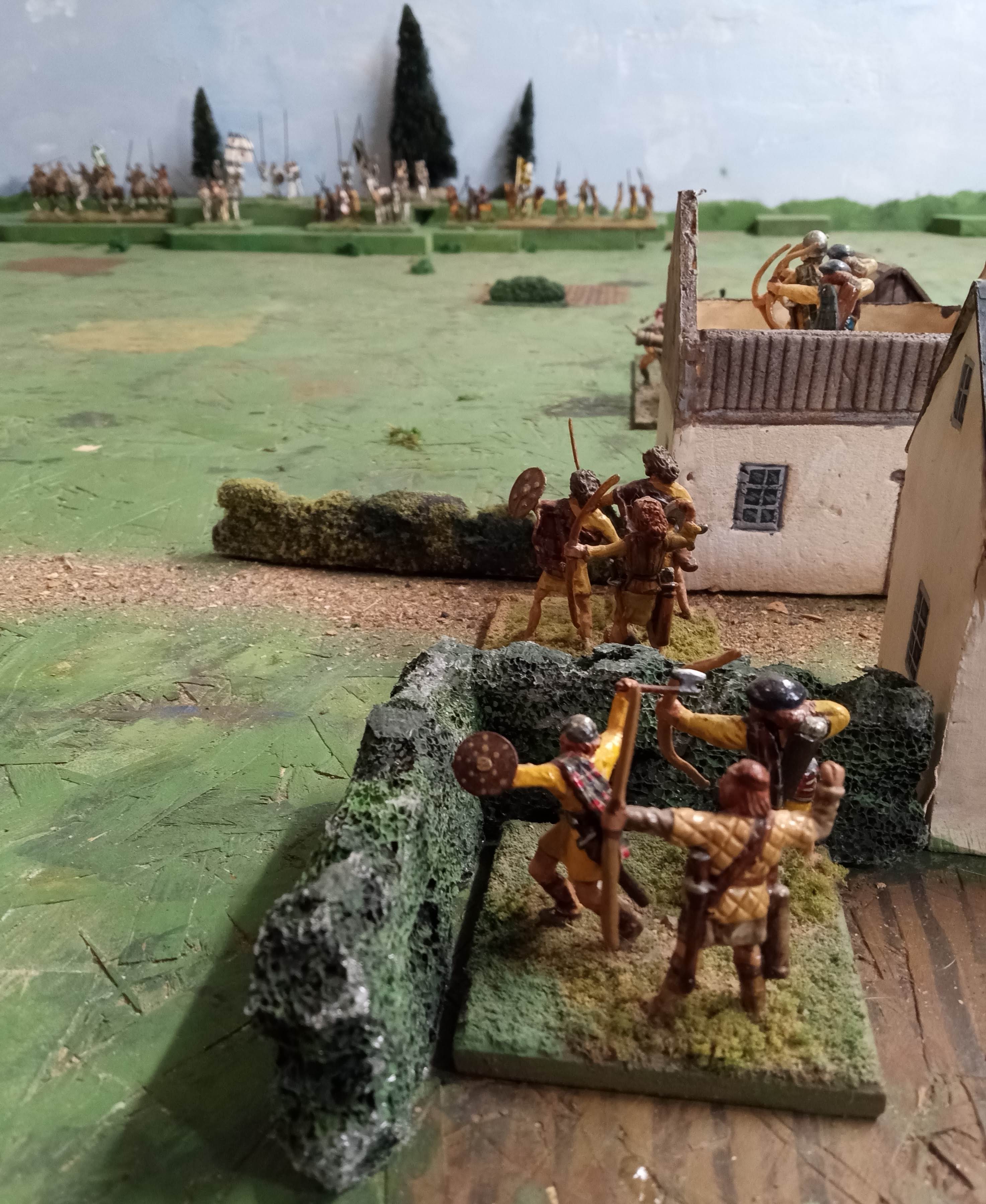
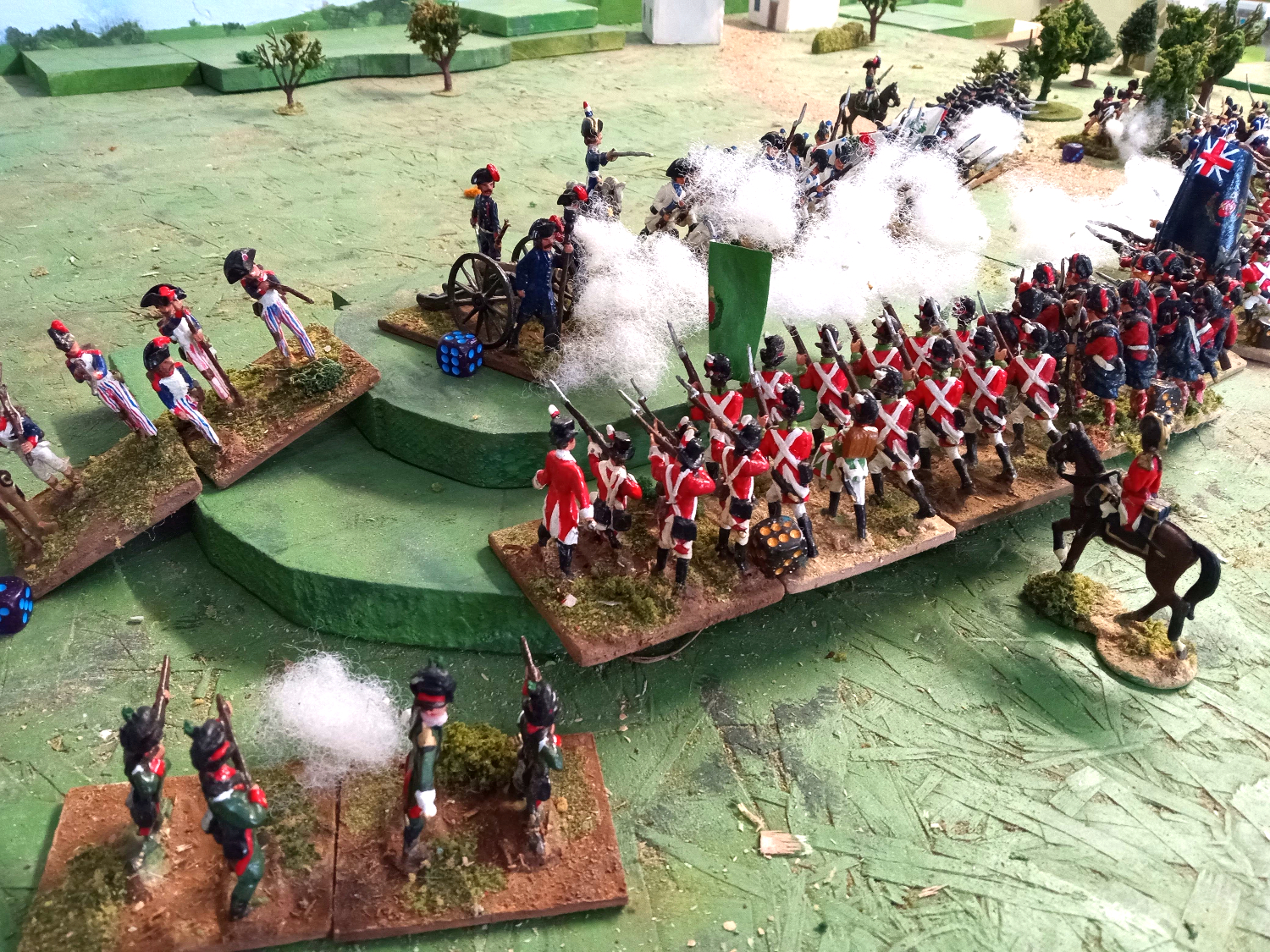
It was Saturday afternoon when the battle resumed. It didn't take long for the skirmishing to turn to massed musketry at close range.


At first the Republican army appeared like a mighty wave rolling in to smash a seawall.


The torrent of fire from the Redcoats didn't seem to bother the Greycoats at all.


But the Republic's troops must have been rattled and fired over the heads of the redcoats on the hill, or into the hillside. Soon the battered attackers were streaming back done the hill, covered by their cavalry supports. 

_____________

The game went quickly, with a decisive end, one side breaking with 2 turns to go out of 15. (It was a One Hour Wargame scenario.) However, the game lasted way longer than it should have for such a simple scenario with few units and some simple rules and the rate at which stands were removed just didn't look/feel right. Having a look at what stats I could find for War of 1812 battle casualties, my rules seem to allow units to take many more casualties than is right, despite my claims that my "hits" include fatigue, fear, ammo shortages and so on. 

The One Hour Wargame way is to track hits on a unit without weakening its fighting ability until it collects 15 hits and then suddenly disappears. That doesn't 'feel' right to me either so I've been pondering other options. One idea I'm thinking about is to have a higher number of hits before a stand is removed BUT force the unit to retire when it has lost 1/2 of its stands, OR maybe just take a morale test each time it loses a stand, with penalties for each stand lost. 

It'll need more thought. Comments and suggestions are welcome.


Saturday, October 14, 2023

Battle of Bridgetown

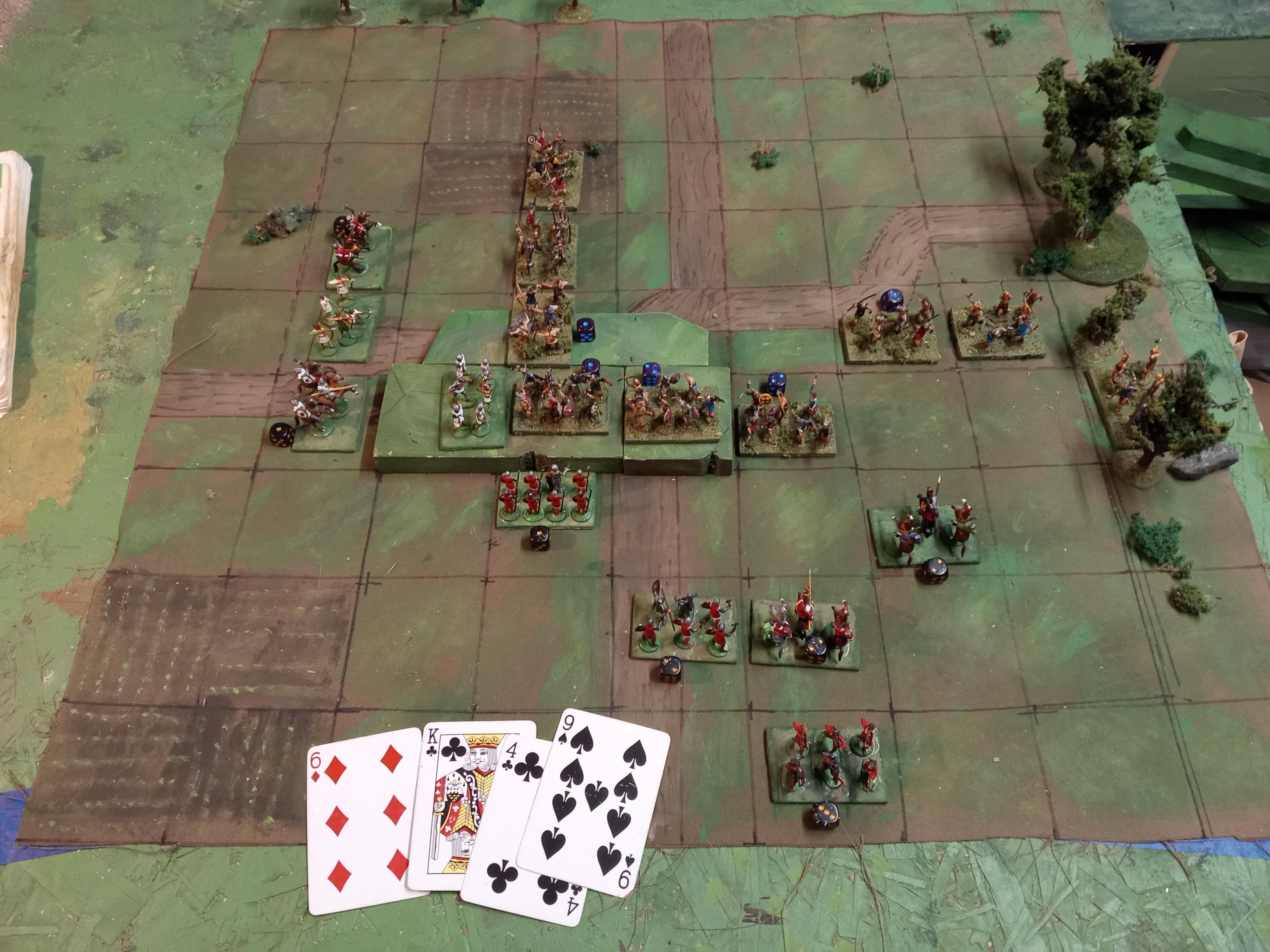
The Oerburg front had been quiet for over a year, but having heard rumours of agitators trying to stir up trouble, the Dominion had recently increased the outpost at Bridgetown. So it was that when a company of Oerburgers quietly occupied the far side of the rail bridge, the garrison commander ordered out 3 companies of Ross's Rifles supported by a 4.7" naval gun to clear them away.


  To no one's great surprise, that first company was well supported.

To the Dominion's surprise though, the Orberg cavalry splashed through a ford the Dominion's soldier were unaware of and were advancing at a good pace towards the 4.7". A squadron of Larsen's Lancers were there though so no one was too worried.


Instead of dismounting as was their habit though, they came on at a gallop, firing from the saddle. The Lancers were thrown back, and the 4.7" overrun! 


To make things worse, the Rifles had suffered heavy casualties and the remnant had been forced to fallback to the town. Only the company of Dominion Guards were left intact to strengthen the defence of the vital town and railway.   


It was enough.   The Oerbergers launched a weak attempt to storm the town but they had also suffered heavily in the early fighting and there wasn't enough time for their artillery to demolish the town, even if they wanted to. 

So, the day ended, as it began with the two parties glaring at each other across the Blutape River.

(Note: After some false starts with versions of the WW1 Sq Brigadier rules, I decided to fall back on the rules I intend to use with my 54's. I've finally agreed with myself that the fewer sets of rules I use, the easier my life and games will be. I'll post them once they are tidied up and tested again... oh!.. another game!  awright! 

Friday, September 15, 2023

First Battle of Edgeton

It was easy enough for the English under the command of the Earl of Belmont: "Gentlemen, we have no need to concern ourselves with some Scots on a hill, we will go straight at that town and those guns.  For the King, for England and St. George, FORWARD! 

But for the Scots, with three  prickly Dukes, each with their own contingents and their own idea of who should have been appointed commander of the army, it was more problematic. Everyone had agreed that the guns  should be placed beside the town with a clear field of fire and that a town was no place for cavalry. Argyle argued that Douglas's pikes would be the best defenders for the town. Their long spears turning the hedges and improvised barricades into an abatis while their armour would help protect them in hand to hand combat. Douglas naturally answered that the terrain would disrupt the pike's formation and make then vulnerable, especially if the treacherous English flanked the town and that if the Highlanders did not have the discipline to hold defences, perhaps the barricade could protect the archers while they shoot down the English until relieved. Home backed that suggestion and offered to move his cavalry against the English first but Argyle insisted that if his men were first to the fray, Douglas's men should at least be second.       (For those not familiar with the scenario, the Scots may only activate 1 unit on the hill, until it is destroyed, then another unit may be activated.)  

On such infirm ground was the Scots plan rooted.

Douglas, reluctant to risk all of his men at once, led his own schiltron forward to tangle with twice his number of enemies.


At first, all went well. Argyle's archers shot true and though lightly armed, they held the barricade against twice their numbers, confident that the main body of Highland warriors would soon relieve them. However, across the field, despite having fought bravely for so long, Douglas's men were reaching their breakpoint and the gunners which had done such damage had at last succumbed to an arrow storm.


With loud cries of "Huzzah" and "Saint George" the White Coats finally surged over the barricades and chased the last archers from the town. Hoping still that he was in time, Argyle finally led his clansmen forward.


The Highlanders fought hard but already the sun was sinking, earlier than anticipated (wild cards shortened the game) and the order came to fallback, leaving the Lowland town to the English.

--------------

I've only played the scenario once before, back in 2015 when I had been gifted with a copy. I decided not to look at that after-game report until this game had been played. (see: ACW Botched Relief Game, 2015). I couldn't even remember if that had been a good game or a flop, turns out I had enjoyed it.)

This time around, the game started off quite slow after the heated solo debate over which reinforcement unit to activate (see above). A fairly prolonged melee, and an artillery bombardment were the only active thing until the English white coats got to the town, then stalled. The Scots pike were doing better than expected (darned dice) and suddenly I realized that the Scots pike units were not only the slowest units, they were also the toughest units, meaning their prolonged fight was pinning all of the other units on the hill.  By the time they were finally broken, the Highlanders (rated as light infantry for speed) barely had time to reach the village  and make one desperate try to retake it when the game ended, (two turns early thanks to 2 "turn over" chance cards, ie jokers). 

That left me wondering if my original plan of putting the Highlanders in the town and sending out the cavalry first, might have been better? Well, there's only one way to settle that sort of question..........

Thursday, September 14, 2023

Now The Hurley Burley's Done

The Hurley Burley, and the game as well, but, I've been too occupied with preparing for the next retired hurricane (aka post-tropical storm) to come roaring in from the sea this weekend, to write it up yet. 


So, just a peek ahead. The rest should be posted sometime Friday.

Monday, September 11, 2023

Botched Relief

Having finished my jigsaw puzzle, and with the two new stands of Scots being almost table ready, I figured it was time to pick a scenario.

The English deploy for battle.

Flipping through the One Hour book, I noticed the Botched Relief scenario (#28) which I've only played once. Suddenly seemed just the thing. A small English force needs to capture a town despite being outnumbered by the Scots. The catch for the Scots is that the bulk of their force, which is on a ridge ready to flank any attack, is having command and control issues and can only be committed one formation at a time.

The Highlanders, supported by artillery, are defending the village. 

and here's my proof that the puzzle was solved and not just quietly packed away so I could use my table again:

Minnow did her best to "help".


Monday, August 28, 2023

Rearguard

The French commander was under orders to hold this little hamlet and the important bridge, the only place where guns and supply wagons could pass. However, he was also under orders to send half of his force on a forced march to Louisburg. It was a tough enough assignment but if the British found the ford, it would be near impossible. Well, none the less, it would have to be done.   He would send 2 of the detachments of French infantry, followed by his only gun.  The troupes de la marine, the native Acadiens and the Mq'ma warriors would have to be up to holding the village.


A futile long range artillery duel begins the fight. 


On the British left, an overwhelming force of British regulars runs into an impenetrable wall of Colonial troops.


Meanwhile, back at the Bridge, after 4 attempts, and some bitter point blank fighting, the Grenadiers had taken the bridge and seized one quarter of the town but the men were exhausted and were sent running by a French counterattack. The 28th Foot stepped forward to renew the attack.


The fighting only grew in intensity as the troops from the ford rushed to join the main battle.


The British commander decided on a desperate gamble and threw every man into the assault. As battalion after battalion was forced to retreat, the Commander suddenly remembered that he was also under orders, and was supposed to send two battalions to serve under Brigadier Wolfe.
Well,.... fat chance of that now. His only option was to fallback and seek the cover of the fleet's guns.

(Figures are homecast, mostly from Prince August moulds, but the Acadian militia are my originals. Rules were the the current The Square Brigadier.)

Sunday, August 27, 2023

I Had An Hour To Spare So.....

Well, OK, I had more than an hour and I didn't time how long it took me to pick a scenario, lay out the table, pick a setting and era, and then select units (whooff) and then play the game (without putting it away yet). The point being that on a Sunday afternoon in 1758 on Ile Royale, a small force of British infantry supported by artillery attempted to cut off and capture  a detachment of French troops which was retreating to Louisburg and had stopped for the night in a small Acadian village. 

(No don't bother try to find any other report of this action, especially not in history books or memoirs, you'd be better off looking in One Hour Wargames).


To be continued.....

Sunday, February 19, 2023

Battle for the Ridge: Day 2

Having pulled themselves together over the night, and the Scarlet Pimpernal having switched the rules without the French realizing it, the British were back on Saturday morning.

The French must have been celebrating through the night as the reinforcements were slow in moving from the town in the morning. This took a little bit of pressure off the Brits. 


A prolonged close range firefight ensued with the opposing cavalry shouting insults and taunts at their counterparts without either being willing to risking leaving a hole in the line. 


For what seemed an eternity, the two lines stood and traded point blank fire. Casualties were heavy on both sides but neither would give ground or risk a charge.


At last as the sun began to sink towards the horizon, the Debrouiller Regiment wavered. The General rushed over waving his hat to encourage them but a cannister round found him and the emigres broke. The situation was desperate! Col Grey took command and putting himself at the head of the 42nd and with the pipes urging them on, led them forward with the bayonet. Their battered French opponents broke and fled.

The hill was solidly in British hands and the French in full retreat.
  

__________________

The main difference between this version of the rules and the one used in the first game, was that instead of a stand being removed for every 4 hits, the hits were accumulated until the unit had 8 or 12 hits depending on the troop types. That not only kept more figures on the table but it meant there was room to take a pounding and come back. 

There are still some minor tweaking to do but the biggest thing is to reconsider for the 100th time whether I can stick to the original idea in Morschauser's rules that had inspired the earliest versions of Hearts of Tin, and lump pointblank shooting with charges with cold steel into one type of potentially deadly combat called "melee" while all shooting at effective ranges is "shooting" or divide combat into 3 zones: long range shooting that has  minimal effect but can slowly weaken units, effective close range shooting that can break units, and charges with cold steel which are largely about opposed will but can also be bloody. 

My brain tells me that the long range shooting can be safely "factored in" (ie ignored) and close range shooting and cold steel lumped together. After all, that's what I've been doing for the last 2 decades since  Rob handed me a copy of Morschauser at a used book stand at a Cold Wars convention, but from the back of my brain, my older British wargaming roots occasionally urge a return to long range, short range and melee. In theory, its a mere matter of a modifier here or there but in practice, the whole thing seems to shift players' attitudes and choices in ways that often negatively affect the games, even if only dragging them on beyond the time available. 

There's also the variance between Morschauser's "every stand is a unit" and the traditional the battalion or higher is the unit unless its a man-to-man "skirmish" (in the gaming rather than historical sense). 

I'll have another quick consult with me and myself but I'm pretty sure we'll eventually back Morschauser in most of these questions if we can't find a compromise.


Friday, February 17, 2023

The Hurley Burley Is Done

It was a lovely day with light snow then rain then freezing rain,,,,just right for an indoor wargame. 

After a brief cavalry clash, the British infantry is ready to assault the hill.

Full report tomorrow.

Somewhere in Flanders

A Republican advance guard stands-to as dawn breaks.

To be continued...


Saturday, December 17, 2022

The Battle of Nolac Hill: Day 2

 It was delightfully cold, wet and windy this morning so I was able to throw together a new version of the draft of my gridded medieval/fantasy rules (All of the backup copies seeming to have gone astray.) followed by a test game of the same scenario.

Turn 2 and the opposing Generals seem to have made better plans and discovered different mistakes to make.


Turn 4 and the hill is being contested.


Turn 5 and the Red General has again learned to beware of fickle dice.


Turn 7 and the Red Duke has been gravely wounded and escorted off the battlefield  while his remaining units are starting to crumble. The battle is lost again!


This game was much more engaging and this One Hour Wargame scenario took a full hour to resolve. A few more turns were played, roughly 1/2 the alloted turns, ut more imoortantly, the advantage flipped back and forth and this time, my decisions had as much influence as chance did.

When I get the rules done and proofread, I'll post a link but now, its time for another, bigger, game.

Thursday, December 15, 2022

The Battle of Nolac Hill: Day 1

I had been planning to play this game using my own rules but it occurred to me that given the idea of a game in a box that I could take with me and talk someone into playing a game, using a published set of rules might be a good idea. Since I had my copy of Developing the Portable Wargame on hand, it made sense to try that.

The Attacking force moved quickly, hoping to take the hill before reinforcements could arrive. The infantry launched a direct assault while some cavalry turned the flanks, while others,backed by archers, moved to intercept the defender's reinforcements.


Several turns later, the hill was still holding while beyond the hill, the attacking Knights were having a hard time breaking the enemy shieldwall.


By turn 6 of 15, the attacking army was 'exhausted' and unable to attack. The only units to have made it onto the hill had been forced back and no others could advance onto it. The game was over. 

Well, that worked, but it was a little quick for my tastes. The combat was very attritional but what I noticed most, was that despite being very simple, there are some important rules tucked away here and there that are easy to miss or forget, especially since some things are done differently from what is intuitive to me. I'll have to make a 'cheat sheet', arranged for how my mind works, before I play another game. 

Before that happens though, I should replay the scenario using a gridded version of my own rules, and just maybe, try playing the scenario using the One Hour Rules, maybe.


Monday, January 4, 2021

Not Quite, Gentleman!

 Well there I was on New Year's, a little tired after a week of indulgence and too much herbal tea (sighhhh), and  there was a messy table full of the bodies of zulus and British soldiers and seamen. It seemed only right to dismiss them to their respective homes. Then I had an empty terrain staring at me.......... hmm.... I wonder how this scenario would work in a different period with different rules?

Not Quite A Gentleman's French Revolution. Note the improvised Cycle track to tie AGW cycles to OHW turns.

It has taken a fair bit of thought and a few games to manage to balance A Gentleman's War's lack of turns to One Hour Wargames scenario fixed turn limits, but,  I think I now have a good method of doing it. At least it has worked for 2 games in a row. 

What I have done is count each sides cycles. When both players have played at least as many cycles as the scenario has turns, the game is over and victory is assessed.  To make it easier to track, I quickly made a little scoreboard out of foam core and used coloured pins to advance each side as they started a new cycle. Once the first player reaches the end, that side no longer needs to track cycles. Once the other side finishes their 15th cycle, the game is over. 
Casualties were high on both sides and at last the French got to recycle a unit!

Once again the game played well with a fair degree of uncertainty. That aspect reminds me of my old MacDuff rules though with more fiddly bits and modifiers. I really need to make some period specific Quick Reference sheets for the French Revolution and print them out. 

Magically appearing on the other road (Good thing most of the French were in the new universal uniform!) the column attacked, took 1/2 the town and then broke momentarily. The Skirmishers moved in to finish the job.


More important is that like MacDuff, it takes longer to play and requires more thinking, chart checking and dice rolling than most of my current rules, especially when playing solo. Playing more often would help but isn't likely to happen this year. I'm trying to resist doing a lazy man's set of rules for my French Rev armies to use at home. There are lots of other troops to exercise! 

The Grand Finale. Three French units were in on the kill. It was nip and tuck with both Generals in the thick of it but on the 14th French cycle, the last Highlander fell along with the British General.
Vive la republique!
 

The table has now been cleared and the question is: "What shall I play after I finish painting up my first unit of the new Hat ACW?" 

Sunday, March 15, 2020

Giving OHW Another Shot

The other day I stopped by Dale's Wargaming blog and read his latest post  discussing Neil Thomas' Late Arrival scenario from One Hour Wargames.  Since I was looking for a quick game I thought "why not?".

I like the boiled down scenarios from the book but the last time I tried the rules I wasn't impressed. Dale has got me thinking that I may not have given them a fair shake. So I decided to try them. Dale had been discussing an ancient game and, no longer having ancient armies (I can't believe I just wrote that after 45 years as an ancient's player!!), I grabbed some 16thC Scots and English and used them with the ancients rules.

The army selection gave the English (Blue Army though dressed in Red) 4 infantry, 1 skirmisher, 1 cavalry and the Scots (Red Army though dressed in White) 3 Infantry, 1 skirmisher and 2 cavalry.

The scenario has the Scots arriving en masse at the start of the game except that all units arrive on the single road so get stacked up. The English start with two units with another pair arriving on each of turns 5 & 10. To complicate things there is an impassible hill and a wood which only the skirmishers can move through.


I had hoped that the  Scots would roll more skirmishers so that one could flank the English while the other ran fast and nabbed the town which is the objective. Having only rolled one, I sent it to the town.


 What followed was a prolinged melee with the dice favouring one side then the other. English reinforcements arrived in time to restore the line and retake the town.

At least in the English counterattack the dice favoured one side over the other through the whole short fight.  If the dice hadn't rolled English 5's and 6's vs Scots 2's and 3's   the outcome of the game would have been different with the English being too damaged to hold out later if indeed they had had time to break in.

 At last the Scots cleared the gap and their cavalry had just time to dash across the table and make a long odds attack on the town. It was close but the game ended with the English having 1 unit with 1 hit left facing 4 Scots units. A clear English victory.


So what did I think?

Well, it was fast, actual playing time was not quite 1/2 hour. In that time I made something close to 100 die rolls and made perhaps 6 or 8 decisions, all important. Since each die roll counted, there was some tension that built towards the end of the game when a few good rolls by the Scots would have reversed the decision.

On the whole, the rules are better than my original assessment. They aren't my  cup of tea and I still have some objections on the historical side, for example,  most units are allowed one and only one tactic although in many wars many, not all but many, unit types had a choice of tactics and all arms forces are not allowed if using the lists. With those exceptions, when it comes to how the rules play, they work and whether you enjoy their style is a matter of taste.

I decided to reset the table and play the scenario again later using a different period and rules but that's another post.

Saturday, February 1, 2020

As long as I'm there...

I started to clear the table this morning but it seemed a shame to clear it after a single game so.......


Now that my 54's are back on their Volley & Bayonet/Morschauser style 3" unit bases, the grid is less useful than it was. I still had the measuring sticks I made a couple of years ago with brightly coloured 3" segments. It is easy to use and read in dim light even without glasses and also makes the grid less useful as long as all ranges and moves are in multiples of 3".


Since it's not quite a Square Brigadier game I quickly scribbled a one page variation but decided to experiment with getting a bit more radical and  leaving out  even more detail and removing more unit action options since I was going to be playing a Thomas scenario anyway. By and large it worked and a play through only took about an hour using roughly 1/2 the planned total number of units per side.  I think I want to bring back a bit more colour and more player decisions but its going to take some thought and experimentation.

Thursday, December 19, 2019

Surprise Attack

"Those are Toy Soldiers Bigawd!" some General is supposed to have exclaimed. (or not)

Gratuitous close up of my homecast, original, US infantry 
(apart from the Zinnbrigade drummer.)

Yesterday I managed to finish fiddling with the rules (for now) and get a game on the table. Since, at this particular point, I was most interested in how it played as a game, I chose one of Thomas's One Hour scenarios, "Counter Attack". A scenario which I had previously played with other rules and enjoyed.

Since "Blue", is the attacker, approaching from the south, once again the colours matched the armies and seemed perfectly suited to the historical setting. In this case the British have one unit holding a critical bridge while the Americans have all of their 6 units gathered around a critical village on the southern table edge. On Turn 3 the other 5 British units arrive and have access to 2 secret fords across the river. Victory is achieved by holding both the village and the bridge at the end of 15 turns.
Somewhere around Turn 6 of 15. The British infantry are over the East ford and their Dragoons have switched from the West ford to the East.
Since I want to be able to use the rules to refight historical battles as well as play generic scenarios, my first revision was to adjust the ground scale to match the 1 unit=1 battalion=1 grid square equation. Unfortunately that didn't work very well on the table since effective musketry was only between adjacent units. This made it hard to make sensible adaptations of most generic scenarios and also made pretty much all tactics and unit types into vague die modifiers and unexplained special rules.

Not very intuitive at all or satisfying for a toy soldier game and waaay too quick for small games. It might work with 20-30 units a side but that's not my idea of a 'Game in a Box'. I went back a couple of steps, making constant scale subordinate to having significant, easily recognised, tactical choices. (Hopefully

The American left flank has been driven back and turned and their General has been hit by a stray shot slowing down their response to the threat.
There were 3 really major changes made from the previous editions.

The first change was that I resurrected rolling for the number of "Orders" available along with a group order capability. Apart from being a challenge for players when their nice neat battle plans come apart at the seams, risking Commanders in combat becomes a serious risk not to be taken lightly. As a bonus I found that it more or less removed the need to have a rule for units to rally or hold position after retreating and so on.  There almost never seemed to be enough orders available once the formations got knocked about and it soon became obvious that stopping periodically to reform your battlelines was usually a good idea rather than pressing on helter-skelter. Can't remember now why I removed it, whether it was because it was too obviously adapted from DBA or because I was experimenting with something else. Anyway I've brought it back and I'm glad I did.

The two biggest changes though, were the elimination of separate close combat system with the loser being forced to retire, and a change to the turn system so that now there are only 3 phases rather than the 6 I have had for years. Now the 1st player moves then the 2nd then both sides resolve all combat simultaneously. (Rather like one of the rules variants in the example games in Featherstone's Battles With Model Soldiers, now that I think of it.)

The effectiveness of long range fire has been reduced to reflect both prolonged skirmishing and the occasional indecisive long range firefight. The latter was the sort of thing the generals frowned upon as it expended ammo, fouled muskets and tired the men more than killing and injuring significant numbers of the enemy but sometimes it was better than having the men stand idle under fire.

With average die rolling and a default 15 turn game length, a unit of infantry with average die rolling would need around 18 turns of long range fire to break their enemy. That means its not really a good battle winning plan but it has its uses, especially in a game like the last scenario where an impassible river crossed by a single bridge separates the armies or when you are trying to tie up and weaken the enemy while waiting for reinforcements or a turning force.

I thought this might really change, if not spoil, the "feel" of the game but in practice it was quicker, kept both of my selves engaged  and somehow kept  the same basic overall feel of the game, only more so. As expected, units that were getting battered were often pulled back by the player (me) from close range fire, especially if they had 2nd move that turn, or were broken before they could pull back so the lack of a forced retreat wasn't really missed. What was diminished was the temptation to focus on low level details which shouldn't be the General's concern and weren't actually in the rules but only suggested for "feel" or "flavour".

Late in the day, the British General has been hit while leading the battered 89th Foot against the American artillery. They were nearly exhausted, only 1 hit from breaking but obviously they were so enraged at the loss of their beloved General that they over ran the battery and followed it up by driving the remnant of the American riflemen from the Stone House, breaking their army morale. (or perhaps they just suddenly got lucky with the dice ?)

The current Square Brigadier in the War of 1812 rules are available from the "Current Rules" page link in the side bar or from this link.

Hopefully the next test will confirm my satisfaction and not turn up some huge but hidden flaw but there is only one way to tell, play another game! The next 1812 game will be an Historical refight but it won't happen till the new year.

I've pretty much decided that Prince Valiant will get the traditional "Last Game of the Year" slot, usually played on New Year's Eve but I want to get my traditional Toy Soldiers on the table as well and the Christmas break is almost upon us. 2019 is not done yet!