Showing posts with label ww1. Show all posts

Wednesday, June 22, 2022

Halt! Who Goes.....ALARM!!!

Sometime, somewhere near the Kapelle/Oerburg border, there was a Dominion supply depot, and an outpost. Early one morning......


To be continued!

Friday, May 25, 2018

Square Brigadier in the Great War: Debriefing

This sudden, unexpected, WW1 game seems to have been with me almost constantly for months now and I'm looking forward to "changing horses" for a while. However, I plan to revisit the early 20th Century again before too long and have to write up a full set of rules to support the existing two-sides-of-a page quick reference. 
The Square Brigadier in the Great War

I will need to remember the observations that follow when I do!

The allies deployed for the first game. 
It really helps having someone else play your game. Always interesting to see where the rules work the way you planned and where they don't, where others pick up things as you intended and where they either don't 'get' something or see things that you had missed, whether that is good or bad. Its also interesting to see what sort of tactics and plans others try and how they interface with the rules, scenario and other players.   So a BIG thank you to the eight adults (and the two kids) who played in the two sessions  of My Grandfather's War. 

Scruby Foreign Legionnaires waiting for the enemy.
One of the things that had given me brain stress in the lead up was the question of how to handle the different way the two sides organized and used their machine guns. Basically, the allies distributed a pair to each battalion while the Germans grouped their machine guns into six gun companies, one  attached to each three battalion regiment (giving the same ratio), plus some which were independent companies for various purposes.

2/3 of the way through the 1st game. A prolonged barrage  by 2/3 of the German artillery backed by MG and rifle fire have finally cleared the unsupported British infantry from the hill and the Chasseurs have moved over to counter attack the advancing Germans.

What I had decided in advance was that the allied MG's would be treated like infantry but have an extra die when firing and have the defensive bonus in melee while the German MG companies would always have a "superior firepower" bonus but would not be allowed to assault and would taken fewer hits. However, by the time I got to the convention I had changed my mind and decided to treat all the MG units on both sides the same as the German units. Partly this was because it would be simpler for 1st time players to grasp but mostly because it seemed to have a more Old School feel which pleased me.

Game 1.The end. Robbed of the 2nd last turn by a Joker as a chance card, the Allies lacked time for  last ditch counter attack for  draw or win. The Germans ended with possession of the Wood, Hill and Farm for 15 pts while the Allies clung to the town for 10 pts.
During the two games the MG's had what seemed like just the right effect: deadly but needing infantry support. They were particularly effective in the second game when Rob tried throwing rank after rank of infantry into a hail of mg fire and lyddite. On the Allied right, Norman launched the Zouaves into a surprise counter attack with cold steel which swept away some already shot up German infantry but which eventually faltered in a hail of MG bullets as well.

I liked the feel of the MG's enough that I am adopting that approach as standard.

Game 2 getting underway.
Towards the end of my pre-game play testing I had decided to change the "-1 die" modifier for artillery changing targets to "artillery must cease fire for a turn when changing target". I then promptly forgot for the first game but remembered for the second game.

Over all I prefer the feel of the second approach and its effect on player's decisions. The quicker switching of artillery fire seems more suited to later artillery with radio and telephone communication.

I was initially uneasy at the delay when a gun had to switch from indirect fire to point blank fire over open sights at an attacking infantry unit but the infantry had emerged from cover at a very close range and ended up in melee range where the gun was able to fire in self defence anyway. If the infantry had approached in the open there would have been time to switch fire and give the infantry real issues, especially with the Bombardment rule.

Game 2: The Zouave attack up the right has been stopped by infantry backed by an MG hidden from the camera by a tree at the corner of the field.
Speaking of the Bombardment rule, which reduces the effect of shooting for units (including artillery) in an area under artillery fire (because they have their heads down) and forces units to test for hits if trying to leave, enter or attack the area, I'm really pleased with how it works as an alternative to a Pin and Rally rule. It now occurs to me that it could well apply to MG fire as well.

Game 2 end. The Germans eventually captured the wood and farm but never took the redoubt and have taken absolutely horrendous casualties. 
I'm not expecting to play many (any) more France 1914 games but luckily both figures and rules will see use in early 20th Century "Colonial" or "Back of Beyond" games in the years to come and the Great Atlantican War is still ongoing.

Gratuitous shot of the Cycle Company in action.
Next post: What to expect to see on my blog over the next month or two.

Saturday, May 12, 2018

The Final Flocking Offensive

The armies are finally flocked and ready to go,

and the British battalion has even got its own MG at last!

The Germans have double the number of infantry companies and the support of that field kitchen but the quantity of artillery and machine guns is equal and the Allies have a slight edge in cavalry, not to mention the armoured car, but only 1/2 the Allied units begin on the table.

I don't think it'll be easy for either side.


Friday, May 4, 2018

Good to go!

Well, I want a to paint a few more figures and work on some shrubbery but if I had to, the game is ready to go and the final version of the rules is now set and available (click)

Over view as the game gets under way. The US infantry near the white house are just filling in for now.
It was a tremendous struggle. The fight over the rules I mean, not the game although it was hard fought and close as well.

The idea, ever since getting hooked on Morschauser in 2003, has been to keep the rules results based rather than the process based approach I had been used to for the 30 years preceding that. It seems that my subconscious mind has yet to fully surrender on the issue though, despite being shown time and time again that the results based approach ends up giving me, not just a more interesting game, but also one where the tactics and results more closely resemble my reading. 

 
The British are coming! The British are....HERE!

In the case of late 19th/ early 20th wargames, my mind wants to see an explicit rule for "pinning" amongst other things but getting an effective rules with the right feel and effect has proved elusive for a long time. Time and again, experience has shown me that dumping the various explicit "pin" rules always gets me closer to the right feel but with a more interesting flow and more player choices to make.

In essence, troops in the open which come under fire have two options if they are attacking: return fire or advance. Advancing can work, as it sometimes does in life, as long as the distance is short and the quantity of fire not excessive but it will tend to be costly and there is a strong risk that an assault against an untouched enemy will fail. The alternative is to lay down, return fire and call for artillery or for a friend to flank the enemy while you keep them occupied. These things aren't specified, they just work that way if you think about it or experience it.

The Germans turn the Allied right flank.

The other silly thing I've had to contend with over the last 2 weeks is a strong urge to increase the firepower of units because I increased their strength. It took several tries before the obvious finally sank in that increasing potential hits that a unit can inflict in the same ratio as I increased the number of hits it can sustain, meant little change on the tabletop.

No matter how much it rubbed me the wrong way, to get the effect I wanted without complicating everything, I needed to increase the number of hits that a unit can take without changing the maximum number of hits that it can inflict in one turn. 
End Game: to everyone's surprise the French cavalry are still holding the line but the farm has been lost to the Germans.
 There were a few other details to fuss over but the rules are once again relatively straight forward, quick to learn and quick to play. Much like the early versions that I have to keep bring back. Maybe this time.....
On the other flank, the hill redoubt was lost, retaken and lost again along with the woods. The Allies get 2 VP for the town but the Germans have 3 for the rest. An 11th hour victory. 
This time two weeks from today, it will all be over!

Thursday, May 3, 2018

Getting Closer!

Three weeks from today I'll be in Portland, Maine for Huzzah. Time is running short!

I now have the German forces almost up to the New Order, just a dozen more Bluecoats to modernize and a commander or two to base up.

One German player's Command: Battalion commander, 4 infantry companies @of 6 figures, an MG company and a supporting battery of infantry
Of course, now that I had realized that I needed more persistent units rather than just more units, I had to revisit the rules again.

After wasting considerable time making the rules slightly more complicated and less exciting (which was NOT the plan), a little light went on and I reverted to the good old Square Brigadier (click) adjusted for larger units. I just had to remember that the rules were Morchauser inspired, designed to get the right effect, not to show the detailed processes. If the game goes well I'll have more to say on that.

The French are ready.
I'm hoping to play a test game on Friday but certainly by Sunday so stay tuned.

Sunday, April 29, 2018

Soup's Up!

That's the easy part done.
"Cookie" originally had a ladle but it broke prior to me painting him in 2008 as an Oberhilse field hospital orderly. No matter his glare will stir the soup!
The new infantry recruits have their basic uniforms and will hopefully get fleshed out and given kit tomorrow. One little problem cropped up though. I sat down at the table to visualize how the extra units would fit in. That's when I remembered that the table is only 14 squares wide. With an empty one on each end, each of the 4 German players will only have a frontage of 3 squares  on which to deploy their proposed 7 companies and supporting artillery. That sounds like wall to wall troops to me and won't do.

Now that I think about it, that and the look were the reasons that I had been contemplating using stronger individual companies that would be a bit harder to eliminate as opposed to more small companies. Technically that doesn't actually require more figures but 4 men in a 5" square does look pretty thin, and since the extras are here, 6 figures will look better!

"Hey Cookie, see all those new recruits over there? They look hungry!"
Oh, I forgot to add, the soup cart isn't just a pretty toy. As long as it is undisturbed and on table, a "support" stand allows a player to try to recover one hit each turn. If attacked it is removed and counts as a unit lost for army morale. 

Friday, April 27, 2018

Reinforcements Are Approaching the Front


  • There's no way around it. I've been fiddling with the damned rules as a way of trying to avoid the fact that for a good 8 player game with the best, simplest, most effective version of my rules, I am going to need more men!


Hans, we better get the cooking cart painted up and get some soup on!
Not all that many more thankfully and the source is close at hand.
Here they come!
Instead of each of 3 German players having a full strength battalion of 4 companies, they will each have  a half strength regiment of 6 companies plus a machine gun company supported by a battery.

I'm also going to finally paint up the Zinnbrigade field kitchen I bought a decade ago to use as a  support token.

Rumour has it that a few companies of La Légion may show up in time to swell the ranks of the allied defenders as well.


Monday, April 23, 2018

The Great Machine Gun Compromise

The Machine Gun is an iconic weapon for 1914. They were also an iconic toy soldier figure for most of the 20th Century so I needed to include MG models and have them be different from other infantry.

The Belmont Arms Factory fills another order.
My game is designed at a fairly abstract intermediate level with a grid square's worth of troops representing a company of between 100 to 200 men.  The basic infantry organization for the British and French armies consisted of 4 companies of infantry and a pair of machine guns. The German infantry battalions were also 4 companies but they had no integral machine guns, instead there was a 6 machine gun company grouped with 3 battalions to form a Regiment. The ratio of machine guns to men was the same but in one case the machine guns were concentrated and the other they were dispersed.

At first glance it seems easy enough, an old school set of rules would just mirror the organization and let players place their machine guns where they thought best. A modern set of mid level rules or a board game would just "factor them in". When trying to write a simple, mid-level gridded game with a certain sort of toy soldier feel to it however, its a bit harder.

I need to see the machine guns and have them be different but I can't really have a pair of machine guns holding the frontage of a company of infantry without any infantry support. My compromise was to include an MG in one of the infantry companies and give it more firepower when stationary but not be able to move and fire.

When I turned to the Germans I have been torn between two options. The simplest and most Toy Soldierly option would be to use the same rules for both sides and assume that all of the MG sections have been distributed in support of individual battalions, something that was done at least occasionally.  The other would be to stick to the book and have pure MG companies and no mixed companies for the Germans. In a multiplayer game this means that some German players will not get to use MG's when they play the game. More than that, I need to tweak the rules so that the all MG companies and the mixed companies have strengths and weaknesses.

Having failed to come to a definite conclusion, I had decided to dodge the issue by doing the German MG's in pairs and doing an extra pair of infantry stands to go with each. That way I will have 3 options:
1. Field 2 stand MG companies if I can get the rules balance right or
2. Field 2 game unit MG units each with an MG and a stand of infantry, just like the British and French ones. The assumption would be that they have been assigned infantry supports and the effect would be that all MG stands would have the same effect, just the distribution would change.
3. Issue one MG to each German battalion so that all players would get at least 1 MG unit and both sides would fight the same way, like Red and Blue armies.

So far I'm leaning to Option 2 but once I finish these 2 MG stands with crew and infantry supports, all options will be available on any given day.

Sunday, April 1, 2018

Hotchkisses

Another hurdle overcome, sort of.
The Zouaves and Chasseurs now have an MG each.

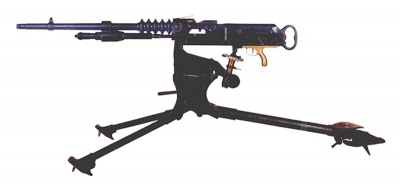
I thought making Maxims was stretching my scratch building skills until I turned to the French army's Hotchkiss machne guns.
Thank you  whoever I borrowed this picture of a Hotchkiss from. 
Rather than a big fat water filled sleeve with a  big breech section and tripod,  the air cooled Hotchkiss has a thin barrel with another thin cylinder (gas?) underneath, with a big complex base connecting the gun to a tripod.

The tricky bit was the thinness of the barrel and other cylinder and the scarcity of materials, tools and techniques on hand for me to work with. After rejecting various fiddly possibilities which, in the unlikely event that they were successful,  would have been very fragile on the table, I finally remembered that I still had some sprues of 1/35th WWII bits in the cupboard including some air cooled German light machine guns and some ammo boxes. 
A very crude portrayal of the pedestal and there are no fins but....
Oddly, despite being 1/35 item used with 1/43rd-ish figures, they look a bit too short and thin to my eye but they'll do.

The Zouaves are now ready for battle.


Tuesday, March 27, 2018

Aux armes, citoyens, Formez vos batteries!

I decided that my WWI French force deserved its own artillery.


I have two more Crescent WW1 18 pdrs in hand but while the Germans are making do with the same somehow it just did not seem right to make the French do the same. None the less,  I did not have a 75 to give them.

I decided to check the cupboard and this is what I found:


What I found was a cheap copy of a Marx howitzer, a surplus Sash & Sabre Napoleonic cannon, and some cardboard, later replaced by some thin plywood.

Oddly enough my childhood Marx  Miniature Masterpiece Over The Top WW1 playset included  a 25mm version of this same howitzer for the French.

Anyway, putting these bits together gave me this:


As an accurate model its a disgrace, as a toy gun, I rather like it and so do "mes enfants"!


Friday, March 23, 2018

Tweaking with a Sledge Hammer

There have been too many disruptions and distractions so I have not yet played a full test game of the tweaked scenario and the re-re-re-revised rules but there has been a partial test.

Aerial Recce photo taken prior to Saturday's attack.
For the scenario itself, the tweaks were small, mostly a matter of spreading out the victory points, tweaking the cover to make for a better selection of attack routes to add interest and using the new units to get the force balance closer to what I envisaged. The rules had been more than tweaked and were the real source of my unease until a test game was played.

For several years now I have swayed back and forth between a Charge! inspired system of half casualties for cover (etc) vs a different score by target type approach inspired largely by the old WRG 1685-1845 rules (How's that for a catchy title?). Each time, the 1/2 casualties have eventually won out so I'm not sure why I felt the need to go back and try the other way again.

One of main the advantages of the different score approach is that its easier to have a more nuanced approach with a wider range of weapon and target modifiers. Unfortunately this is also one of the main disadvantages since the rules quickly get more complicated, harder to remember and sometimes its harder to  recognize  the impact of some of the nuances before playing. If restricting yourself to d6 its also really easy to modify yourself into a corner where a small +1 or -1 die modifer changes 'normal' to 'too easy', 'too hard' or even 'impossible' when combined with the "to hit" chart. That is not what this is supposed to be about!

So, after hours of lost time making tweaks during spare bits of downtime during the last two weeks and 3 turns of playing, I reset the rules (click) and the table.

Since this is a dogshow weekend, I anticipate having the time for a full play through on Saturday.

Sunday, March 18, 2018

Tuning the Scenario

Having added some of the missing units and de-tweaked the rules a little, I decided that it was time to tweak the scenario and play another solo test. If that works then I can take a break to play something else while I paint a few more figures and work on terrain.


This is essentially the same layout as originally planned but with a few adjustments. The most important is that the allied front line has been moved back and the depth of the German deployment area increased. I have also awarded victory points for the rear woods on the far flank and the farm on the near side as well as for the central hill and each block of the town as before.

Perhaps most importantly, the higher infantry movement rates and ability to move and fire with a penalty to both have been restored so that the Germans have more chance of actually reaching the main town with time to attack it.

In addition to now having the always planned 4th battalion of German infantry I have decided to backtrack on my decision to split up the regimental MG company and will instead field it as a pure MG stand with an extra die but not capable of firing and moving or of assaulting.

Now to see what, if any, difference the tweaking makes to the game.

Monday, March 12, 2018

Les bicycletes de Belmont

Don't worry, I'm not going to sing, but the Bicycle Scouts are done.

Converted Zinnbrigade Prussians with 3d printed bicycles courtesy of e_tenbris_lux.

The uniforms are a tiny bit darker than intended, an unfortunate side effect of mixing colours in a casual fashion. Since some colours dry darker, it can be easy to misjudge slightly when mixing a rarely used colour. An organized sort of person would probably make a careful note of exact paints used and exact proportions but where's the sense of adventure in that?

There should also be a number on the shako cover but I need to figure out if they should wear the number of the Jaeger regiment they are part of or something else.

The black leather is questionable but I was getting tired of the brown and Nash's Almark book shows one Jaeger in his grey-green uniform with black leather and that was good enough for me!


I was rather unsure what to do about the missing handlebars since the stand needs to be rugged enough to travel to conventions. Luckily I found a picture of German cyclists with their blanket and great coat rolled up and strapped to the handle bars. A close inspection would reveal that the Officer's bike has invisible handlebars underneath the blanket roll.

Next up is, well, a Mystery, even to me at this point.

Wednesday, March 7, 2018

The Arms Race Continues

Time to get back to work on some more toys for my 1914 game.

Since the biggest need was more ordinary infantry, I decided to start by fixing up some toy guns and figuring out what to do with the makings of some bicycle scouts.

Field Artillery and Bicycle Scouts in various states from conception to completion.

Repainting one of the Crescent 18 pdrs was easy. The 25 Pdr Howitzer Conversion is proving more problematic. The original plan was to replace the broken wheels and call it a 4.5" and perhaps that may yet be how it ends up.

Apart from the issues with how accurate a toy it would be, I started to wander when I thought it might be nice for my French friends to have their own artillery. Since I'm only planning on two allied field artillery pieces  and I have nothing like the famous 75, I thought perhaps they should have the Howitzer. Imagine my surprise that confidence in the capabilities of the 75 was so high that a field howitzer had been thought unnecessary. Quite apart from the completely different appearance of heavy howitzers, they wouldn't normally appear on table so it was back to a 4.5" for the British and I turned my mind to the pair of unassembled 3d printed bicycles. (Actually I think there may be more, including the second set of handlebars, I'm just not exactly sure where except that they aren't in with the steam engine kits, but two are all I need anyway.)

Originally they were going to be German but having seen a picture of a French Cyclist in natty red breeches I changed my mind, right up until I saw a picture of British cyclists and thought they might be of more use in other theatres of war in coming years. So I decided to look at OB's to see which would be the best fit for the scenario. By chance, my allied forces are almost all Colonial troops. Apparently, both nations had determined that bicycles were more useful on the paved roads of Europe than in foreign mountains, deserts and jungles. Neither the African nor Indian formations included cyclists. The German Jaegers did though and that is an easier conversion so Jaeger bicycle scouts it will be!

However, the same OB indicated that the heavy artillery for the Indian Corps consisted of 4.7" Guns not 4.5" Howitzers. ARGH!  I could swap in my Boer War era 4.7"  for a rather appropriate Wellsian Little Wars look but I wanted one Howitzer on each side!  I also want to convert that broken 25 pdr into something useful! After some more brain straining, I decided that the confused situation during the Race to the Sea would excuse having elements from the BEF being reinforced first by French Colonial troops and then by elements of the Indian Corps.

So, I am going to do the Jaeger  bicycle scouts first, then I'm going to get some better wheels, move the axle to lower the over all profile and  then shorten the barrel on the 25 pdr to better approximate a 4.5" howitzer. It still won't be an accurate model but it might be a more identifiable toy.

Image from Wikipedia
The_Battle_of_Arras%2C_April-may_1917_Q5142.jpg


Monday, March 5, 2018

Souvenirs and Assumptions

One of my IT Bosses used to love writing ASSUME on the whiteboard then slashing it thus: ASS/U/ME, while reciting  "Assume makes an ASS of U and ME" as a way of reminding us never to make assumptions when planning and implementing projects.

Today I was clearing a work space as yet another subconscious tactic to avoid starting in on year end books and tax returns when I came across my little stash of old maps. Two were essentially souvenir maps handed out to the 5th Canadian Armoured Division HQ (Dad's outfit) of their journey up the Italian Boot and through Holland. The third was an old WWI tactical map.

1:20,000 map near Villers-Bretonneux July 1918,
in other words the area where the first tank vs tank battle was fought and the Red Baron shot down.

Now, I haven't really looked at this map since I was a kid, and always ass/u/med it belonged to my Mom's dad who had been a regular in the Royal Horse Artillery, recalled to the colours for the Great War.  Since it seemed both topical and a welcome diversion I decided to take a closer look, to see where it was in France and to call up some of the places in Google maps so I could look at street views of houses and terrain. AMAZING technology we have available to us!

However, that's not the point now, while looking at the scales etc I noticed that the map was subject to updates issued by Canadian Corps Intelligence. What? Why would an RHA corporal have a Canadian army map?

That's when I remembered what I had only fairly recently discovered which is that my Dad's father had emigrated from Glasgow to Montreal before WWI, met a nice girl, (also from Glasgow which is where another assumption had earlier led me astray), got married, had a couple of kids then headed off to war. Luckily he came back from the war and fathered my Dad. He died when I was very young and Dad never talked much about his early life or about his father and every one who had known my grandfather was either already dead or beyond questioning  when I found the picture of him in uniform so I had let it drop for the time being.

Today, I looked him up on line and downloaded his service record. He was 27 (!?) when he joined and served as a driver with the Canadian Field Artillery in France from 1915 to 1918. His medical records indicate that he was invalided to hospital as sick a few times but was never wounded. Well, not in action, there is some indication that he had some fun on his annual 2 week leave in 1917.  Anyway the point is, he came home intact so I am here and apparently he brought home a WWI tactical, topographical, map, all marked up with British and German trenches, enemy battery and MG positions, etc!  Thanks Grampa Mac!

Je me souviens.

Friday, March 2, 2018

Refocusing

Its March! Barely 10 weeks to get the Great Shiny Wargame ready for Huzzah. To get my mind back on track I decided to play a 1914 game.

German Ulans and Hussars scout the British Positions. 
Since I didn't want to either reset the table or replay Sawmill Village I tweaked the terrain slightly and played an attack from the march scenario.

The Allies began with 6 companies of Ango-Indian infantry (1 mg) supported by an 18 pounder battery. On their way were 3 squadrons of cavalry, a cavalry MG and an armoured car.

The Germans marched on with 3 cavalry squadrons and a Jaeger battalion of 4 companies (1 mg). They were followed by 2 similar infantry battalions and 2 batteries, one field gun, one howitzer.

Victory  would go to who ever controlled the village at the end of 15 turns.
The streets are barricaded, the enemy have been spotted. Where are the reinforcements??
Its been another busy week so the game was played in fits and starts.

Alas for the poor Germans, their Commander was very slow to come up with a plan and was caught off guard by an aggressive use of the armoured car to blunt and slow a flank attack on the town.

By the time the artillery had put an end to it, time was running out.
Around Turn 10. The British are near breaking but the town has yet to be seriously attacked and the French cavalry is at hand. 
A rush seemed suicidal so the Germans moved up their artillery and MG's and tried to blast the Indians out or at least weaken them so that a final rush might take the ground. It requires lucky dice to do serious damage to troops in cover but the Indians and 18pdr were in a lucky mood and out shot superior numbers of Germans firing from the shelter of hedges and ditches and lucked into a joker who sped the clock forward. By turn 14 it was obvious that  the Germans needed just a little more time and a few more men! 
Too little, too late. Many casualties later, the Indians are still clinging to the town while the German attack is spent.
Despite the disrupted nature of the game and several fine tunings of the support and morale rules, it was a very enjoyable game and it did what it was intended to do. Now I'm ready to get back to working on figures and then work on terrain.

I'd like to have an overall commander on each side with control of all of the artillery as well as a reserve although that sort of thing can be problematic with a group of random strangers. At any rate I want to provide a force equivalent to 2 battalions (8 "units" )to each player.

Time to get painting!


Saturday, February 10, 2018

1914: Live Playtest

Its good to have friends willing to kick the tires on my convention games and a regional association that welcomes us to join in their quarterly Table Top Games days.

Today 6 of them and I played a version of my 1914 game. From intro to end of game lasted about 4 hours, maybe a titch more and reached a conclusion after some 8 of 15 possible  turns including some heated fighting and heavy losses.

The Germans took a big chunk of the primary objective, the hill, but again lost it to a counter attack. On the woods in the far North the French were finally wiped out but at a high cost and a counter attack by the armoured car broke the back of the flanking attack.  On the other flank there was a prolonged long range duel which ended with the beginning of a French counter attack.

In short, it was Good but it can be Better!
After 3 hours and about 8 out of 15 turns, I called the game as the defending French began a pursuit.
The available table was around 5'x7' or about the same size as many of the Huzzah tables. I was able to lay out my 5'x6' (+ variable border) cloth with a few inches of bare table on either for paraphernalia. I always used to try and cover the table completely for scenic effect but I am starting to appreciate the practical uses of on table/off game-mat space and there was easily room today for more units than 3 players per side can handle in a 4 hour game slot and certainly room for a 4th player so I may plan for a 5'x6' battlefield for Huzzah.

The game slot at Huzzah is 4 hours and that has to include the rules and scenario briefing. I played all 15 of the planned turns but today we reached a conclusion 1/2 way through the game.

What I do need to do for Huzzah is to strengthen the attacking army and spread the objectives out or else find a way to get the game to play faster and that brings us to the rules.
Set up in progress.
Photo courtesy of Jeff of the Armchair Commander blog. 
When I resurrected the 1914 campaign I instinctively brought back 2 rules from that era of Square Brigadier: rolling for numbers of available orders each turn, and a Pin rule. Both of these had been dropped from my late 19thC rules after an intense internal debate. The last game had me wondering if that had been a mistake. This game confirmed that suspicion and my first act on getting home was to repeal them. 

Both rules slowed the game without adding anything really useful although they appear to reflect the command structure on one hand and the reaction of troops to heavy fire on the other. 

The  19thC rules I have been using assume that if a Commander is there then he is doing what he is supposed to be so I only test isolated units which is a big time saver and ends up having  similar effect. 

The voluntary pin rule allows a player to, cancel one hit in exchange for not shooting or moving that unit. In effect it made fire feel ineffective even though it wasn't for the defender and meant that less bold attacking players took that option too often thus had trouble making any headway. Its something that has to be learned but my years of GM'ing convention games tell me that few players will have time to learn the lesson during one convention game and rather than increasing "realism" it really just makes the game slower.

The alternative which I normally use is to allow a unit with multiple hits to try and remove one hit instead of shooting or moving. It has the same practical effect as the voluntary pin rule as heavy fire will usually stop an attack cold but it is less likely to be abused since it is an immediate choice of a chance of saving vs an immediate chance of shooting or moving as opposed to a guarantee of a cancelled hit now in exchange of not moving or shooting at some later point.

The new, slightly more complex, artillery rules also served largely to confuse everyone including me and have been trimmed back.

This puts things back to the well tested version and I feel like slapping myself up the back of the head for talking myself out of making the change before the game. 
Jeff's counter attack secured the main objective.Photo courtesy of Jeff of the Armchair Commander blog.
So far so good. With the rules in hand I need to turn my attention to reinforcing the German side by adding two battalions of infantry, a few squadron of Uhlans and another field gun and the Allied side by adding the 2nd half of the  British Battalion and a British squadron as well as the French heavy gun.

Monday, February 5, 2018

Debrief

Its always a little hard to judge a game when its been played in short spurts between non-gaming obligations especially when there were also pauses to consider the rules but we do what we must.

The game patiently awaiting my return.
As laid out in the first post of this series,the game was an attack by German forces on a thinly held French position with British reinforcements being rushed forward.

The German plan was to screen the French infantry, which was hastily entrenched on the objective hill with a battalion supported by cavalry, while attacking the thin screen of dismounted French cavalry with 2 battalions.

The troops laid out, ready to begin.
In retrospect, the attack was not as well handled as it might have been. The pinning attack got carried away and stormed the hill while one of the battalions making the main attack drifted a bit far to the right and took heavy casualties engaging the French infantry when they were supposed to be pressing the cavalry. Oops.

Mid game and the Zouaves have already had to retake the hilltop once.
Despite the action in the centre, the cavalry line did look hard pressed and all reinforcements were originally directed  that way with the cavalry and armoured car finally making it secure so that even when the French MG was FINALLY knocked out, the Germans lacked the strength to push forward into the gap.

The Lancers close a gap in the middle while the armoured car secures the extreme right flank.

At that point the German cavalry came forward to dismount and attack through the woods held only by a 1/2 strength  Company of Zouaves. They failed, twice, and then were evicted by a counter attack! Brave Zouaves! By the end of the game the Zouaves had been reduced from 4 companies to 1/4 of one company but they still held one length of trenches.

The battered Jaegers managed to take the hill top again and held it against several counter attacks interspersed with artillery, machine gun and rifle fire but finally on Turn 15, the last turn, a final counterattack by dismounted French cavalry managed to take back the hilltop for a narrow victory.

A close end.
So, what does this mean? Firstly, I'm satisfied that I can take this to a convention and run it with the hope that some players will enjoy the game. The rules don't deal in low level detail and don't have a fancy activation system but there is lots of uncertainty and following period tactics and basic military principles will generally help. I may have a good imagination but the games remind me of my overall impression of accounts in several  memoirs that I've read as well as some histories and that's good enough for me.

Secondly, there is ALOT of work to be done to get ready. I need to add units, make and mend lots of terrain and either tart up this cloth or preferably get a bigger cloth and do it up.

There was nothing new in the rules but I fiddled and then unfiddled a couple of things and identified some unwritten rules. I don't have a full version of the rules anywhere so I really should write one and at very least I need a better Quick Reference sheet to hand out. It may end up being 2 sided.

I did make an interesting discovery about terrain and the grid. Twice I had a problem trying to figure out whether opposing units in diagonally connected squares were in cover to each other or even capable of seeing and firing at each other. For example, when lining opposite sides of a hedge kitty corner to each other. Similarly when a unit captures a defensive position they are suppose to occupy it but if its a linear defence, it would then be behind them and not providing cover. These are plainly artificial situations created by the grid and rules. I finally realized that the easiest solution would be to run roads and hedges as well as trench  lines, through the middle of a square, not along the edge.

More importantly, I've been worried about the smaller number of 5 inch squares and so reduced movement which meant losing the option to move 1/2 and shoot. Movement in this game was just too slow for the time limit and speed of action. Even if the German attack had been successful at the first go, they didn't really have time for a turning movement or to cross the full distance to assault the second objective. I needn't have worried about the slight reduction in grid areas so the movement rules will go back to move 2 being slightly more vulnerable or move 1 then shoot or attack.

Sunday, February 4, 2018

and the work goes on

Sorry folks, no battle report but it was a useful day.
Game 2, Turn 4. A French counter attack has recovered a captured section of improvised trenches atop  a vital hill.
 I started out with a test of a new system but after four not very interesting turns, both sides had lost so many stands that the game was essentially over. I'm not trying to do the  Somme or bore the players so I pulled the plug, updated the Square Brigadier, reset the table, and started again.

Game 2 Turn 4. The first British reinforcements have reached the front line.

After playing four engaging turns, there has been some to and fro action, some tense die rolls and the need for both sides to keep making decisions. There were still a lot of turns to play but  I was out of time. Hopefully I will be able to pick it up and finish tomorrow or maybe even reset again from the begin and play a game from start to end.

(OMG there is a LOT of work to do, troops, bases, scenery, markers,etc etc)